The room smelled of stale lavender and the sharp, metallic tang of an oxygen concentrator. It is a scent you never forget once it takes up residence in your home. For Arthur, a retired geography teacher who spent his life mapping the peaks of the Lake District, the world had shrunk to the four corners of a rented hospital bed. His breathing was a ragged, uneven staccato—the sound of a man trying to run a marathon while lying perfectly still.
His daughter, Sarah, sat by the window. She watched the legislative updates on her phone, the scrolling text of legal jargon feeling like a surreal insult to the visceral reality of the man gasping three feet away. The debate currently echoing through the halls of Westminster isn't about abstract liberty or philosophical definitions of "the good life." It is about whether Arthur should have the right to decide when his final chapter ends, or if the law should hold the pen until the very last drop of ink runs dry.
The Weight of the Gavel
In the United Kingdom, the legal status of assisted dying is currently suspended in a state of agonizing tension. We are watching a historic shift. For decades, the Suicide Act of 1961 has stood as a rigid barrier, making it a criminal offense to encourage or assist the death of another, carrying a potential sentence of up to 14 years in prison.
But the air is changing.
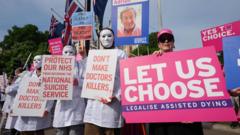
The Terminally Ill Adults (End of Life) Bill, recently introduced to the House of Commons, represents the most significant attempt at reform in a generation. This isn't just another dry amendment. It is a response to a growing, restless public consensus. Statistics suggest that roughly 75% of the British public supports a change in the law for terminally ill adults. Yet, the path from a polling station to a pharmacy is littered with ethical landmines and fierce parliamentary resistance.
Consider the mechanics of the proposed law. It is designed to be narrow. This isn't a wide-open door; it is a strictly guarded gate. To even qualify, an individual must be an adult, have the mental capacity to make the choice, and be expected to die within six months. Two independent doctors must sign off. A High Court judge must hear the case.
Critics argue that these safeguards are mere paper walls. They fear the "slippery slope"—a metaphor often used to describe the transition from helping the dying to discarding the vulnerable. They worry that the "right to die" will slowly, insidiously morph into a "duty to die" for those who feel they are a burden to their families or a drain on the NHS.
The Arithmetic of Agony
We often talk about palliative care as if it is a magic wand. The argument goes: if we just funded hospices better, no one would want to leave early. It’s a comforting thought. It’s also, for a significant minority of patients, a lie.
Palliative care is a miracle of modern medicine. It can manage pain, ease anxiety, and provide a cushion of dignity. But it has its limits. There are some forms of bone cancer that feel like a slow-motion car crash inside the skeleton. There are neurodegenerative diseases that leave a person trapped in a body that has forgotten how to swallow or breathe, while the mind remains cruelly sharp.
In these instances, the "choice" isn't between life and death. Death has already made its arrival known. It is sitting in the corner of the room, waiting. The choice is between a death characterized by a peaceful, planned farewell and a death characterized by a desperate, suffocating struggle for air.
Sarah looks at her father. Arthur had always been a man of precision. He liked his maps folded correctly and his tea brewed for exactly four minutes. Now, he has lost control over his bowels, his speech, and his ability to hold a book. To Arthur, the indignity isn't the illness; it’s the forced endurance of it. He told her once, during a brief window of clarity, that he felt like a guest who had overstayed his welcome at a party and was being forced to watch the staff clean up around him.
The Shadow of Zurich
Because the law remains stagnant in the UK, we have created a two-tier system of mercy. Those with the financial means—roughly £10,000 to £15,000—can choose to make the "final flight" to Switzerland.
Dignitas. The name carries a heavy weight.
Every eight days, a British citizen travels to Switzerland to end their life. This "exportation of death" creates a grotesque inequality. If you are wealthy and mobile, you can buy a peaceful exit. If you are poor, you must wait for the natural clock to wind down, regardless of the friction.
Furthermore, the journey itself is a form of trauma. To qualify for assisted dying in Switzerland, you must be well enough to travel. This means many people leave their homes weeks or months earlier than they would have liked, terrified that if they wait until they are truly ready, they will be too weak to board the plane. They are forced to die while they still have "good" days left, just to avoid the "bad" ones at the end.
And then there is the legal fallout for those left behind. Sarah knows that if she were to drive her father to the airport, she could, technically, be met by police upon her return. While prosecutions are rare when the person acted out of genuine compassion, the threat remains a cold shadow over the grieving process. It turns family members into conspirators.
The Conscience of the Commons
Inside Parliament, the debate is splitting parties down the middle. This is a "free vote," meaning MPs are guided by their own consciences rather than a party line. It is a rare moment of raw, personal politics.
The religious objections are clear and deeply held. The Sanctity of Life is a foundational principle for many. They argue that life is a gift, not a piece of property to be disposed of at will. They worry about the message this sends to the disabled community. If we say some lives are so painful they aren't worth living, what does that say to the person thriving with a severe disability?
On the other side are the proponents of Autonomy. They argue that the most basic human right is the right to bodily integrity. If the state cannot force you to undergo surgery or donate blood, how can it force you to endure the final stages of a terminal collapse against your express will?
The middle ground is a thicket of bureaucratic anxiety. How do we ensure a doctor isn't being pressured? How do we verify "mental capacity" in someone who is heavily medicated for pain? These are not easy questions. They are the reason the bill is hundreds of pages long, filled with "ands," "ifs," and "buts."
The Silence of the Aftermath
Arthur died on a Tuesday.
The bill hadn't passed yet. There was no peaceful injection, no planned goodbye with the whole family gathered around for a final toast. Instead, there was a three-day period where his breathing became so loud it could be heard in the hallway. Sarah sat there, holding his hand, wondering if she was being a "good daughter" by staying, or a "cruel observer" for not being able to do anything more.
When the end finally came, it wasn't a climax. It was just the stopping of a motor.
The current legislative push is an attempt to turn that motor off with a steady hand rather than waiting for it to seize and smoke. It is about acknowledging that while we cannot always cure, we can always care. And sometimes, the ultimate form of care is stepping back and allowing a person to say "enough."
The headlines will talk about "historic votes" and "constitutional shifts." They will use terms like "legal thresholds" and "judicial oversight." But in the quiet rooms where the lavender scent is fading, the stakes remain much simpler.
We are all walking toward the same horizon. The question is whether we should be allowed to choose the pace of our final steps, or if we must be dragged across the finish line.
The gavel is poised. The doctors are waiting. The families are watching. And for the people like Arthur, every minute the debate continues is a minute that feels like an eternity.