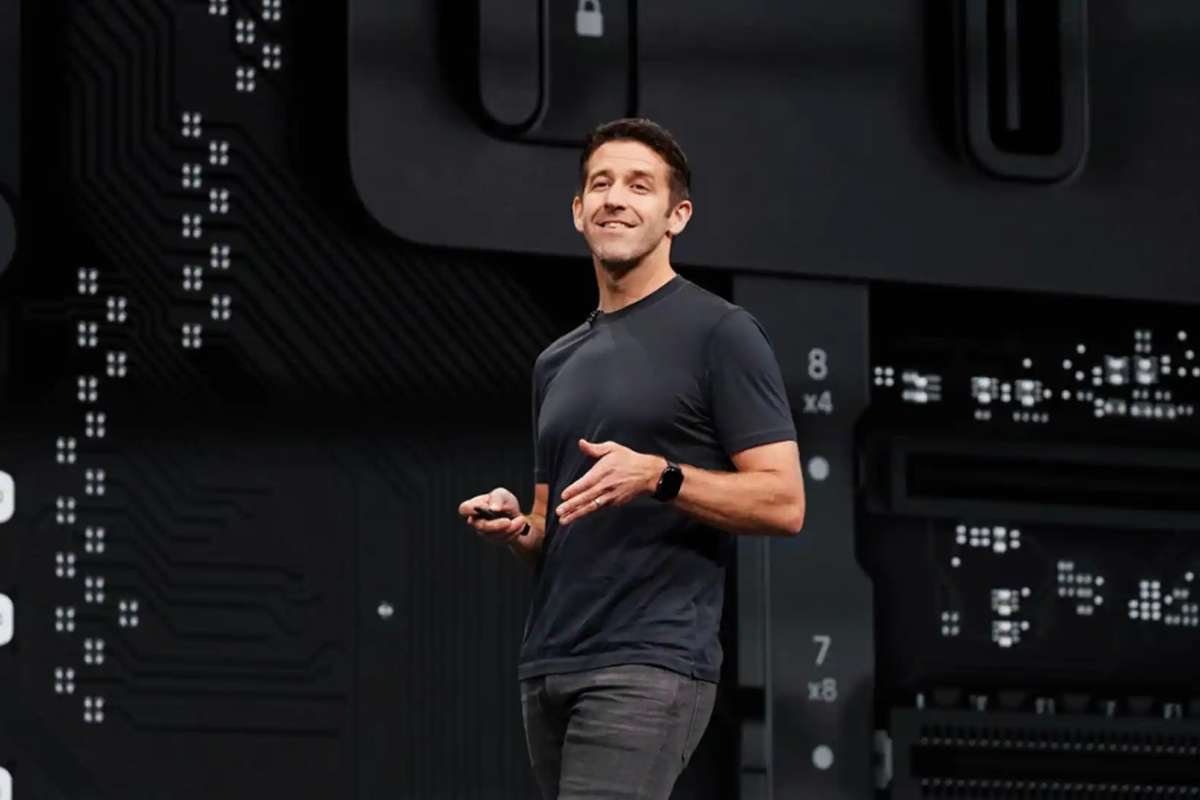
The air inside the Steve Jobs Theater usually tastes like expensive silence and pressurized expectations. For years, the world watched Tim Cook walk onto that stage, a master of the supply chain, a man who turned a creative boutique into a three-trillion-dollar fortress. But the fortress was built on a specific kind of alchemy. It relied on the ghost of a founder and the steady hand of a successor who knew how to keep the trains running on time.
Now, the hand has changed.
John Ternus is not a household name. He does not possess the calculated mystery of Jony Ive or the folksy, operational charm of Cook. Yet, he is the man who just took the keys to the most influential machine on the planet. To understand why this matters, you have to look past the stock prices and the press releases. You have to look at the hardware. You have to look at the screws.
The Architect of the Invisible
Ternus spent years as the Vice President of Hardware Engineering. In the hierarchy of Silicon Valley, "Hardware" is often the grueling, unglamorous sibling to "Software." Software is fluid; you can patch a bug in the middle of the night. Hardware is unforgiving. If you miscalculate the thermal expansion of a glass casing by a fraction of a millimeter, ten million devices become paperweights.
Ternus thrived in that unforgiving space.
Consider the transition to Apple Silicon. It was perhaps the most audacious gamble in the company’s modern history. They decided to stop buying brains from Intel and start building their own. It was a move that required a terrifying level of coordination. Ternus was the bridge. He had to ensure that the physical shell of a MacBook Pro could handle the raw, blistering power of a chip that hadn't even been finalized yet.
Imagine a hypothetical engineer named Sarah. She sits in a windowless lab in Cupertino, staring at a prototype of a new iPad. To the world, it’s just a thinner screen. To Sarah, working under Ternus’s philosophy, it is a war against physics. Every internal component is a puzzle piece that must fit with zero margin for error. Ternus is the person who tells Sarah that "good enough" is a fireable offense. He isn't just a manager; he is a craftsman who happens to manage thousands of people.
The Weight of the Crown
The transition from Tim Cook to John Ternus marks the end of the "Post-Jobs" era and the beginning of something entirely different. Cook was the perfect steward. He expanded the empire. He made the iPhone ubiquitous. But there was always a lingering question: could Apple still surprise us?
Ternus represents a return to the product-first mentality. He is a "product guy" through and through. When he speaks about the internal architecture of a Mac, there is a genuine, almost geeky reverence in his voice. He cares about how the hinges feel. He cares about the specific frequency of the click when you attach an Apple Pencil.
This shift is vital because we are entering the era of Spatial Computing. The Vision Pro was a shot across the bow, a signal that Apple wants to change how we interact with reality itself. That isn't a challenge for a supply-chain expert. It’s a challenge for a builder. It requires someone who understands that if a headset is even three grams too heavy, the magic dies. The user doesn't see the engineering; they only feel the neck strain.
Ternus’s task is to make the technology disappear.
The Cultural Ripple
Inside Apple Park, the vibe is shifting. Transitions at this level are never just about the person at the top; they are about the thousands of people underneath them who suddenly feel a change in the wind.
Under Cook, the focus was often on services—Apple Music, iCloud, TV+. These are high-margin, reliable revenue streams. They are the moat around the castle. But under Ternus, the focus is swinging back to the castle walls themselves. There is a renewed energy in the hardware labs. The people who spend their lives debating the tactile response of a button feel like their champion has finally taken the throne.
But there is a risk.
Apple is no longer the scrappy underdog of the 1990s. It is a nation-state. When Ternus makes a decision, he isn't just affecting a product line; he is shifting global markets. If he decides a certain rare-earth mineral is no longer viable for a battery, entire mining economies feel the tremor. The human cost of these decisions is staggering.
He inherits a company that is currently under fire from regulators across the globe. The Department of Justice and the European Union are looking at the "Walled Garden" and seeing a monopoly. Ternus cannot just be a builder anymore. He has to be a diplomat. He has to defend the garden while keeping the gates high enough to satisfy the board and low enough to appease the judges.
The Ghost in the Machine
There is a story often told about the early days of the Macintosh. Steve Jobs insisted that the internal circuit boards be beautiful, even though no consumer would ever see them. He believed that the soul of the product resided in the parts that remained hidden.
John Ternus is the modern keeper of that soul.
He is younger than the previous leadership. He brings a different kind of stamina. In his first town hall as CEO, he didn't focus on quarterly earnings or buybacks. He focused on the "why." Why do we make these things? Why does it matter if a laptop opens with one finger?
It matters because these devices have become extensions of our nervous systems. We record our children’s first steps on them. We run businesses from them. We find our way home with them. When a device fails, it isn't just a technical glitch; it’s a breach of trust.
The Unwritten Chapter
The skeptics will say that Ternus is a safe choice. They will argue that he is a "legacy pick," someone who won't rock the boat. They are wrong. To maintain the status quo at a company like Apple is to invite a slow, gilded death. To survive, Apple must constantly cannibalize its own successes. It must be willing to kill the iPhone to create whatever comes next.
Ternus knows this.
He has spent his career making things smaller, faster, and more intimate. He has watched the evolution of the silicon that now powers everything from the watch on your wrist to the desktop on your studio. He doesn't see these as separate gadgets. He sees them as a single, cohesive environment.
The stakes are invisible but absolute. If Ternus succeeds, we won't even notice. The technology will become so intuitive, so perfectly integrated into our lives, that it will feel like breathing. If he fails, the "Apple Magic" will evaporate, replaced by the cold, sterile efficiency of a standard electronics corporation.
He stands on the stage now. The lights are bright. The silhouette of the apple logo glows behind him. He isn't looking at the crowd. He is looking at the device in his hand, checking the seam where the metal meets the glass, looking for that one-micron imperfection that only he can see.
The spaceship has a new captain. He helped build the engines. He knows exactly how much pressure they can take before they break. Now, he has to find out if he can steer through the storm.
One screw at a time.