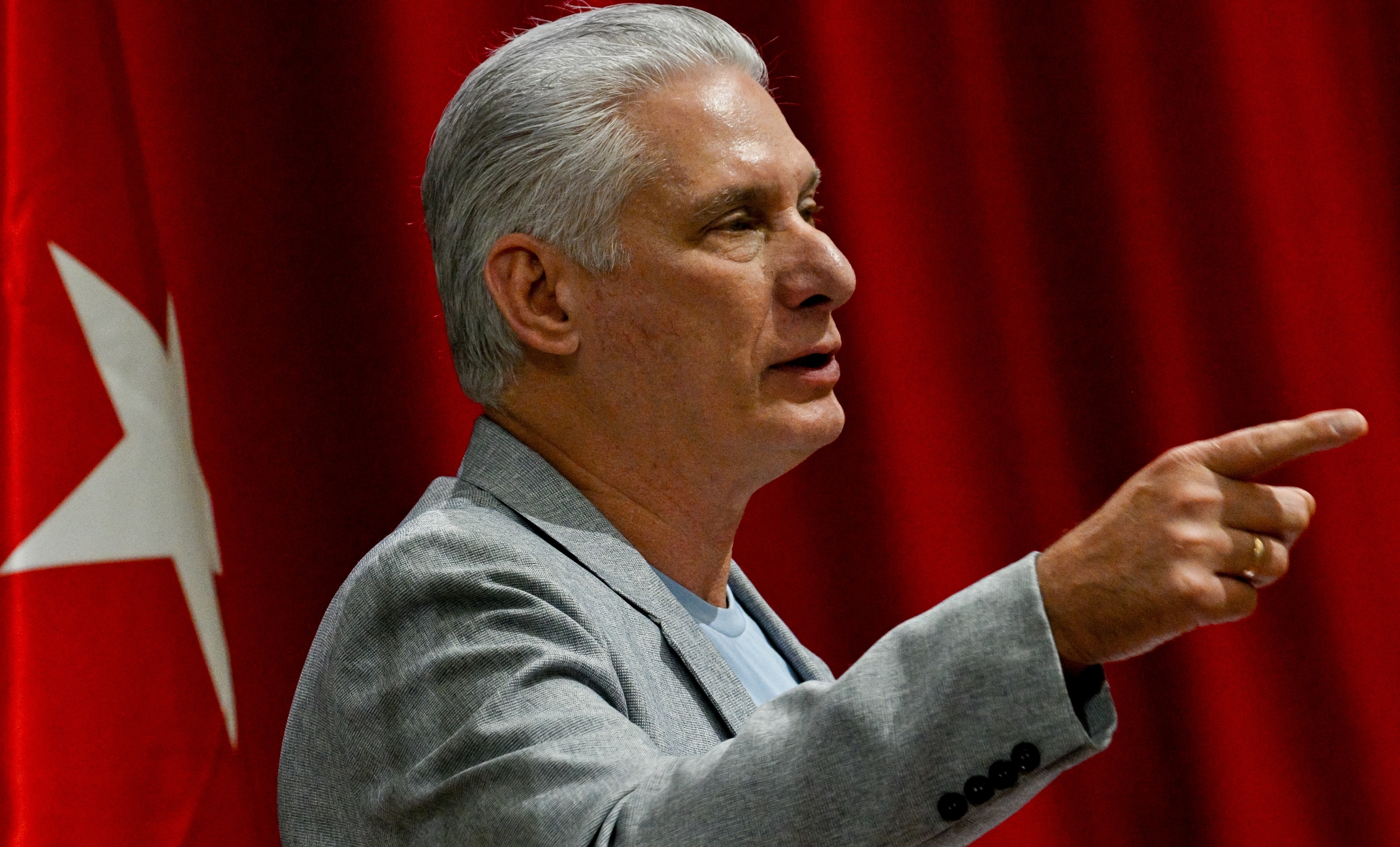
The air in Havana doesn’t just sit; it clings. It carries the scent of salt spray from the Malecón, the exhaust of Ladas that should have died decades ago, and the weight of a clock that seems to have stopped somewhere around 1959. Inside the Palace of the Revolution, the air is cooler, but the pressure is higher.
Miguel Díaz-Canel sits behind a desk that carries the ghost-weight of two brothers named Castro. For sixty years, the world knew exactly who ruled Cuba. Now, the man sitting there is facing a lens from NBC News, and the question hanging in the humidity is the one everyone from the bodegas of Old Havana to the high-rises of Miami is whispering: When do you leave?
He isn’t leaving. He says it with the practiced stillness of a man who knows that in Cuba, words aren't just speech—they are survival.
To understand why a man stays in power while his country’s lights flicker and its pharmacies run dry, you have to look past the political theater. You have to look at the anatomy of a stalemate.
The Weight of the Chair
Imagine for a second you are a father in Matanzas. Your refrigerator is a white metal box that hums with nothing inside but a jar of water and a sense of dread. The "Special Period" of the nineties was supposed to be a one-time nightmare, yet here you are, watching your daughter pack a backpack not for school, but for a journey through the Darien Gap.
For that father, the President’s refusal to step down isn't a headline. It is a ceiling.
Díaz-Canel told the world he has no intention of resigning because he believes he is part of a "continuity." It is a word the Cuban government loves. It suggests a smooth, unbreakable thread from the Sierra Maestra mountains to the present day. But continuity is a double-edged sword. If you claim the glory of the past, you own the rot of the present.
The facts are cold and unyielding. The Cuban economy is shrinking. The sugar harvest—once the proud heartbeat of the island—has slumped to levels not seen since the 1900s. Inflation isn't just a number on a chart; it’s the reason a single egg now costs more than a day’s worth of a state pension.
When the interviewer asks about the protests, about the 11th of July when thousands of Cubans broke the silence to scream for bread and freedom, the President doesn't flinch. He speaks of "sovereignty." He speaks of the "blockade." He uses the old script because the old script is the only one he is allowed to read.
The Invisible Stakes
Why stay? If the ship is taking on water and the pumps are broken, why fight to remain the captain?
The answer lies in the architecture of the Cuban state. It isn't a one-man show anymore. It is a complex, interlocking grid of military interests, aging revolutionaries, and a younger generation of bureaucrats who are terrified of what happens if the thread finally snaps.
Power in Cuba is a game of Jenga. Every block—the tourism industry, the export of doctors, the control of the internet—is stacked precariously. Díaz-Canel knows that if he pulls himself out of the tower, the whole thing might not just change; it might vanish. And for the men in green fatigues who stand behind him, disappearance is not an option.
There is a hypothetical scenario we should consider to understand the internal logic of the Palace. Suppose a leader in his position did want to walk away. Where would he go? In a system built on the absolute binary of "Revolution or Death," there is no "Former President" lounge. There is no quiet retirement teaching at a university. To step down is to admit the continuity has failed. To admit failure is to invite the collapse.
So, he stays. He tells NBC that he is a "servant" of the people, even as the people vote with their feet, crossing borders in numbers that dwarf the Mariel boatlift.
The Disconnect of the Digital Age
The real battle isn't happening in a televised interview. It’s happening on five-inch screens.
For decades, the Cuban government controlled the narrative because they controlled the paper and the airwaves. But the 3G and 4G signals that now drift over the island have changed the physics of dissent. A grandmother in Sancti Spíritus can now see a video of a protest in Santiago in real-time. She can see her grandson in Madrid eating a steak.
The President’s defiance is an attempt to talk over the digital roar. He frames the discontent as a foreign product, a "Made in the USA" conspiracy designed to destabilize the nation. It’s a classic move: if you can’t fix the hunger, blame the person pointing it out.
But the hunger is real. The lack of antibiotics is real. The rolling blackouts that plunge entire cities into a stifling, humid darkness are real.
During the interview, the President looked like a man trying to hold back a tide with a broom. He spoke of reforms, of opening the door slightly to small businesses, of "perfecting" the system. But how do you perfect a system where the currency has lost its meaning? How do you tell a young person to wait for a future that has been "arriving" for sixty-five years?
The Ghosts in the Room
There is a specific kind of loneliness in being the first leader of Cuba not named Castro.
Fidel had a charisma that could fill a plaza for eight hours. Raúl had the iron grip of the military. Díaz-Canel has... the bureaucracy. He is the first "civilian" face, a man who rose through the ranks by being dependable, by not making waves, by being the ultimate company man.
His refusal to step down is the ultimate act of a loyalist. He is holding the line because that is what he was trained to do. He isn't a king; he’s a placeholder for an ideology that is struggling to breathe in the 21st century.
When he talks about the "harshness" of U.S. sanctions, he isn't lying about the impact. The embargo is a crushing weight. But he is omitting the other half of the story: the internal embargo. The layers of red tape that prevent a Cuban farmer from selling his own beef. The laws that make it a crime to think differently. The fear that keeps a genius programmer from building an app because he doesn't want to "disturb the order."
The Final Standoff
The interview ends, the cameras are packed away, and the President remains.
Outside the Palace, the sun sets over the Malecón. The "Almendrones"—the vintage American cars—rumble by, held together by duct tape, boat engines, and sheer willpower. They are a metaphor for the country itself: beautiful from a distance, struggling under the hood, and running on fumes.
Díaz-Canel says he will not step down. He says the Revolution is eternal. But eternity is a long time to go without electricity.
The man in the mirror knows that the true test of his leadership isn't whether he can survive an interview with an American news network. It’s whether he can survive the silence of a city that has stopped believing in the promises of the past.
He sits in the chair. He holds the pen. He watches the clock. And outside, the Caribbean Sea continues to beat against the sea wall, indifferent to the men who claim to own the shore, slowly wearing away the stone, one wave at a time.