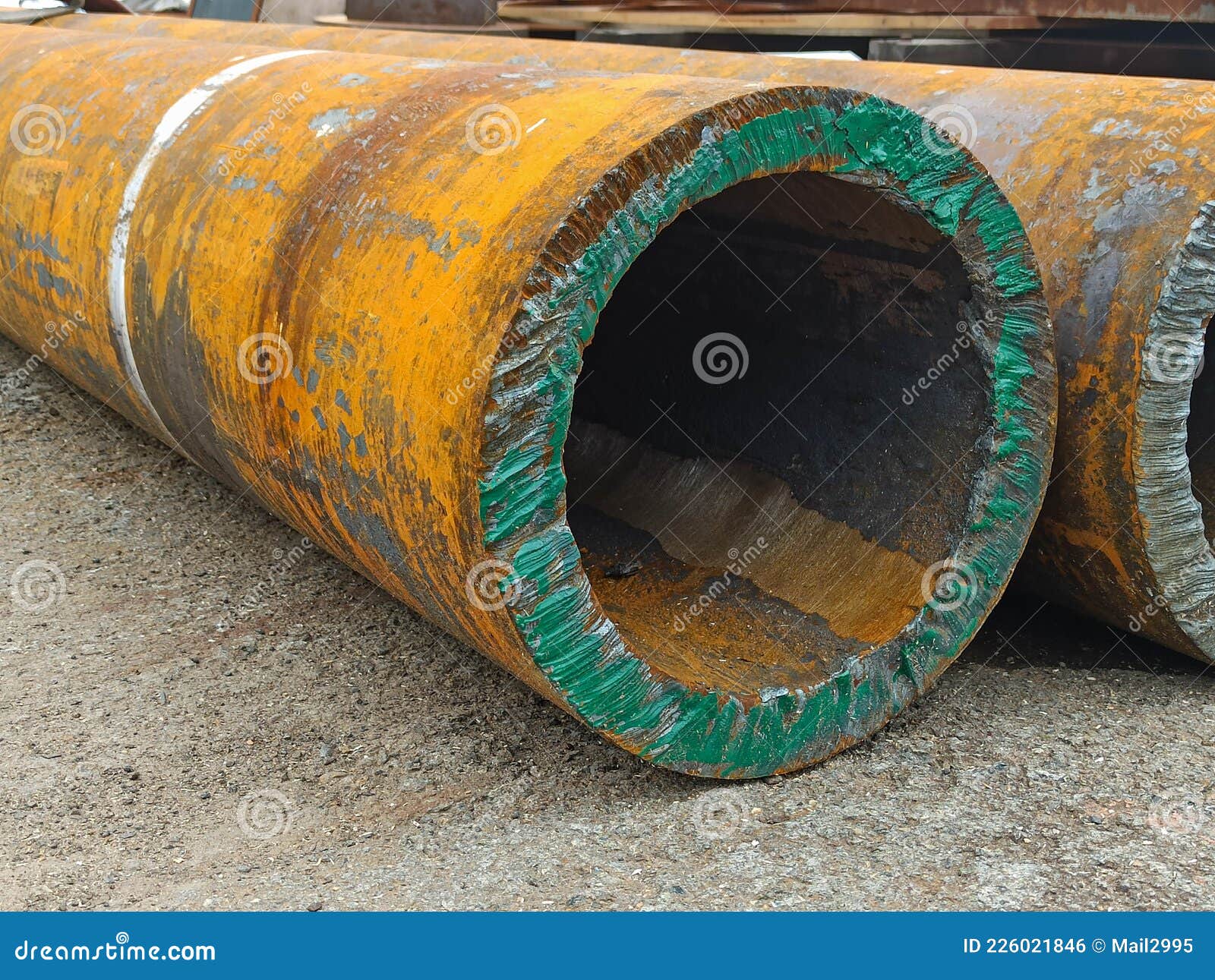
Residents in the city of Oita recently woke up to a sight that looks like a poorly rendered video game asset. A massive, industrial-grade pipe is sticking straight out of the asphalt. It’s not just a small vent or a manhole cover. We’re talking about a thick, metallic cylinder emerging from the ground at a jaunty angle, right in the middle of a public thoroughfare. Social media naturally lost its mind. People started theorizing about underground bases, secret government projects, or just a massive plumbing fail.
The reality is actually more interesting because it involves the chaotic intersection of aging infrastructure and modern engineering. When a huge pipe emerges from the ground in Japanese city streets, it’s rarely an accident. Japan’s urban planning is a dense web of history and necessity. You’ve got layers of pipes, some dating back decades, sitting right beneath high-tech sensors and fiber optics. Sometimes, the ground simply decides it’s done holding onto them.
The mechanics of why the ground spits out steel
It’s easy to assume someone just forgot to bury it deep enough. That’s rarely the case. Soil liquefaction and seismic shifts are constant threats in Japan. When the earth moves or when water pressure builds up in the subsoil, objects can become buoyant. It’s a physical phenomenon. If the density of the surrounding soil drops—which happens during heavy rains or minor tremors—the hollow, air-filled pipe wants to rise. It’s basically a buoy in a sea of dirt.
I’ve seen this happen in construction zones where the "overburden" or the weight of the dirt on top isn't enough to counteract the upward force of groundwater. In Oita, the sight of this pipe wasn't just a curiosity. It was a warning sign. It tells us the ground beneath our feet isn't nearly as solid as the concrete makes it look. If a pipe can move that much, what else is shifting?
Japan's aging underground headache
The Ministry of Land, Infrastructure, Transport and Tourism (MLIT) has been screaming about this for years. A huge chunk of Japan’s utility infrastructure was laid during the economic boom of the 1960s and 70s. These pipes have a shelf life. Usually, it's about 40 to 50 years. Do the math. We’re right in the danger zone.
- Corrosion eats the outer casing.
- Soil shifts create stress points.
- Joints fail, leaking water into the surrounding earth.
- The soil loses its grip, and the pipe migrates.
When you see a pipe sticking out of the road, you’re looking at a symptom of a much larger systemic failure. It’s not just one bad contractor. It’s a nation-wide struggle to replace thousands of miles of metal before they decide to introduce themselves to the morning traffic.
This wasn't a secret base
Stop with the conspiracy theories. I know the internet loves the idea of a secret "Tokusatsu" base hidden under Oita, but the truth is usually boring. This specific pipe was identified as part of a drainage and ventilation system. Why was it sticking out? Likely a combination of recent heavy rainfall and a failure in the anchoring system.
Engineering teams in Japan use a method called "shield tunneling" for a lot of their work. They leave vents and access points as they go. If a project gets stalled or if the "backfill" isn't settled correctly, things move. The pipe didn't "grow" there. It was pushed. Gravity and pressure don't care about your commute.
The cost of fixing the unfixable
Fixing these "emerging" pipes isn't as simple as hitting them with a sledgehammer. Engineers have to excavate the entire section. They have to stabilize the soil, which often involves injecting chemical grouts to turn the dirt into something resembling sandstone. It’s expensive. It’s loud. And it’s why your taxes in urban Japan are what they are.
We often ignore the stuff we can't see until it literally blocks the road. This incident is a wake-up call for urban planners everywhere, not just in Japan. If you don't maintain the guts of your city, the city will eventually vomit them up.
What to do if you see infrastructure acting weird
Don't go near it for a selfie. Seriously. If a pipe has enough force to punch through asphalt, it’s under immense pressure. There could be a sinkhole forming right next to it that hasn't collapsed yet.
If you see the ground bulging or a pipe "emerging" where it shouldn't be:
- Move away immediately. Asphalt is surprisingly thin and brittle when it's not supported from below.
- Report it to the local ward office. Don't assume someone else already did.
- Check for the smell of gas. While the Oita pipe was for drainage, many utility corridors are shared. A shifting pipe can easily snap a nearby gas line.
The Oita pipe incident ended with crews securing the area and beginning the long process of re-burying the beast. But don't expect this to be the last time. As the earth continues to shift and our metal skeletons continue to rust, the ground is going to keep talking back. Pay attention to what it's saying. Check your local government's infrastructure map to see just how old the pipes under your own house are. You might be surprised how close they are to the surface.