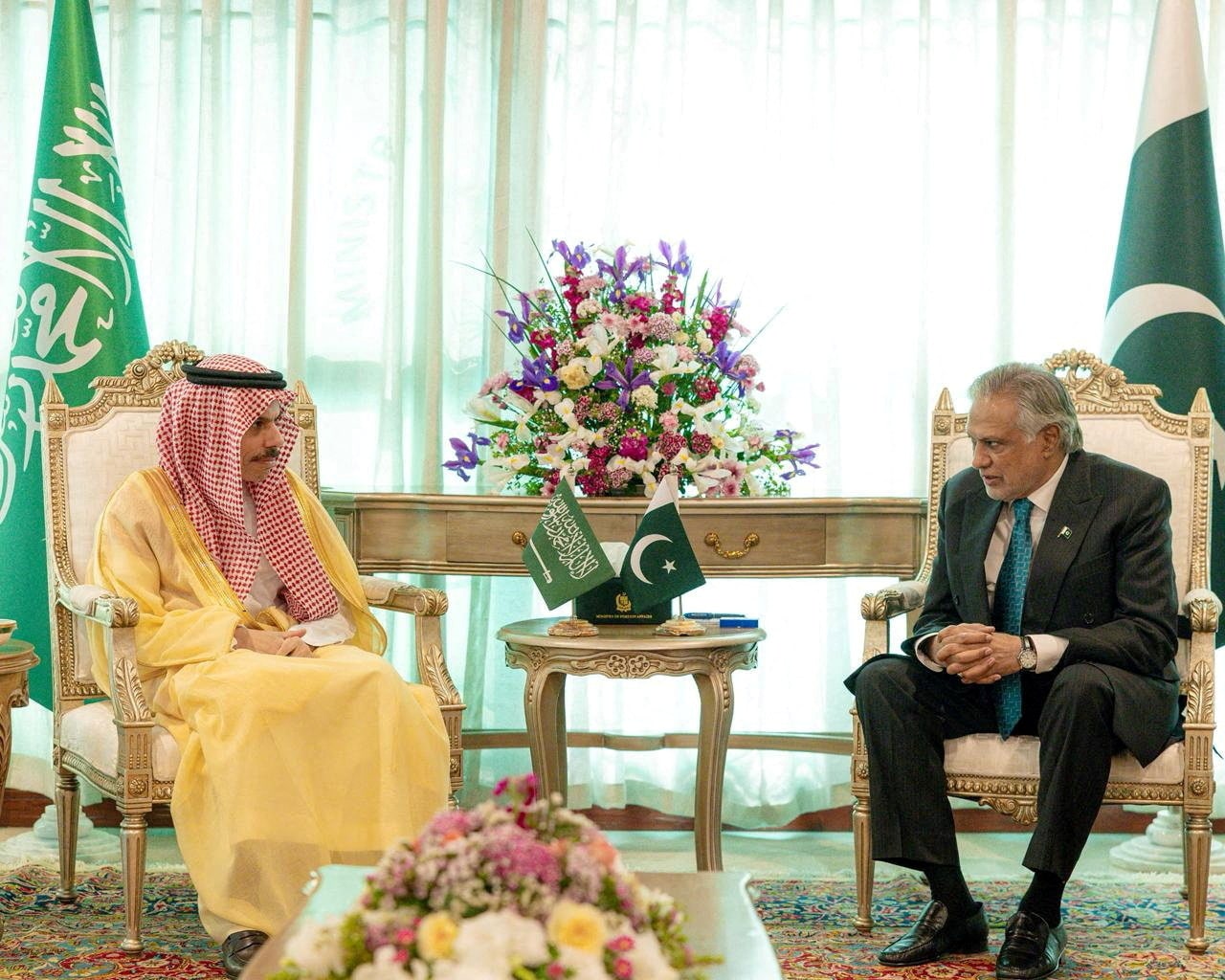
The deployment of 13,000 Pakistani troops alongside a contingent of multi-role fighter jets to Saudi Arabia represents more than a reactive military movement; it is the execution of a long-standing bilateral security protocol designed to mitigate specific regional vulnerabilities. This mobilization operates at the intersection of kinetic defense and economic stabilization. To understand the gravity of this deployment, one must look past the raw troop counts and examine the structural dependencies between Islamabad’s surplus human capital in the defense sector and Riyadh’s requirement for a non-aligned, culturally integrated deterrent force.
The Tripartite Logic of the Deployment
The current security arrangement functions through three primary mechanisms: internal stability maintenance, border integrity, and technical capacity building.
1. The Internal Security Buffer
Saudi Arabia’s defense strategy historically relies on "depth by proxy." By integrating Pakistani infantry and specialized counter-terrorism units, the Kingdom creates a secondary layer of protection for critical infrastructure—specifically oil processing facilities and desalination plants—without straining its own domestic manpower. This allows the Royal Saudi Land Forces (RSLF) to remain focused on high-tech border surveillance and mechanized warfare.
2. Aerial Integration and Interoperability
The deployment of fighter jets signals a shift toward integrated air defense. This is not merely a show of force but an exercise in hardware synchronization. Given that both nations operate variants of the F-16 and are increasingly looking toward 4.5 and 5th-generation platforms, the presence of Pakistani pilots provides a "force multiplier" effect. They bring combat experience from high-altitude environments and counter-insurgency operations that are directly applicable to the mountainous border regions of the Arabian Peninsula.
3. The Human Capital Arbitrage
Pakistan possesses one of the world's largest standing armies, yet its domestic economy lacks the liquidity to maintain such a force at peak readiness without external support. Saudi Arabia provides the capital; Pakistan provides the trained personnel. This is a cold-eyed economic transaction where security is the primary export.
Tactical Composition and Resource Allocation
The 13,000-person figure is not a monolithic block. Operational data suggests a tiered distribution of personnel:
- Combat Engineers and Technical Staff: Approximately 15% of the force is likely dedicated to maintaining hardware, fortifying positions, and managing logistics chains.
- Special Operations Forces (SOF): A concentrated element of elite units focuses on asymmetric threats, specifically protecting the House of Saud and key governmental nodes.
- Infantry and Border Guard: The bulk of the force provides a physical presence in the southern and eastern provinces, acting as a conventional deterrent against non-state actors.
This distribution follows a cost-benefit curve where the most expensive assets (SOF and pilots) are placed at the highest-value nodes, while the standard infantry acts as a "tripwire" force.
The Economic Feedback Loop
The financial underpinnings of this deployment are often obscured by diplomatic rhetoric. In reality, the arrangement serves as a critical component of Pakistan’s Balance of Payments (BoP) strategy.
Direct Remittances and Institutional Support
The salaries of these 13,000 troops are often paid in part or in full by the host nation, with a significant portion being remitted directly back to the Pakistani state or into the domestic economy. This creates a steady stream of foreign exchange reserves. Furthermore, such deployments are frequently tied to deferred oil payment schemes or direct central bank deposits from Riyadh to Islamabad.
The Opportunity Cost of Neutrality
Pakistan’s primary challenge is balancing this deployment with its relationship with Iran. The "Red Line" for Islamabad has historically been the crossing of the Saudi-Yemeni border. By framing the deployment as "internal security" or "training and advisory," Pakistan attempts to minimize the risk of being drawn into a regional sectarian conflict while still fulfilling its contractual obligations to Riyadh. If the deployment moves from a defensive posture to an offensive one, the diplomatic cost functions exponentially increase, potentially destabilizing Pakistan's western border.
Technical Limitations and Operational Friction
No military integration is without bottlenecks. The most significant constraint in this 13,000-troop deployment is the Command and Control (C2) Paradox.
While the troops are on Saudi soil, they remain under the ultimate jurisdiction of GHQ in Rawalpindi. This creates a lag in decision-making during high-intensity kinetic events. If a Pakistani jet is required to intercept an unidentified aerial vehicle (UAV), the authorization chain must navigate both Saudi operational commands and Pakistani diplomatic protocols. This latency is a structural weakness that adversaries may seek to exploit through "gray zone" tactics—actions that fall below the threshold of open war but require immediate tactical responses.
A second limitation is Equipment Homogeneity. While both nations utilize Western and Chinese hardware, the specific configurations, encryption modules, and communication protocols often differ. Without a unified data link system (like a localized version of Link-16), the "fighter jets" mentioned in the deployment may struggle to share real-time targeting data with Saudi ground-based radar systems, reducing them to visual-range interceptors rather than nodes in a modern networked defense grid.
The Deterrence Equation
To quantify the effectiveness of this move, we must look at the Deterrence Value (D), which can be modeled as:
$$D = (C \times W) / R$$
Where:
- C is the visible Capability (13,000 troops + fighter jets).
- W is the perceived Will to use that capability (the strength of the bilateral treaty).
- R is the Risk of regional escalation.
The deployment maximizes C, but the W remains a variable. If regional actors perceive that Pakistan will only defend "holy sites" and not the broader Saudi territorial integrity, the deterrence value drops. Conversely, if the deployment includes offensive aerial capabilities, the R value spikes, potentially inviting retaliation against Pakistani interests elsewhere.
Strategic Forecast: The Shift Toward Defense Industrialization
The future of this relationship is moving away from "boots on the ground" and toward joint production. The 13,000 troops are a bridge to a more sustainable model: the localization of defense manufacturing. Saudi Arabia’s Vision 2030 aims to localize 50% of its military spending. Pakistan, with its established (though capital-starved) defense industry—including the JF-17 Thunder program and various missile technologies—is the logical partner for this transition.
We should expect a gradual tapering of raw troop numbers over the next decade, replaced by joint ventures in UAV production, munitions manufacturing, and cybersecurity frameworks. The current deployment acts as the "security guarantee" necessary to protect the high-value infrastructure projects currently under construction across the Kingdom.
The most effective utilization of this force is not in the theater of active combat, but in the psychological space of regional power dynamics. By placing 13,000 troops on the board, Pakistan has signaled that its economic survival is inextricably linked to Saudi stability. The strategic recommendation for regional observers is to monitor the specific location of the fighter jet basing; proximity to the southern border indicates a kinetic intent, while basing near Tabuk or Dhahran suggests a broader regional containment strategy. The deployment is a hedge against a vacuum of Western interest in the region, positioning Pakistan as the primary guarantor of the Gulf's traditional security architecture.