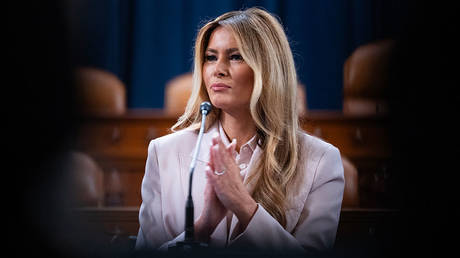
Public grievances between political figures and media personalities are rarely isolated outbursts; they are strategic maneuvers within a broader ecosystem of reputation management and brand equity protection. When Melania Trump issued a formal rebuke regarding a joke made by Jimmy Kimmel, she moved the conflict from the realm of entertainment into a structured defense of personal and political dignity. This reaction functions as a "Cease and Desist" of social narrative, designed to shift the cost of engagement for the critic while reinforcing the boundaries of the Trump brand. Understanding this friction requires deconstructing the specific triggers of high-stakes public relations and the logic of selective outrage.
The Taxonomy of the Discursive Violation
The conflict originated from a late-night monologue where Kimmel referenced a "widow" joke, a linguistic choice that Melania Trump’s office categorized as an unacceptable breach of decorum. To analyze this, one must look at the specific variables that dictate when a public figure decides to escalate a rhetorical slight into a formal confrontation.
- Contextual Severity: Jokes involving mortality or the status of a spouse carry a higher emotional and social weight than critiques of policy or fashion. By labeling the joke "unacceptable," the response establishes a hard line in the sand regarding what is considered "fair game" in political satire.
- The Audience Multiplier: Kimmel’s platform provides a massive, high-frequency distribution channel. A joke told in a private setting is a nuisance; a joke told to millions is a brand-damaging event that necessitates a counter-signal to prevent the narrative from becoming a settled truth.
- Signal vs. Noise: Public figures ignore 99% of criticism. The decision to respond to this specific instance signals that the perceived damage to the "Melania Trump" brand exceeded the threshold of acceptable background noise.
The Three Pillars of Strategic Rebuttal
The statement issued by Melania Trump’s team utilized three distinct psychological and tactical levers to regain control of the narrative. This is not merely an emotional reaction; it is a calculated deployment of social capital.
1. Moral High-Ground Positioning
By framing the joke as an attack on the sanctity of family and the dignity of a woman, the rebuttal forces the critic into a defensive posture. It shifts the debate from the content of the joke to the character of the joker. This tactic utilizes a "values-based" framework, where the critic is portrayed as lacking the fundamental empathy or respect required for civil discourse.
2. Demographic Galvanization
A public rebuke of a "mainstream media" figure serves as a potent signal to the base. It reinforces the perception that the Trumps are under unfair, constant assault from a biased entertainment industry. This creates a feedback loop: the media attacks, the subject defends, and the supporters’ loyalty is hardened by the perceived martyrdom of the subject.
3. The Risk-Reward Asymmetry
Kimmel, as a comedian, operates on the frontier of what is socially permissible. However, when he targets a figure with a highly organized and vocal support system, the "cost" of the joke increases. The backlash—ranging from negative social media sentiment to formal statements—forces the entertainer to weigh the value of the punchline against the friction generated by the target's response.
The Cost Function of Late-Night Satire
In the current media landscape, political satire has transitioned from observational humor to a form of narrative warfare. The efficacy of a joke is no longer measured solely by laughter, but by its ability to "trend" and consolidate a specific political viewpoint.
When an entertainer like Kimmel utilizes a highly personal trope—such as the "widow" comment—they are leveraging a high-risk, high-reward strategy. The reward is a viral moment among their core audience. The risk is the alienation of centrist viewers and the triggering of a formal counter-offensive. Melania Trump’s response highlights a growing trend where political figures refuse to be passive participants in their own caricature. They are now active auditors of the jokes made at their expense.
The Erosion of the Third Wall in Political Branding
Historically, First Ladies and their counterparts maintained a degree of distance from the day-to-day skirmishes of late-night television. This "Third Wall" provided a layer of prestige that was thought to be compromised by engaging with comedians. That model is now obsolete.
The current strategy involves a rapid-response mechanism. By treating a monologue joke with the same gravity as a policy critique, the Trump office treats the media environment as a flat landscape. In this view, there is no distinction between a news anchor and a late-night host; both are seen as influencers whose output must be managed, corrected, or denounced to maintain brand integrity.
The Bottleneck of Effective Retraction
A fundamental limitation of this defensive strategy is the "Streisand Effect." By drawing attention to the joke through a formal condemnation, Melania Trump’s office ensures that millions more people hear the joke than would have otherwise.
- Primary Reach: The initial audience of the late-night broadcast.
- Secondary Reach: The social media clips and news cycles generated by the joke.
- Tertiary Reach: The massive surge in attention triggered by the formal response.
This creates a paradox: to defend one's honor, one must often amplify the very insult they wish to suppress. The decision to proceed despite this bottleneck suggests that the goal is not to hide the joke, but to control the reaction to it. The objective is to make the audience's last memory of the incident the rebuke, not the punchline.
Analytical Projection of Media Hostility
The frequency and intensity of these interactions are likely to increase as we approach high-stakes political cycles. The traditional boundaries of satire are dissolving, replaced by a binary system where every public statement is viewed through a lens of total alignment or total opposition.
Entertainers will continue to push the envelope of "personal" humor to satisfy a fragmented and highly polarized audience. Simultaneously, public figures will continue to refine their "rapid-response" capabilities, treating every late-night monologue as a potential threat to their social and political capital. This is an escalation ladder with no clear exit ramp, as both sides derive significant value (in the form of engagement and loyalty) from the conflict itself.
The strategic play for any high-profile brand caught in this crossfire is not to avoid the conflict, but to ensure that the response is more viral than the attack. Melania Trump's statement succeeded in shifting the conversation from Kimmel's humor to Kimmel's "cruelty." In the economy of public opinion, the ability to redefine the terms of an insult is the ultimate form of power.
The next phase of this evolution will likely involve the preemptive monitoring of scripts or the use of legal "warning shots" to chill specific types of personal commentary before they reach the airwaves. Brands that fail to adopt this aggressive, proactive stance will find their reputations slowly eroded by a thousand "small" jokes that, in aggregate, form an inescapable and negative public identity. The Melania Trump model of the "formalized rebuke" is the new baseline for elite reputation management in a decentralized media world.


