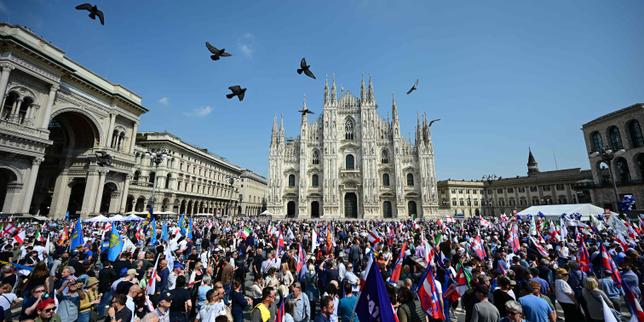
The legacy media loves a simple script. When the so-called "hard right" gathers in Milan, the headlines write themselves: "Threats to Democracy," "The Return of Nationalism," or "The End of the European Union." It is lazy. It is predictable. It is fundamentally wrong.
What happened in Milan wasn't a funeral for the European idea. It was a hostile takeover bid. The pundits are so busy clutching their pearls over the rhetoric that they are missing the structural shift happening right under their noses. This isn't about isolationism. It is about a new, aggressive form of Sovereign Integration. You might also find this connected story insightful: Inside the White House Ballroom Legal Quagmire.
The standard narrative suggests that Europe is divided between "Pro-EU" centrists and "Anti-EU" radicals. This binary is dead. What we are seeing is the birth of a right-wing internationalism that is more organized, more tech-savvy, and more strategically aligned than the Brussels bureaucracy it seeks to replace.
The Myth of the Anti-European Right
The most common misconception is that these parties want to destroy the EU. They don't. They want to wear its skin. As reported in latest coverage by The Guardian, the effects are widespread.
I’ve spent a decade analyzing geopolitical shifts, and the pattern is clear: modern right-wing movements have realized that exiting the EU—the "Brexit Path"—is a logistical nightmare that yields diminishing returns. Instead, they are pivoting toward a "Capture and Reform" strategy. They aren't looking for the exit; they are looking for the keys to the building.
When Matteo Salvini or Marine Le Pen speak about "A Europe of Nations," they aren't calling for a return to 19th-century borders. They are proposing a decentralized trade bloc that retains the benefits of the single market while stripping away the social and judicial mandates of the European Commission.
[Image of map showing the European Union Member States]
The mistake the "lazy consensus" makes is assuming that opposition to Brussels equals opposition to Europe. It doesn't. These groups are building a parallel structure of cooperation. They are sharing data on border security, aligning their voting blocks in the European Parliament, and synchronizing their digital messaging across borders. This is a high-level coordination that traditional parties simply cannot match.
Why the Immigration Debate is a Red Herring
The media focuses on the slogans about immigration because slogans are easy to report. But the immigration debate is merely the entry point. The real war is being fought over Demographic Sovereignty.
Establishment politicians view immigration through the lens of GDP growth and labor shortages. They see bodies as economic units. The Milan contingent sees bodies as cultural pillars. This isn't just "racism" in a vacuum; it’s a fundamental disagreement on the definition of a state.
- The Centrist View: The state is a service provider.
- The Milan View: The state is a cultural inheritance.
By ignoring the cultural anxiety and focusing solely on the economic data—which, by the way, is often skewed—the establishment creates a vacuum. The right isn't "winning" because their solutions are perfect; they are winning because they are the only ones acknowledging that a country is more than a balance sheet.
I’ve seen political campaigns collapse because they refused to touch the "third rail" of cultural identity. The hard truth is that you cannot sustain a high-trust welfare state without a cohesive social fabric. This is a sociological reality that Northern European countries are finding out the hard way.
The Economic Counter-Intuition
The prevailing wisdom says that a shift toward the right will tank the Euro and lead to economic chaos. Look at the markets. They aren't panicking. Why? Because the "radicals" have become fiscally pragmatic.
Georgia Meloni in Italy provided the blueprint. She talked like a firebrand on the campaign trail and acted like a disciplined technocrat the moment she took office. She realized that the global bond market has more power than any populist rally.
The new European right is moving toward a Hybrid Protectionism. They want:
- Internal Freedom: Keep the Euro and the single market for ease of trade.
- External Barriers: Aggressive tariffs on non-European goods, specifically targeting Chinese expansionism.
- Energy Autonomy: A rejection of "Green Deal" mandates in favor of nuclear and domestic fossil fuels.
This isn't "anti-EU." It is "Europe First." It’s an attempt to turn the EU into a fortress rather than a laboratory for social engineering.
Dismantling the "Fascism" Label
Calling everything in Milan "fascist" is the ultimate intellectual white flag. It’s what you say when you have no actual counter-argument.
Fascism is a specific historical phenomenon defined by the total subordination of the individual to the state, the abolition of private property, and expansionist militarism. What we see today is almost the opposite: a demand for less central government interference and a hyper-focus on domestic preservation.
By crying wolf, the establishment has desensitized the electorate. When you call a mainstream voter a "fascist" for wanting secure borders, you don't change their mind; you just make them stop listening to you. You lose the ability to point out actual authoritarian creep when it happens.
The Demographic Math No One Wants to Face
Let’s talk about the data the "centrist" articles ignore. Europe is aging. Its birth rates are well below replacement level. The standard solution is "replacement migration" to keep the pension systems solvent.
The Milan perspective offers a brutal alternative: Natalism over Migration. They are proposing massive state subsidies for families and tax breaks for multi-child households.
Does it work? Look at Hungary. Despite the international outcry, their birth rate has actually ticked upward while the rest of the continent plateaus or drops. It is an expensive, slow, and difficult path. But for the voters in Milan, it is the only path that preserves their identity.
The establishment's refusal to discuss the long-term cultural impacts of mass migration has handed the right a monopoly on the most important conversation of the 21st century.
The Technocratic Trap
The European Union's greatest weakness is its "Democratic Deficit." Most Europeans cannot name their MEP, let alone the heads of the Commission. This creates a feeling of being ruled by a faceless, unaccountable elite in Brussels.
The Milan gathering leverages this perfectly. They position themselves as the "Voice of the People" against the "Technocrats." It doesn't matter if their leaders are also career politicians; the perception of being an outsider is the only currency that matters in the current climate.
If you want to understand why these movements are growing, stop looking at their speeches and start looking at the EU's regulatory overreach. When Brussels tries to dictate the specific dimensions of a vegetable or the nitrogen output of a family farm in the Netherlands, they are doing the right-wing's PR for them.
A New Map of Power
We are moving toward a Europe of "Variable Geometry."
Instead of a monolithic union where everyone follows the same rules, we will see clusters of nations forming their own agreements. The Visegrád Group was just the beginning. We are looking at a future where Poland, Italy, and perhaps a post-Macron France form a "Sovereignist Core" that dictates the continent's direction.
This isn't a breakdown. It's a reformatting.
The "Pro-EU" camp is obsessed with the institutions. The "Milan" camp is obsessed with the people. In a time of crisis, the people will always choose their tribe over an institution.
The real danger to Europe isn't the gathering in Milan. The danger is the refusal of the current leadership to realize that the ground has already shifted. They are defending a version of Europe that exists only in their white papers.
Stop asking when the "populist wave" will recede. It isn't a wave; it’s the new tide. You can either learn to swim in it or get swept away while complaining about the water temperature.
The era of the "Borderless Europe" experiment is over. The era of the "Fortress of Nations" has begun.
The center is not holding because the center has nothing to offer but more of the same. Milan offered a vision. Until the establishment offers a better one—one that accounts for identity, security, and the reality of a shrinking continent—they will keep losing.
The smart money isn't on the collapse of the EU. It’s on the EU becoming the very thing its founders feared: a powerful, centralized engine for nationalist interests.
Adapt or get left behind.