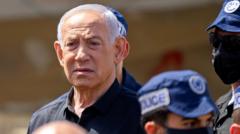
The political commentariat is currently choking on its own predictable script. You’ve seen the headlines: "Netanyahu Cornered," "Tel Aviv Panics as DC Talks to Tehran," or "The End of the Hawk Era." It’s a comfortable, lazy story. It paints Benjamin Netanyahu as a desperate kingpin watching his singular life’s work—the isolation of Iran—dissolve in a cloud of State Department diplomacy.
It’s also entirely wrong.
If you believe Netanyahu is "under pressure" because of renewed US-Iran backchannels, you aren’t paying attention to the mechanics of power. You’re watching the theater, not the director. For a leader whose entire domestic brand is built on being the "Last Defender" against a nuclear-armed caliphate, a diplomatic thaw isn't a threat. It is a lifeline.
The Myth of the Threatened Hawk
The standard argument suggests that any deal between Washington and Tehran strips Israel of its primary security pillar. This assumes Netanyahu actually wants a permanent resolution to the Iran problem. He doesn't.
Strategic tension is the oxygen of his administration.
When the US talks to Iran, Netanyahu gets to play his favorite role: the righteous dissenter. This isn't just about ego; it’s about political physics. Every time a US official sits across from an Iranian counterpart, Netanyahu’s domestic approval ratings receive a shot of adrenaline. He isn’t "under pressure" from the talks; he is using the talks to exert pressure on his own coalition and his rivals.
In the world of realpolitik, a "solved" Iran problem is a catastrophe for Likud. If the threat vanishes, the Israeli public starts asking uncomfortable questions about housing prices, the judicial overhaul, and the cost of living. As long as the "existential threat" is simmering on the front burner, Netanyahu remains indispensable.
The Leverage of the Loud Outsider
Let’s look at the mechanics of the "pressure" the media loves to cite. They claim Netanyahu is losing his grip on the US-Israel relationship. In reality, he is executing a classic pincer maneuver.
- The Public Outcry: By loudly condemning the talks, he signals to the US Republican base and evangelical voters that the current administration is "weak." This turns Israeli security into a US domestic wedge issue.
- The Quiet Coordination: Behind the scenes, the Mossad and the IDF continue to share intelligence with the CIA. The "tension" is a front-of-house performance.
- The Blank Check: By appearing "furious" at US diplomacy, Netanyahu extracts massive military concessions. "If you’re going to talk to the Mullahs," the logic goes, "you better give us more F-35s and bunker-busters to compensate for our 'lost security.'"
I have watched this cycle repeat for decades. In 2015, during the original JCPOA negotiations, the narrative was the same. Netanyahu went to Congress, bypassed the White House, and was declared "politically dead" by the New York Times. What happened? He secured a record-breaking $38 billion military aid package and outlasted the Obama administration entirely.
The "pressure" is the product he sells to his voters. He isn't the victim of the news cycle; he is the architect of it.
Why a Deal is Better for Israel Than No Deal
Here is the take that will get me banned from the dinner parties in North Tel Aviv: Netanyahu actually needs a limited deal to happen.
Israel’s security establishment—the generals and the intelligence heads who actually run the operations—knows that a total collapse of diplomacy leads to one of two things: a nuclear Iran or a regional war that Israel has to fight alone. Neither serves Netanyahu’s longevity.
A limited deal (often called "freeze-for-freeze") provides a stable status quo. It keeps Iran’s enrichment below the 90% "red line" while allowing Israel to continue its "campaign between the wars"—the targeted strikes, cyber warfare, and assassinations that keep the IRGC off balance without triggering a full-scale missile barrage on Haifa.
The current "tension" is a masterful bit of hedging. If the deal fails, Netanyahu says "I told you so" and demands more sanctions. If the deal succeeds in slowing Iran down, he gets the security benefit while still being able to publicly bash the "flawed agreement" to maintain his hardman persona. He wins either way.
Dismantling the People Also Ask Nonsense
If you search for "Will the US abandon Israel for Iran?" you are asking a question rooted in a fundamental misunderstanding of regional gravity.
The US isn't looking for a new best friend; it’s looking for an exit strategy. Washington is exhausted by the Middle East. It wants to pivot to the Indo-Pacific. A deal with Iran isn't a betrayal of Israel; it’s a desperate attempt by the US to "park" the Middle East so it can focus on China.
Netanyahu knows this. He isn't worried about "abandonment." He is worried about irrelevance. As long as he can keep himself at the center of the Iran debate, he remains the most important phone call a US President has to make. The friction isn't a failure of diplomacy; it is the goal of his foreign policy.
The Cost of the Contrarian Stance
To be clear, this strategy has a massive downside that nobody in the Likud inner circle wants to admit. By constantly playing the "aggrieved partner," Netanyahu is burning through the historic bipartisan support Israel once enjoyed in the US.
He is betting the house on the idea that the US will always need Israel more than Israel needs the US. I’ve seen this kind of hubris destroy corporate empires, and it can destroy nations. When you treat your primary benefactor as a political punching bag for domestic gain, eventually the benefactor stops punching back and just leaves the room.
But from Netanyahu’s perspective, that is a "tomorrow" problem. And in the world of the survivor, tomorrow doesn't exist. Only the next election does.
Stop Looking for a Hero
The media wants a story where the "rational" US diplomats are the heroes and the "obstinate" Israeli Prime Minister is the villain. Or vice versa.
The reality is a cold, mechanical exchange of interests.
- Biden wants a win to show he can stabilize a volatile region.
- Khamenei wants sanctions relief to stop his economy from imploding.
- Netanyahu wants a boogeyman to keep him in power.
Everyone is getting exactly what they want out of this "pressure." The only people losing are the observers who think this is about peace, or security, or "deals." It’s about the management of a perpetual crisis.
If you want to understand the Middle East, stop reading the op-eds about "diplomatic breakthroughs." Start looking at who benefits from the stalemate. Netanyahu has built a career on the edge of the abyss. He isn't afraid of the talks. He is afraid of what happens if the talking stops and he has nothing left to protest.
Stop waiting for the "pressure" to break him. He is the one applying the pressure, and he’s never been more in control of the chaos.
Would you like me to analyze the specific economic triggers that make an Iran-Israel stalemate more profitable for regional defense contractors than a resolution?