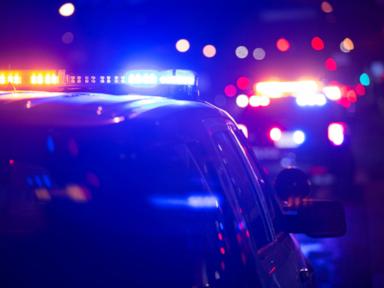
The sirens in Washington, D.C., possess a specific, haunting frequency. They are the background noise of power and protest, usually fading into the hum of the city like a radio left on in another room. But on a late Tuesday night in Northwest, the sound changed. It sharpened. It became the kind of noise that makes people behind locked doors pause mid-sentence, sensing that the air in their neighborhood has just been punctured.
At approximately 9:00 PM, near the intersection of 14th and Quincy Streets NW, the abstract concept of "public safety" dissolved into the visceral reality of gunpowder and adrenaline. A United States Park Police officer, a person whose morning likely began with a standard uniform inspection and a cup of lukewarm coffee, found themselves staring down the barrel of a life-altering moment. Meanwhile, you can explore related developments here: The Cold Truth About Russias Crumbling Power Grid.
They were shot.
Simple words. Devastating weight. To see the bigger picture, check out the detailed analysis by The Washington Post.
In the immediate aftermath, the geography of the nation’s capital transformed. The streets surrounding the incident didn’t just close; they braced. Police cruisers from the Metropolitan Police Department and the Park Police wove a web of flashing blue and red lights that reflected off the brick row houses of Petworth. This wasn't a tactical exercise or a political debate about police reform. This was a frantic, synchronized effort to save a colleague and find a shooter who had vanished into the humid night air.
The Invisible Thin Green Line
Most people think of the U.S. Park Police as the guardians of the monuments. We see them near the Lincoln Memorial or patrolling the wide, grassy expanses of the National Mall. We associate them with tourism, with the quiet dignity of stone pillars and historical markers. We forget that their jurisdiction extends into the living, breathing, sometimes bleeding heart of the city's residential corridors.
They operate on the "thin green line." It is a space where the serenity of federal land meets the unpredictable volatility of urban life. When an officer is struck in the line of duty here, it shatters the illusion that these spaces are somehow insulated from the rising tide of violence affecting major American hubs.
Consider the sequence of events. The officer was reportedly conducting a stop or an investigation—the details of which remain tightly held by investigators—when the situation turned lethal. There is a specific kind of silence that follows a gunshot in a residential block. It is the silence of a hundred neighbors simultaneously holding their breath, wondering if the next sound will be a footfall on their porch or the screech of tires.
The Anatomy of a Manhunt
By 10:30 PM, the perimeter had hardened. Federal and local agencies, often depicted in media as bickering bureaucracies, moved with a terrifying, singular focus. Helicopter blades chopped the air overhead, their searchlights sweeping over rooftops like the eyes of an angry god.
The "human element" of a manhunt is often lost in the news tickers. We see the black tactical vests and the long guns. What we don't see is the tremor in the hands of a rookie officer holding the perimeter tape. We don't see the frantic text messages being sent from phones in precinct locker rooms: Are you okay? Was it you?
The suspect remained at large as the clock ticked toward midnight. The description was sparse—a male, possibly masked, disappearing into the shadows of an alleyway. In a city where every corner is monitored by high-definition lenses, the perpetrator managed to find the blind spots. This gap in the net creates a specific kind of civic anxiety. It suggests that despite the massive apparatus of the state, a single individual with a weapon can still bring the machinery of the capital to a grinding halt.
The Hospital Hallway Vigil
While the search intensified on the streets, another story was unfolding at a nearby trauma center. The officer was transported with injuries that were serious, though thankfully not described as life-threatening in the final tallies of the night.
Think about that waiting room.
It is a place of fluorescent lights and the smell of industrial antiseptic. It is where the "uniform" is stripped away, replaced by a hospital gown and the raw vulnerability of a human body trying to knit itself back together. Family members arrive in a state of shock, their lives bifurcated into "before the call" and "after."
This is the hidden cost of the badge. It isn't just the risk of the wound; it is the permanent tax levied on the peace of mind of everyone who loves the person wearing it. Every time that officer leaves the house, there is a ghost in the room. On Tuesday night, that ghost finally spoke.
A Pattern of Friction
To understand why this shooting resonates beyond a single police report, one must look at the data. Violence against law enforcement in the District hasn't existed in a vacuum. It mirrors a broader, more jagged trend of firearm-related incidents that have kept city officials and residents in a state of perpetual debate.
The Park Police, specifically, occupy a unique niche. Because they are federal employees patrolling local streets, they represent a bridge between two worlds. When that bridge is attacked, it signals a breakdown in the unspoken social contract. It suggests a boldness among those willing to pull a trigger—a belief that the consequences can be outrun.
But the city doesn't just watch. It reacts.
As the sun began to peek over the horizon on Wednesday morning, the yellow tape was still there, but the rhythm of the city attempted to reset. Commuters walked their dogs past the spots where investigators had spent the night kneeling over shell casings. The blood had been cleaned from the pavement, but the stain on the collective consciousness remained.
The Echo in the Alley
We often want these stories to have a clean resolution. We want the "handcuffs clicking" moment to provide a sense of justice. But the truth of a night like this is messier. Even if the suspect is caught tomorrow, the officer who took the round will never walk a beat with the same lightness of spirit. The neighbors who heard the shots will double-bolt their doors for months.
This wasn't just a "shooting in DC."
It was a reminder of the fragility of the peace we take for granted. It was a testament to the fact that the men and women we task with standing in the gap are made of flesh and bone, not Kevlar and carbon fiber.
The investigation continues. The leads are followed. The sirens will eventually return to their standard, background hum. But for one officer and a handful of blocks in Northwest, the world is now a significantly smaller, sharper, and more dangerous place.
The District is awake now. It has to be.
The city waits for the next sound, hoping it’s just the wind, yet knowing exactly what a heartbeat sounds like when it’s under fire.


