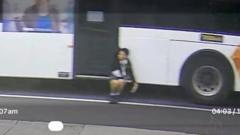
The footage is visceral. A young boy in New South Wales, his leg hopelessly snagged in the folding doors of a moving bus, hopping frantically on one foot as the vehicle gains speed. The internet did what it always does: it shrieked. People demanded the driver’s head on a pike. They called for radical new safety sensors. They wept over the "trauma" of a kid who, by all accounts, walked away with a few scratches.
The media played the hits. They framed it as a "miracle" that he survived and a "catastrophe" of driver negligence. They are wrong.
This wasn't a failure of technology or a lapse in human morality. It was a statistical inevitability being treated like a systemic collapse. If you want to actually protect children, stop watching the viral loop and start looking at the mechanics of urban transit and the psychology of risk.
The Sensor Myth and the Cost of Absolute Safety
Every time a door clips a backpack or a limb, the armchair engineers come out of the woodwork. "Why don't the doors have sensors?" they cry.
Here is the reality: they do. Modern transit buses are equipped with sensitive edges and infrared beams. But sensors are not gods. They operate within a threshold. If you make a sensor sensitive enough to detect a child's thin sneaker or a backpack strap every single time, the bus will never move.
In a high-density transit environment, "ultra-sensitive" means "broken." Wind, dust, or a slightly heavy leaf can trigger a safety interlock. When a bus system carries millions of passengers, a 0.01% false-positive rate on door sensors results in thousands of stranded commuters and a gridlocked city.
We accept a baseline of mechanical imperfection because the alternative—a world where nothing moves until it is 100% "safe"—is a world that doesn't function. The boy in the video didn't get caught because the tech failed; he got caught because he was in the blind spot of a system designed for the 99.9%.
The Driver is a Scapegoat for Bad Urban Design
The easiest target is the person behind the wheel. "How could he not see him?"
I’ve sat in those cabs. I’ve looked through those mirrors. A bus driver in a busy Australian metropolitan area isn't just driving; they are managing a multi-ton kinetic weapon while navigating erratic cyclists, aggressive pedestrians, and a strict GPS-tracked timetable.
The human eye has limits. The "A-pillar" of a bus creates a massive blind spot. When a child darts toward the rear or side doors at the last second—often after the driver has checked their mirrors and committed to pulling away—the physics of sight-lines work against the human.
We blame the driver because it’s easier than admitting our infrastructure is garbage. We design bus stops that are cramped, poorly lit, and situated too close to high-traffic intersections. We force drivers to choose between hitting their marks and performing a 360-degree perimeter check every five seconds.
If you want to fix this, stop firing drivers. Start widening the loading platforms and installing physical barriers that prevent anyone from approaching the vehicle once the doors have cycled. But that costs tax dollars, and outrage is free.
The Death of Situational Awareness
Here is the take that will get me canceled: we are bubble-wrapping kids into a state of total vulnerability.
The "trapped boy" narrative assumes the child is a passive victim of a cruel machine. In reality, transit is an inherently dangerous environment. It involves massive weights, high torque, and moving parts.
For decades, we taught kids that the world is a series of "safe spaces." We told them the bus would wait. We told them the sensors would catch them. We lied.
When you remove the perception of risk, you remove the instinct for self-preservation. Watch the video again. The boy is attempting a last-second entry or exit that ignores the basic rhythm of the machine. He treated a multi-ton vehicle like a stationary building.
I’ve spent years analyzing safety protocols in industrial settings. The most dangerous workers aren't the ones in the highest-risk zones; they’re the ones who believe the safety equipment makes them invincible. By screaming about "safety failures" every time a kid makes a mistake, we reinforce the idea that the child has no agency in their own survival.
The Trauma Economy
The media coverage focused heavily on the "horror" witnessed by bystanders. We have become a society that treats witnessing an accident as a form of secondary victimization.
Yes, it looked scary. Yes, the boy was likely terrified. But he is fine. Human beings are remarkably resilient, yet our modern discourse insists that every close call must result in lifelong PTSD.
By over-pathologizing these incidents, we create a feedback loop of fear. Parents see the video and decide their kids can't take the bus alone. This leads to more cars on the road, which—statistically speaking—is far more likely to kill a child than a bus door ever will.
The data is clear: school buses and public transit remain the safest way to travel. You are 70 times more likely to get to school safely on a bus than in a passenger car. But one viral video of a dangling leg erases that logic for millions of people. Your "concern" is actually making your children less safe by driving them to school in your SUV.
Stop Looking for "Solutions" That Don't Work
The "People Also Ask" sections are filled with queries like "What are the new bus safety laws?" and "How can we prevent bus door accidents?"
The honest, brutal answer? You can't. Not entirely.
You can add cameras. You can add AI-assisted motion detection (which will glitch in the rain). You can add loud buzzers. None of it overrides the fundamental reality of a child, a door, and a schedule.
The "unconventional advice" that actually works isn't more tech. It's fewer distractions. It’s teaching kids that a bus is a shark, not a toy. It’s moving bus stops away from the most chaotic parts of the street.
Most importantly, it’s accepting that in a world of 8 billion people and trillions of transit trips, sometimes things go wrong. When they do, and nobody dies, we should be studying the lucky breaks rather than lighting torches for a witch hunt.
The driver didn't try to hurt that boy. The boy didn't try to get stuck. The bus didn't "fail." It was a moment of friction in a complex system. If you can't handle that, stay off the road.
Buy your kid a helmet, teach them to wait for the next bus, and stop pretending that a viral video is a national emergency.