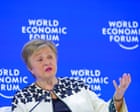
The global economy is currently walking a tightrope over a pit of fire, and the International Monetary Fund (IMF) knows the safety net is gone. While diplomatic circles focus on the immediate mechanics of a ceasefire, IMF Managing Director Kristalina Georgieva is sounding an alarm that most policymakers are too terrified to articulate. A full-scale conflict involving Iran would not just be a temporary spike in energy prices. It would be a structural wrecking ball. We are looking at a scenario where even if the guns fall silent tomorrow, the damage to trade routes, investor confidence, and the cost of debt remains etched into the global ledger for a generation.
The market has a short memory, but the balance sheet does not. Current projections suggest that a sustained conflict in the region could shave percentage points off global GDP that we simply cannot afford to lose. This isn't about a three-week oil shock. This is about the permanent rewiring of how the world moves goods and prices risk.
The Myth of the Quick Recovery
The prevailing wisdom in many Western capitals is that war is a temporary disruption—a "blip" on the chart that eventually reverts to the mean. History suggests otherwise. When a region as central as the Middle East descends into chaos, the "peace dividend" doesn't return just because a treaty is signed.
The primary mechanism of this destruction is the fragmentation of trade. For decades, the global economy relied on the assumption of safe passage through the Strait of Hormuz and the Red Sea. A war involving Iran turns these vital arteries into high-risk zones indefinitely. Insurance premiums for shipping don't just "go back to normal" after a conflict; they reset at a higher floor. This permanent increase in the cost of logistics acts as a hidden tax on every single consumer product on earth.
Furthermore, the physical destruction of infrastructure—refineries, ports, and desalination plants—takes years, if not decades, to rebuild. The capital required for this reconstruction is capital that isn't being spent on innovation or green transitions elsewhere. The world effectively spends its future to fix a broken past.
The Debt Trap Tightens
The fiscal reality for most nations is already precarious. We are emerging from a period of historic inflation and massive pandemic-era spending. Central banks are exhausted. If a Middle East war forces a massive spike in energy costs, it triggers a "stagflationary" shock—prices go up while growth stalls.
For developing nations, this is a death sentence. Many of these countries are already spending a massive portion of their revenue just to service interest on their debt. When energy prices rise, their import bills skyrocket, forcing them to borrow more at higher rates. The IMF is watching a potential wave of sovereign defaults that would make the 2008 financial crisis look like a minor accounting error.
We often talk about "contagion" in the banking sector, but we are now facing a contagion of instability. If Iran is drawn into a total war, the surrounding economies—Jordan, Egypt, Lebanon—will face a refugee and fiscal crisis that spills over into Europe and beyond. These are not isolated incidents. They are interconnected dominoes.
Oil is the Distraction Data is the Reality
While headlines focus on the price per barrel of Brent crude, the deeper threat lies in the shattering of investor certainty. Capital is a coward. It flees at the first sign of structural instability. For the last twenty years, the Middle East has been a destination for massive foreign direct investment in technology, tourism, and infrastructure.
A war involving a regional power like Iran signals to the global market that the "rules-based order" is no longer functional in the world's most sensitive energy hub. Once that trust is broken, it doesn't come back with a handshake. Investors will demand a "conflict premium" for years to come, making it more expensive to build anything in the region. This lack of investment leads to stagnation, which leads to further social unrest, creating a feedback loop of decline.
The Hidden Cost of Defense Spending
There is another, more insidious scar: the diversion of national budgets toward the military. In times of war, "butter" is always sacrificed for "guns."
- Social Safety Nets: Programs that support the elderly and the poor are the first to be gutted when defense budgets must be doubled.
- Infrastructure: Maintenance of roads, bridges, and power grids is deferred, leading to a long-term decay in national productivity.
- Education and R&D: The "seed corn" of the future economy is eaten to pay for immediate security needs.
This shift in spending isn't easily reversed. Once a military-industrial complex expands to meet a wartime threat, it develops a political gravity that makes it nearly impossible to shrink. The global economy becomes more militarized and less efficient.
The Geopolitical Realignment
We must also look at the shadow cast by the East. A war that destabilizes Western interests in the Middle East provides a vacuum that other powers are eager to fill. We are seeing the birth of a bipolar economic system.
If the West is bogged down in managing or funding a Middle East conflict, it loses its ability to dictate the terms of global trade. We could see a permanent shift where a significant portion of the world's energy trade moves away from the dollar. This "de-dollarization" isn't a conspiracy theory; it is a pragmatic response by nations looking to insulate themselves from Western sanctions and the volatility of a U.S.-led financial system. If the petrodollar dies, the American standard of living changes forever. That is a scar that no amount of diplomacy can heal.
The Human Capital Flight
Perhaps the most permanent damage is the loss of talent. War doesn't just destroy buildings; it drives away the people who build them. The Middle East has a young, increasingly tech-savvy population. In a state of war, the "brain drain" becomes a flood.
When the engineers, doctors, and entrepreneurs of Tehran, Riyadh, or Amman move to London, New York, or Singapore, they rarely return in the same numbers. The "peace" that follows a war often finds a region stripped of its most capable citizens. Without that human capital, economic recovery is a hollow promise. You can rebuild a factory with a loan, but you cannot buy back a generation of lost expertise.
The Fragility of Global Supply Chains
We learned during the pandemic that our supply chains are "just in time," not "just in case." They are built for efficiency, not resilience. A war in the heart of the world's energy supply is a stress test that the system will fail.
It is not just about the oil. It is about the petrochemicals used in plastics, the fertilizers used in global agriculture, and the massive amounts of energy required to manufacture semiconductors. If the Middle East goes dark, the assembly lines in Taiwan, Germany, and the United States begin to jitter. The inflationary pressure this creates is not a "spike"—it is a new plateau.
A Permanent State of Crisis Management
The IMF's warning is essentially a confession that the tools we used to manage the world economy in the 20th century are no longer sufficient. We are entering an era of "permacity"—permanent crisis.
In this environment, the traditional metrics of success, like quarterly GDP growth, become meaningless. The real metric is resilience, and currently, the global economy has almost none. We have high debt, low social cohesion, and a crumbling international consensus. A war with Iran is not the start of a new problem; it is the final weight that breaks the camel's back.
Governments must stop pretending that "getting back to normal" is an option. The old normal was built on a foundation of cheap energy and safe seas. Both of those are now historical artifacts. The path forward requires a brutal assessment of how to survive in a world where the Middle East is no longer a reliable partner, but a volatile variable.
Business leaders need to stop waiting for the "all clear" signal. It isn't coming. The strategy must shift from expansion to insulation. Secure your supply lines. Diversify your energy needs. Expect higher taxes and higher interest rates as the permanent state of affairs.
The scar is already forming. The only question left is how deep it will go before the bleeding stops.
Identify the assets in your portfolio that are most exposed to shipping lanes and regional stability. Move them now. Waiting for the first missile to fly is not an investment strategy; it is a suicide pact.