Elon Musk just walked away from his own $150 billion legal war to board Air Force One.
By flying to Beijing with President Donald Trump this week, the Tesla and SpaceX chief explicitly defied a clear warning from a California federal judge that he remained subject to an immediate courtroom recall. Musk left the country without seeking formal permission from the United States District Court for the Northern District of California, where his high-stakes lawsuit against OpenAI and CEO Sam Altman is reaching its climax.
While legal commentators scan the horizon for a potential contempt-of-court citation, focusing strictly on the procedural snub misses the massive geopolitical chess game currently playing out. Musk did not gamble his standing in a federal court out of scheduling carelessness. He did it because the future of his industrial empire is on the line in China, and a seat at Trump’s table with Chinese Premier Li Qiang is worth more to him than the immediate goodwill of a single American judge.
The Courtroom Recall Weapon
The procedural friction stems directly from the final, volatile days of evidence in Oakland, California. Musk had already taken the stand last month to argue his core claim: that Altman, Greg Brockman, and Microsoft systematically dismantled OpenAI’s original nonprofit mandate to build a closed-source profit machine.
Before Musk stepped down from that initial testimony, the presiding judge explicitly asked the legal teams if the billionaire should remain on standby. When OpenAI’s defense attorneys answered in the affirmative, the judge delivered a direct order to Musk. He was told he was not excused from the case and was formally held in recall status.
Despite that warning, Musk packed his bags. Legal experts note that while civil trial witnesses are rarely barred from traveling internationally by physical force, leaving the jurisdiction while under an active recall order without notifying the bench is an extraordinary gamble. If OpenAI’s lawyers had triggered that recall on Wednesday—the final scheduled day for evidence—Musk’s physical absence in California could have opened the door to severe evidentiary sanctions or a formal finding of bad faith.
He was not recalled by midday Wednesday, and the trial is moving toward closing arguments. But the stunt exposes a deeper truth about how Musk views the American legal system when contrasted against global market realities.
Why Beijing Mattered More Than Oakland
The motivation for the trip sits squarely within the shifting economic priorities of the second Trump administration. Trump arrived in Beijing alongside a delegation of heavy-hitting American chief executives, including Apple's Tim Cook and Nvidia's Jensen Huang, to negotiate market access, investment structures, and the guardrails governing international artificial intelligence.
For Musk, the stakes in these bilateral discussions are existential.
- The Tesla Supply Chain: Tesla’s Gigafactory Shanghai remains the operational heartbeat of the automaker's global export strategy. Any shift in Chinese tariff structures or regulatory penalties hurts Tesla's bottom line immediately.
- The AI Competition: While Musk fights Altman in a California courtroom over the soul of OpenAI, his own artificial intelligence venture, xAI, is desperate for hardware, computational runway, and global market positioning.
- The Political Pivot: Musk’s relationship with Trump has been notoriously turbulent, highlighted by a bitter public feud last summer. After leaving his role at the short-lived Department of Government Efficiency, Musk needed a concrete display of alignment to cement his status as Trump’s premier technology advisor.
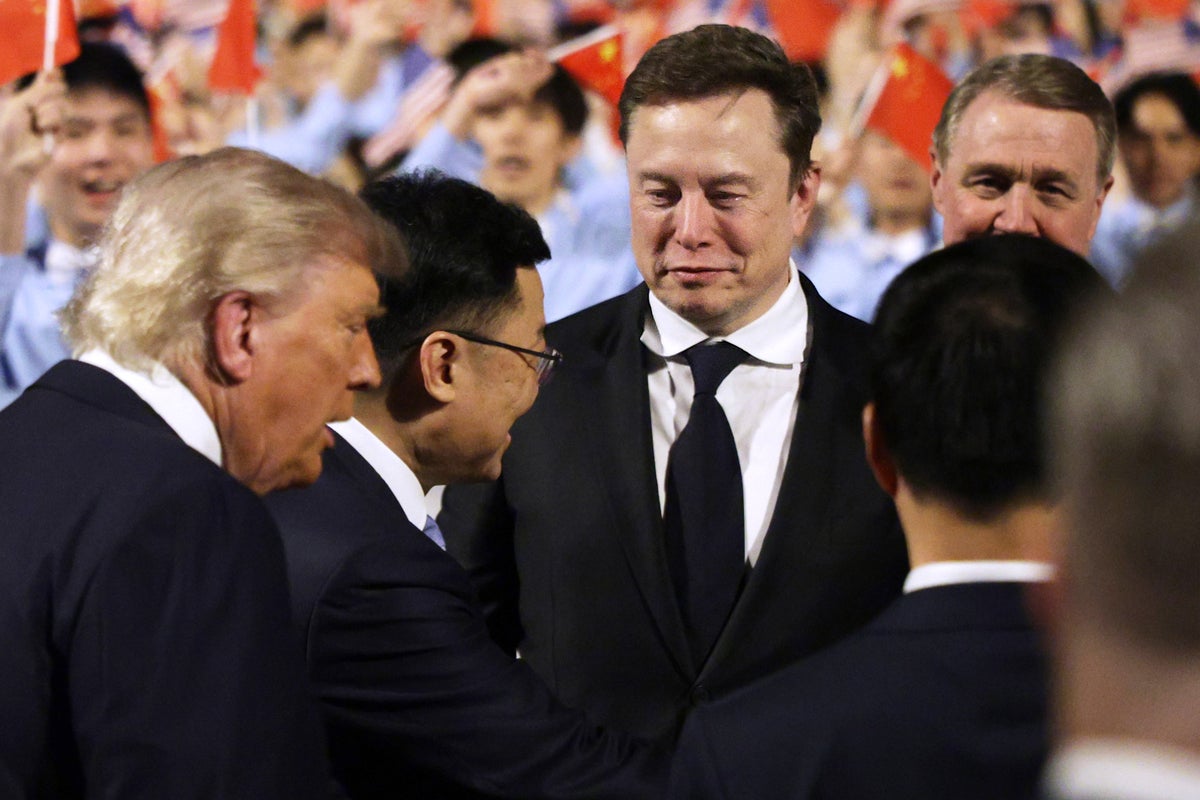
Walking the halls of Beijing with Premier Li Qiang alongside Trump sends a deliberate signal. It tells the Chinese government that despite Musk's domestic legal distractions and past political spats, he remains an indispensable bridge between Washington policy and Beijing manufacturing.
The Hypocrisy of the Billionaire Feud
The trial itself has devolved from a philosophical debate over safe, open-source artificial general intelligence into a grueling, deeply personal mudslinging match. OpenAI’s defense has used the proceedings to paint Musk as a hypocrite driven by personal jealousy rather than humanitarian concern.
Internal emails and private text messages presented to the jury revealed that before Musk walked away from OpenAI in 2018, he actively advocated for a for-profit pivot. The documentation suggests Musk wanted absolute control over that commercial entity himself. When the remaining founders rejected his leadership, he left, later launching xAI as a direct commercial competitor.
The defense also took aim at Musk’s ongoing credibility. They introduced evidence showing that Musk routinely received insider updates about OpenAI long after his formal departure via board member Shivon Zilis, the mother of four of his children.
Musk’s legal team has countered by focusing heavily on the sheer scale of the financial transition. They argue that a charity initially funded by public-spirited donations has effectively been handed over to Microsoft, creating an unjust enrichment scheme valued in the hundreds of billions. Musk is asking the court to force Altman and Brockman to disgorge up to $150 billion back to the original nonprofit entity.
The Reality of a High-Stakes Absence
By choosing a diplomatic flight over a courtroom standby obligation, Musk demonstrated his ultimate hierarchy of needs. A $150 billion lawsuit is a massive financial variable, but the long-term viability of Tesla’s manufacturing dominance and xAI’s geopolitical footprint represents a multi-trillion-dollar calculation.
The defense tried to use his departure to score a final rhetorical point, framing it as part of a consistent pattern of erratic behavior and disrespect for established institutions. His lawyers had to sweat out the clock on Wednesday, hoping the defense wouldn't call their bluff and demand Musk return to the stand within hours.
The gamble paid off logistically; the evidence window closed without an emergency summons. But as closing arguments begin, the image of Musk walking through Beijing while technically tethered to an active California witness order remains a perfect encapsulation of his operational playbook. Rules, schedules, and judicial warnings are variables to be weighed against market leverage. If the leverage is big enough, the courtroom can wait.