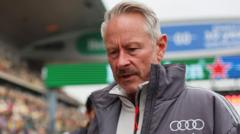
Two races. That is all it took for the carefully constructed facade of the Audi Formula 1 project to suffer its most public fracture yet. Jonathan Wheatley, the man handpicked to lead the German giant’s trackside operations, has walked away with immediate effect.
The official line is "personal reasons," a phrase that, in the high-stakes world of grand prix racing, usually serves as a polite shroud for a deeper systemic failure or a more lucrative opportunity. In this case, it is likely both. Wheatley’s departure is not just a HR headache for Audi; it is a klaxon sounding across the paddock about the stability of the Hinwil-based operation and the predatory ambitions of a struggling Aston Martin.
The Hinwil Power Vacuum
To understand why a veteran of Wheatley’s caliber—a man who spent nearly two decades as the sporting backbone of Red Bull’s championship era—would quit a "dream" team principal job after 480 minutes of racing, you have to look at the shadow cast by Mattia Binotto.
When Audi cleared out Andreas Seidl and Oliver Hoffmann in 2024, they replaced a fractured dual-leadership with a heavy-hitting soloist in Binotto. Wheatley joined later, ostensibly to handle the "racing" while Binotto handled the "factory." It was a neat diagram on a whiteboard that ignored the reality of Formula 1 egos. Binotto is a man who ran the entire Ferrari Gestione Sportiva; he is not a natural sharer of power. By assuming Wheatley’s duties immediately, Binotto has essentially confirmed that the "dual leadership" experiment is over. Audi is now a monocracy.
For Wheatley, the appeal of Hinwil was the chance to build a culture from scratch. Instead, he found an organization in a permanent state of "transformation"—a polite word for a revolving door. Since 2023, Audi has burned through three distinct leadership structures. This is not how you build a championship-winning team. This is how you build a bureaucracy that fears its own shadow.
The Silverstone Seduction
While Audi fumbled the internal politics, Lawrence Stroll was doing what he does best: writing checks and identifying weaknesses. Aston Martin is currently in a state of technical and operational crisis. Their 2026 car, the AMR26, has been described by drivers Fernando Alonso and Lance Stroll as "undriveable," with vibrations so severe they risk permanent nerve damage.
Adrian Newey, who was installed as team principal late last year in a move that baffled many, is a genius with a drawing board but a reluctant politician. He has been noticeably absent from the pit wall, preferring the isolation of the design office to the glare of the media pen. The team is point-less, the Honda partnership is off to a disastrous start, and the "Managing Technical Partner" title Newey holds is being diluted by the administrative burden of running a 1,000-person company.
Wheatley is the "fixer" Newey needs. Their relationship at Red Bull was the secret sauce of the Vettel and Verstappen eras. Newey built the rockets; Wheatley made sure they never missed a countdown. By poaching Wheatley, Stroll isn't just buying a team principal; he is buying the comfort zone of his star designer.
The Geography of Discontent
There is a less glamorous factor at play that the "hardcore" analysts often overlook: the Swiss tax haven trap. Hinwil is a beautiful place to live, but it is an island. For a British-based F1 lifer like Wheatley, the reality of relocating a life and a family to the outskirts of Zurich is a heavy tax on the soul.
Formula 1’s "Silicon Valley" is the UK’s Motorsport Valley. When Aston Martin came calling, they didn't just offer a massive salary and a reunion with Newey; they offered a commute to Silverstone. In an industry where 24-race calendars are pushing personnel to the breaking point, the "personal reasons" cited in Audi’s press release likely include the simple desire to sleep in his own bed.
The Brutal Truth for Audi
Audi’s 2030 championship target now looks like a fantasy. You cannot win in this sport without institutional memory. By losing Wheatley, they have lost the only person in their senior hierarchy who knows exactly what a modern, winning operation looks like from the front lines.
Binotto knows how to build an engine and he knows the political corridors of Maranello, but he has never been the guy who handles the frantic, split-second sporting decisions that win races. He is now overstretched, serving as both the architect and the foreman of a project that is still missing its foundation.
The departure of Wheatley is a signal to every other top-tier engineer in the paddock: the Audi project is volatile. If a man of Wheatley’s stature can't make it work for a full season, why would a mid-level aero lead take the risk?
A Project in Freefall
The optics are devastating. On the same day Audi loses its team principal, Lawrence Stroll issued a defiant, 28-word statement reaffirming Newey’s role. It was a classic diversion. Stroll knows that by bringing Wheatley back to the UK, he has potentially saved the Newey era before it completely imploded under the weight of a failing car and a struggling engine.
Wheatley’s move—pending what will surely be a draconian gardening leave period—marks the end of the honeymoon for the 2026 regulations. The battle lines are no longer about who has the best wind tunnel, but who can keep their leadership from jumping ship.
Would you like me to analyze the potential gardening leave clauses in Wheatley’s contract to see when he can actually start at Silverstone?