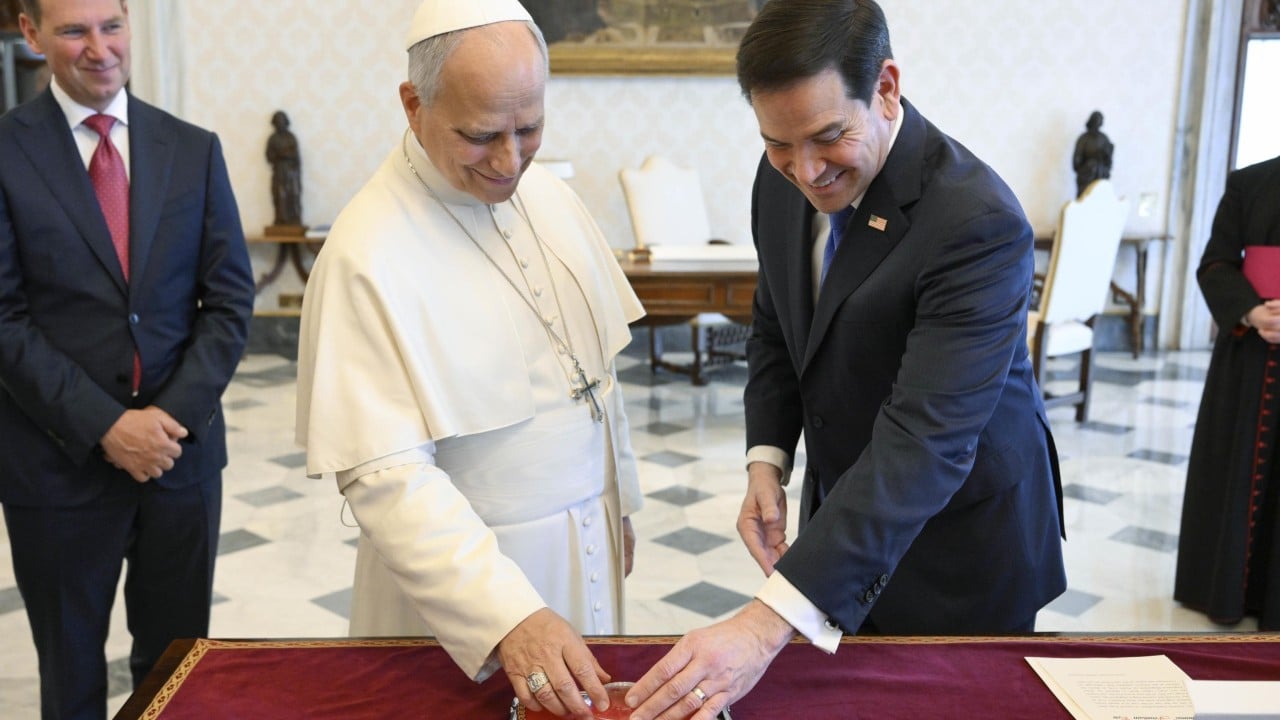
In the quiet, marble halls of the Apostolic Palace, the friction between a populist president and the first American pontiff finally reached a tipping point. On Thursday, U.S. Secretary of State Marco Rubio stepped into the papal library for a high-stakes, two-hour intervention with Pope Leo XIV, aiming to salvage a relationship that has devolved into public mudslinging. The meeting was not just a diplomatic courtesy; it was a desperate attempt to neutralize a political liability that threatens the administration’s standing with Catholic voters as the midterm elections loom.
While official statements from both the State Department and the Holy See spoke of "cordial discussions" regarding peace in the Middle East and humanitarian aid in Cuba, the subtext was far more aggressive. Rubio, a practicing Catholic who has built his career on a carefully curated image of faith and family values, was essentially acting as a semantic firefighter. His mission was to translate President Trump’s volatile rhetoric—specifically recent social media posts accusing the Pope of being "weak on crime" and "pro-Iran"—into the polished language of international statecraft.
The Chicago Factor and the Clash of Identities
The conflict is deeply personal because for the first time in history, the man sitting in the Chair of St. Peter is an American. Pope Leo XIV, born Robert Prevost in Chicago, understands the American political machine as well as any senator. Unlike his predecessors, he cannot be dismissed by the White House as a distant European academic or a South American radical. He is a South Side kid who spent decades as a missionary in Peru before rising through the Augustinian order.
This shared heritage makes the current rift particularly dangerous for the Trump administration. When Trump lashed out at Leo for his criticisms of the Iran war, the Pope didn’t just offer a vague theological rebuttal. He leaned into the authority of his office to remind the world that the Church has opposed nuclear weapons for decades, effectively calling the President’s bluff on the world stage.
Why the Iran War Broke the Silence
The primary catalyst for this diplomatic freeze is the administration’s escalating military posture toward Iran. The Vatican, under Leo’s leadership, has moved from quiet concern to vocal condemnation of what it views as an unjust war.
- The Nuclear Accusation: Trump’s recent claims that the Pope is "OK" with Iran obtaining nuclear weapons were met with a rare, direct denial from the Vatican.
- The Humanitarian Cost: Leo has used his Sunday Angelus addresses to highlight the civilian toll of U.S.-led operations, a move that has infuriated the Pentagon.
- The Religious Freedom Angle: Rubio attempted to pivot the conversation toward religious freedom in the Middle East, a traditional area of consensus. However, Leo remained focused on the immediate cessation of hostilities.
The Latin American Pivot
Beyond the immediate fire-fighting, Rubio’s visit had a second, more calculated objective: Cuba. As the U.S. signals a harder line against the remnants of the Maduro-allied factions in the Caribbean, the Holy See remains the only entity with the boots on the ground—in the form of parish priests and aid workers—to prevent a total humanitarian collapse.
Rubio knows that if the U.S. moves toward military action in Cuba, the moral opposition of an American Pope would be a PR catastrophe. By engaging Cardinal Pietro Parolin, the Vatican’s veteran Secretary of State and a former nuncio to Venezuela, Rubio was testing the waters for a "middle way" where the Church facilitates aid while the U.S. maintains its sanctions regime.
The 2028 Shadow Play
The optics of Rubio handing the Pope a crystal football paperweight while joking about Leo’s allegiance to the Chicago White Sox were charming, but the political reality is cold. Rubio isn't just serving the current president; he is protecting his own future.
Reliable polling shows a significant dip in Catholic support for the Republican party, a demographic that was instrumental in the 2024 victory. By positioning himself as the bridge between the White House and the Vatican, Rubio is signaling to the donor class and the electorate that he is the "adult in the room"—the one man capable of keeping the administration’s foreign policy from alienating the world’s 1.3 billion Catholics.
The meeting ended without a joint press conference or a definitive policy shift. Instead, there was a symbolic exchange of gifts: a pen made of olive wood for the Secretary, and a crystal seal for the Pontiff. In the world of the Holy See, these small gestures are the only currency that matters when the rhetoric outside becomes too loud to hear.
The administration has bought itself some time, but as long as the bombs are falling and the social media posts continue, no amount of "semantic correctives" from Marco Rubio will bridge the gap between the Oval Office and the Apostolic Palace.
The Strategic Failure of Confrontation
The core mistake the administration continues to make is treating the Pope as a political rival rather than a sovereign power. In the eyes of the Vatican, presidents are temporary, but the Church is eternal. Leo XIV is playing the long game, using his American identity to speak directly to the U.S. public over the heads of the political class.
If the White House continues to frame the Pope’s calls for peace as "pro-terrorist," they risk more than just a bad news cycle. They risk a fundamental schism with their own base that no crystal football can fix.
The olive wood pen Rubio carried out of the Vatican is a reminder that in diplomacy, the one who stops writing usually loses the narrative. For now, the dialogue continues, but the ink is running thin.


