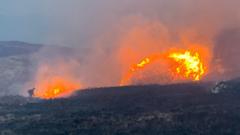
The ground across huge swaths of Scotland is currently a tinderbox. It doesn't matter if it rained last week or if the air feels chilly. The Scottish Fire and Rescue Service (SFRS) just hiked the wildfire warning level to Extreme for West, North, and High Highlands. This isn't a suggestion. It's a high-stakes alert that means even a tiny spark could trigger a fast-moving disaster that destroys habitats and puts lives at risk.
Most people think wildfires are a summer problem. They’re wrong. In Scotland, the early spring and autumn windows are often the most dangerous. Dead vegetation from last year dries out quickly under the wind. It becomes fuel. If you're planning to light a campfire or use a disposable BBQ in these areas right now, don't. You’re playing with fire in the most literal and dangerous sense possible.
Why the Highlands are at high risk right now
Weather patterns in Scotland are deceptive. You see a bit of sun and feel a crisp breeze, and you think it’s a great day for a hike. But that breeze is exactly what worries the SFRS. Wind dries out the "dead fuel"—the heather, gorse, and grass left over from winter—until it’s ready to ignite with the slightest provocation.
When the warning hits the Extreme level, the fire behavior changes. It moves faster than a person can run. It jumps across roads and tracks. It creates its own weather. Firefighters in the Highlands often have to deal with incredibly difficult terrain where getting heavy equipment to the front line is nearly impossible. They rely on hand tools, "beaters," and sheer physical grit to stop flames that can reach several meters high.
The science of the fuel load
The technical term is "fine fuels." These are small materials like dried grass and pine needles. They lose moisture rapidly. Unlike a thick log that takes hours to dry, these materials react to the atmosphere in minutes. If the humidity drops and the wind picks up, the risk spikes instantly. Scotland’s landscapes are covered in these materials, especially in the North and West where the peat soil itself can actually catch fire and burn underground for weeks. That's a nightmare scenario because you can't see it until it resurfaces somewhere else.
What an extreme warning actually means for you
When the SFRS issues an Extreme alert, it’s a direct message to every hillwalker, camper, and landowner. It means the "Energy Release Component" of the landscape is at its peak. Basically, if something starts, the intensity will be off the charts.
You might think you’re being careful with a cigarette butt or a small stove. You aren't. In these conditions, there is no such thing as a "safe" open flame. A single ember carried by the wind can travel hundreds of meters and start a secondary fire behind the main line. This makes the situation unpredictable and deadly for anyone nearby.
- No campfires. This should be obvious, but it isn't. The heat from a fire can soak into the ground and ignite the peat underneath.
- Disposable BBQs are banned. These are the biggest culprits. They get incredibly hot and stay hot for hours. Never use them on grass or wooden benches, especially during a warning.
- Cigarettes. If you smoke, you have to be obsessive about how you extinguish it. Carry a portable ashtray. Don't flick it.
- Parking. Even a hot car exhaust pipe touching tall, dry grass can start a fire. Stick to designated parking areas.
The devastating cost of Scottish wildfires
We aren't just talking about a bit of burnt grass. Wildfires in Scotland destroy ancient woodlands and kill livestock. They wipe out nesting sites for rare birds like the Curlew or the Golden Eagle. When the peat burns, it releases massive amounts of stored carbon back into the atmosphere, which is a massive setback for climate goals.
Take the Cannich wildfire from a couple of years ago. It was one of the largest ever recorded in the UK. The smoke was visible from space. It took weeks to fully extinguish and cost millions in resources. That fire started because of human activity. It was preventable. Most of them are.
How firefighters tackle the flames
It's a brutal job. SFRS crews often have to trek miles into the wilderness carrying heavy packs. They use helicopters to drop water, but that's expensive and not always effective if the wind is too high. Much of the work is done on the ground with beaters—basically long poles with heavy rubber flaps—to smother the flames. It’s exhausting, dangerous work that pulls resources away from other emergencies like house fires or car accidents. When you're careless with a match, you're putting a firefighter's life on the line.
Understanding the SFRS warning system
The warning system isn't just a random guess. It's based on the Canadian Fire Weather Index, which tracks temperature, relative humidity, wind speed, and rainfall. It calculates how easily a fire will start and how fast it will spread.
- Yellow (High): Be very cautious. Fires could start easily.
- Amber (Very High): High risk. Avoid all outdoor burning.
- Red (Extreme): The current status. Any fire will be exceptionally difficult to control.
If you see smoke in the countryside during an Extreme warning, don't wait. Don't assume someone else has called it in. Get to a safe distance and dial 999 immediately. Give the operator as much detail as possible about your location, using an app like What3Words if you’re in a remote area.
Don't be the person who starts a disaster
The "Right to Roam" in Scotland is a privilege, not a law that lets you do whatever you want. It comes with a responsibility to care for the land. During an Extreme wildfire warning, that responsibility means staying hyper-vigilant.
If you see someone lighting a fire or being reckless, say something. It's not being a "nark"; it's protecting the community and the environment. Most people aren't malicious; they’re just uninformed. They don't realize that the ground under their feet is ready to blow.
Stop thinking it can't happen here. It is happening. The weather is changing, our springs are getting drier, and our landscapes are more vulnerable than ever. Check the SFRS website before you head out. Look at the maps. If your destination is in a red zone, change your plans or at the very least, leave the stove in the car. Pack a sandwich instead of a BBQ. It's a small price to pay to keep the Highlands from going up in smoke. Keep your eyes on the horizon and stay off the dry heather.