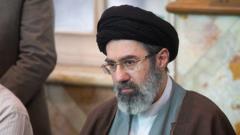
The air in the high-walled compounds of North Tehran is thin, chilled by the Alborz mountains and heavy with the scent of jasmine and woodsmoke. Behind those gates, the world doesn't move at the pace of the street. It moves at the pace of whispers. For decades, one name has occupied those whispers more than any other, a name that carries the weight of a dynasty while remaining as ethereal as a ghost.
Mojtaba Khamenei.
He is the second son. In many cultures, the second son is the spare, the one who wanders. But in the intricate, high-stakes theater of the Islamic Republic, Mojtaba has spent thirty years perfecting the art of being seen without being heard. To understand the man who now stands at the precipice of the Supreme Leadership is to understand the machinery of silence.
Consider a typical afternoon in the capital. A student at Sharif University drinks tea and worries about inflation. A merchant in the Grand Bazaar calculates the cost of imported electronics. Neither of them sees Mojtaba. They do not hear him give speeches on state television. He holds no official government cabinet position. He has no seat in the Parliament. Yet, he is the silent architect of their reality.
The story begins in the heat of the Iran-Iraq War. While other sons of the elite might have sought refuge in academia or diplomacy, Mojtaba was in the trenches. He served in the Habib Battalion. This wasn't just a military stint; it was a forge. It was here that he cemented his bond with the men who would eventually become the iron fist of the regime—the commanders of the Islamic Revolutionary Guard Corps (IRGC).
He learned early on that true power isn't found at a podium. It is found in the logistics of loyalty.
The Office and the Iron Veil
To look at the structure of Iran's government is to look at a labyrinth. On paper, there are presidents and ministers. In reality, there is The Office. The "Beit-e Rahbari" is the administrative heart of the Supreme Leader’s world, and it is here that Mojtaba transitioned from a soldier to a gatekeeper.
Imagine a door. Every piece of intelligence, every economic report, and every request for a judicial pardon must pass through this door before it reaches the eyes of the Supreme Leader, Ali Khamenei. For years, Mojtaba has stood at that door. He isn't just a son; he is the filter. He decides what is urgent and what is irrelevant.
This role turned him into a shadow sovereign long before the current transition talk began. If a general wanted a promotion, they looked to Mojtaba. If a business conglomerate needed a favorable ruling, they sensed his influence. He became the bridge between the aging clerical establishment and the young, aggressive military commanders who crave stability above all else.
The stakes are not merely political. They are existential.
Iran is a country of contradictions—a youthful, tech-savvy population governed by a geriatric theocracy. The tension between these two worlds is a live wire, sparking constantly. In 2009, when the Green Movement brought millions to the streets to protest election results, the whispers became shouts. Protesters didn't just chant against the President; they chanted against Mojtaba. They sensed his hand in the crackdown, the strategic deployment of the Basij militia, and the digital blackout that followed.
He was no longer just a son. He was the enforcer.
The Clerical Ascent
There is a hurdle, however, that bloodline cannot easily leap. To be the Supreme Leader, one must possess more than just a mastery of the secret police; one must have religious legitimacy. This is where the narrative of Mojtaba’s rise takes a turn into the dusty libraries of Qom.
For years, critics dismissed him as a political operative with no theological standing. They called him a "Hojjat al-Islam," a mid-level rank that is respectable but insufficient for the top job. But power has a way of accelerating education.
Suddenly, the curriculum changed.
Mojtaba began leading high-level "Kharij" jurisprudence classes. These are not basic lessons; they are the advanced seminars intended for those on the path to becoming an Ayatollah. It was a clear signal to the religious establishment: the shadow is becoming a shape. He was claiming the scholarship necessary to lead the faithful, even as he maintained the connections necessary to lead the soldiers.
But can a revolution that overthrew a monarchy justify a hereditary succession?
This is the central tension of the Iranian soul. The 1979 Revolution was built on the rejection of the "Shah," the king who passed power to his son. For the current leadership to hand the mantle to Mojtaba feels, to many, like a betrayal of the very foundation of the Republic. It is a bitter irony that the system designed to end kingship might end up creating a new kind of clerical royalty.
The Invisible Hand and the Oil
Money is the blood that keeps the shadow moving. Under the radar, the economic wings of the IRGC and the vast religious foundations (Bonyads) have grown into an empire that rivals the state itself. Mojtaba’s influence over these entities is widely whispered but rarely documented.
Think of it as a corporate takeover of a country.
By controlling the "Setad"—an execution of Imam Khomeini’s order that manages billions in assets—the inner circle ensures that no matter who the President is, the purse strings remain in the same hands. This financial independence means the leadership can weather sanctions, protests, and international isolation. They have built an island within the country, and Mojtaba is the governor of that island.
The human cost of this isolation is felt in the pharmacies of Isfahan where medicine is scarce, and in the kitchens of Mashhad where meat has become a luxury. While the elite navigate the intricacies of succession, the average citizen navigates the intricacies of survival. This gap is the greatest threat to Mojtaba’s future. He has mastered the art of controlling the elite, but he has yet to prove he can speak to the street.
He is a man of the shadows, and the sun is beginning to rise.
The Weight of the Turban
The transition is never just about one man. It is about a coalition of fear.
The IRGC supports Mojtaba because they know him. He is a known quantity. He is a guarantee that their assets will not be seized, that their commanders will not be tried for human rights abuses, and that the status quo will hold. To them, he is not a person; he is a shield.
But what happens when the shield is tested?
The Middle East is a theater of shifting sands. From the proxy wars in Yemen and Syria to the cold war with Israel, the Supreme Leader must be a strategist of the highest order. Ali Khamenei has ruled for over three decades with a mixture of ideological rigidity and tactical pragmatism. Mojtaba has watched this up close. He has seen how his father balances the "hawks" and the "ultra-hawks."
Yet, watching a pilot is not the same as flying the plane.
There is a specific kind of loneliness that comes with the Supreme Leadership. In the Iranian system, the Leader is the "Vali-e-Faqih," the guardian of the jurist. He is meant to be the representative of the Hidden Imam on earth. It is a burden that demands a total erasure of the self.
Does Mojtaba Khamenei want this? Or is he a victim of his own proximity to the flame?
History is littered with sons who were crushed by their fathers' legacies. In the quiet halls of the Beit, the preparations continue. The rumors of his father's declining health act as a metronome, ticking faster with each passing month. The recent deaths of other high-ranking officials in helicopter crashes and sudden illnesses have cleared the field. The rivals are gone. The path is open.
But a path through a minefield is still a minefield.
The Iranian people are not the same people they were in 1989, the last time a leader was chosen. They are connected, frustrated, and increasingly disillusioned with the promise of theocratic rule. They see the gold-leafed shrines and the private jets of the "Aghazadeh"—the children of the elite—while they struggle to pay rent.
Mojtaba represents the ultimate Aghazadeh.
He is the personification of the system’s inward turn. By choosing him, the regime is not reaching out to the future; it is doubling down on the past. It is a fortress closing its gates.
Outside those gates, the jasmine still smells sweet in the spring, but the woodsmoke is thicker now. It carries the scent of things burning. Whether Mojtaba Khamenei can lead Iran or merely rule it is the question that will define the next decade of the Middle East.
He has spent his whole life preparing to step out of the shadow. He may find that the light is more blinding than he ever imagined.
The silence is about to end.
The whisper is becoming a decree.
The gates are opening, and for the first time in forty years, the man behind the door has nowhere left to hide.
Would you like me to analyze the historical parallels between this transition and the 1989 succession of Ali Khamenei?