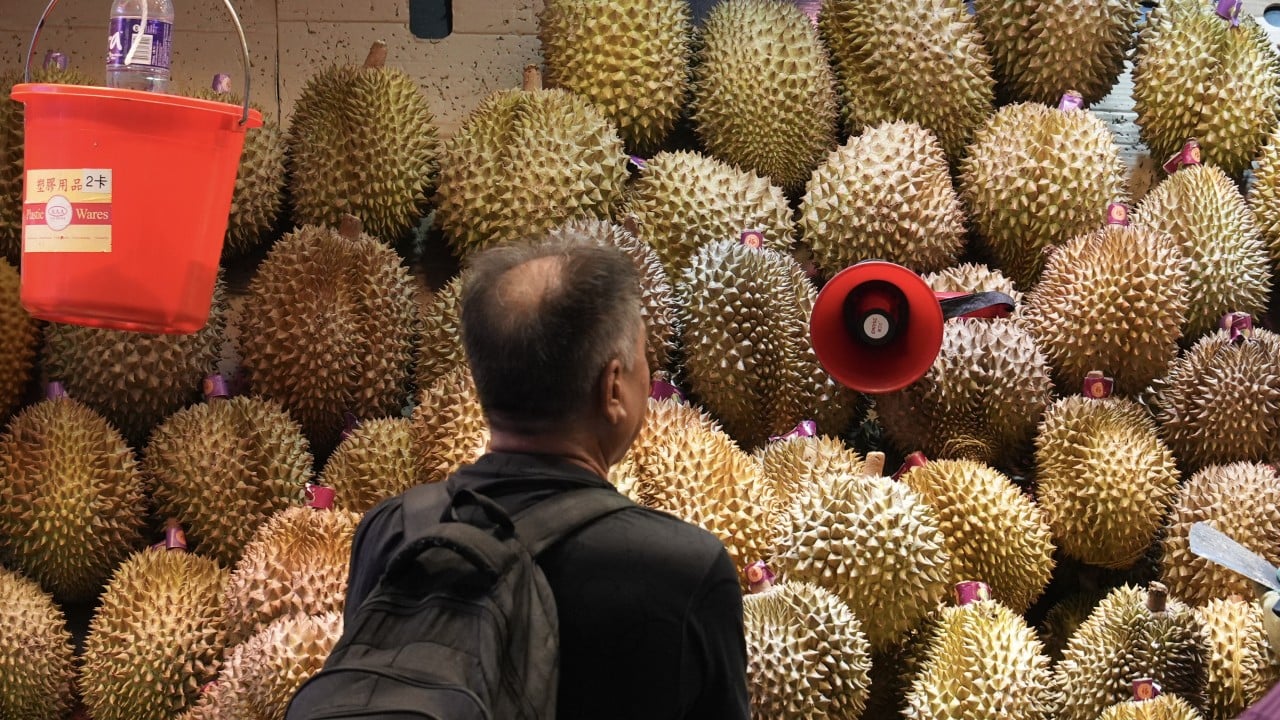
The scent hits you long before you see the crates. It is a thick, custard-heavy musk that hangs in the humid air of a Kunming distribution center, a smell that some describe as rotting onions and others as heaven itself. For decades, this scent—the unmistakable signature of the Musang King and Monthong durian—was the aroma of a luxury few could afford. It was a prize that had to survive a grueling, week-long trek across borders, mountain passes, and bumpy provincial roads.
By the time a Thai durian reached a dinner table in Shanghai or Beijing, it wasn't just fruit anymore. It was a survivor. It was also expensive.
Now, the rhythm of the trade has changed. It has found a new pulse, one made of steel wheels and high-voltage lines. The opening of the cold-chain "Durian Express" via the China-Laos Railway hasn't just lowered the price of a snack; it has effectively redrawn the map of Southeast Asian commerce.
The Five-Day Fever
Consider Somchai, a hypothetical third-generation orchard owner in Thailand’s Rayong province. For Somchai’s father, the harvest was a period of sustained anxiety. Once the spiked husks were hacked from the trees, the clock started ticking. Every hour the fruit sat in the tropical heat, its sugars began to ferment, its shelf life evaporating like morning mist.
In the old days, the journey to the Chinese border was a gamble. Trucks lined up for miles at the Youyi Pass, idling in the sun. A sudden customs delay or a washed-out road meant an entire shipment could turn to mush. To compensate for the risk of "dead loss," prices stayed high. The middleman took his cut, the trucker took his, and the Chinese consumer paid the premium for a fruit that was often past its prime.
The logistics were brittle. They lacked the weight of a superpower’s infrastructure.
But the introduction of the unified rail link has slashed that transit time from seven days down to a mere fifteen hours from the Lao border to the Chinese hub. When you add the synchronized trucking routes from Thai orchards to the Vientiane terminal, a durian can move from a tree in Rayong to a supermarket shelf in Chongqing in less than three days.
Speed is the ultimate price-killer.
The Physics of the Price Tag
Business schools teach that price is a function of supply and demand, but on the ground in Southeast Asia, price is a function of friction.
Friction is the diesel burned while waiting at a border. Friction is the cost of electricity for a refrigerated container that has to run for a week instead of two days. When the China-Laos Railway began its specialized cold-chain service, it didn't just move fruit faster; it effectively lubricated the entire economic corridor.
Recent data reveals that the cost of importing these tropical "crown jewels" has dropped by nearly 20% in some regions. In the bustling wet markets of Yunnan, the durian is no longer a "wealth flex" reserved for weddings or lunar New Year gifts. It is becoming a Tuesday afternoon treat.
The scale is staggering. In the first quarter of the year alone, the volume of fruit entering China via this rail link increased fourfold. This isn't a minor adjustment in trade stats. It is a tidal wave of produce.
While the durian is the headline act, it isn't the only traveler. Mangosteens, longans, and pineapples are hitched to the same engine. The railway has created a vacuum, sucking up the bounty of Southeast Asian farms and depositing it directly into the heart of the world’s largest consumer market.
The Invisible Stakes of a Rail Line
There is a tendency to view these massive infrastructure projects through a purely geopolitical lens. We talk about "debt-trap diplomacy" or "spheres of influence." Those conversations are important, certainly. But they often ignore the person standing in the mud of a Lao clearing or the shopper in a Chengdu mall.
For Laos, a landlocked nation that was once a geographic obstacle, the railway is a transformation into a "land-linked" hub. The country is no longer a place that goods simply pass over; it is the vital valve in the heart of the region. The stations along the route have become miniature ecosystems of trade. Small businesses are sprouting to service the logistics industry.
There is a quiet, desperate hope pinned to these tracks.
The stakes involve the survival of the smallholder farmer. In the past, only the massive plantations had the resources to navigate the labyrinth of international trucking. The "Durian Express" offers a more standardized, predictable window. When the transit is reliable, the risk is lower. When the risk is lower, the bank is more likely to lend a farmer money for better fertilizer or a new irrigation system.
The steel rails are a stabilizer for lives that have been historically volatile.
The Reality of the "Golden Link"
We shouldn't pretend the transition is without its bruises. The sheer efficiency of the rail line puts immense pressure on traditional trucking companies. Thousands of drivers who once spent their lives plying the highways of the Greater Mekong Subregion are watching their livelihoods migrate to the tracks.
The friction that once kept prices high also provided a messy, inefficient kind of employment for a small army of people.
Moreover, the dependence on a single market—China—is a double-edged sword. Thailand’s durian exports to China account for over 90% of its total export volume for the fruit. When the "Express" is running hot, the wealth flows. If the border closes or demand shifts, the silence in the orchards will be deafening.
It is a marriage of convenience and necessity, bound together by a shared appetite.
The Sensory Shift
Walk into a high-end grocery store in Shanghai today. The bins are overflowing with fruit that looks, feels, and smells like it was harvested yesterday. You see a young professional, perhaps someone who moved to the city from a rural province, picking up a pre-packaged tray of durian.
She doesn't think about the 1,035-kilometer stretch of track through the mountains of northern Laos. She doesn't think about the engineering marvel of the tunnels or the complex customs agreements that allow a sealed container to pass through multiple jurisdictions without being opened.
She only notices that the price tag is thirty yuan lower than it was last year.
She buys two.
This is how history moves. It doesn't always move with a bang or a proclamation. Sometimes, it moves through a slow, steady reduction in the cost of a tropical fruit. It moves through the quiet hum of a refrigerated car cutting through the dark of a Southeast Asian night.
The world feels smaller because it is. The distance between the orchard and the table has been collapsed by a thousand tons of moving steel.
As the sun sets over the Mekong, another train is already loaded. It carries the weight of a million meals, the dreams of thousands of farmers, and that heavy, polarizing scent of the summer harvest, hurtling northward at eighty kilometers per hour toward a market that can never seem to get enough.
The spikes are still sharp, but the journey is finally smooth.