The air inside an old Welsh church doesn't just sit there; it weighs. It tastes of cold slate, beeswax, and a thousand years of whispered secrets. For centuries, these buildings served as the literal and figurative bedrock of the valleys, standing firm while the coal mines opened and closed, while the language flickered and flared, and while generations of families were christened, married, and buried in the same damp earth.
But for a long time, that heavy air felt thin for people like Dafydd.
Imagine a man who has spent thirty years polishing the brass lecterns of a rural parish in Powys. He knows every crack in the flagstones. He has comforted grieving widows in the pews and organized the harvest festivals that keep the village heart beating. Yet, for decades, the very institution he poured his life into held a "No Entry" sign over the most sacred part of his identity. He could serve the wine, but he couldn't share the vow.
That changed with a vote that echoed louder than the bells of St. David’s Cathedral. When the Governing Body of the Church in Wales met to decide on the blessing of same-sex unions, they weren't just debating theology or canon law. They were deciding whether the church would remain a museum of ancient anxieties or become a living house for all its children.
The decision was decisive. Two-thirds of the clergy, two-thirds of the laity, and a clear majority of the bishops moved the needle. It was a seismic shift for a province of the Anglican Communion, especially one rooted in the traditionalist soil of Wales.
The Weight of the "I Do"
The nuance matters here. To be clear: the Church didn't technically redefine marriage in its internal law—not yet. What they did was authorize a formal service of blessing. It sounds like a bureaucratic distinction, a bit of linguistic gymnastics to keep the peace.
It isn't.
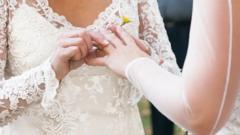
To the couple standing at the altar, the difference between "marriage" and "blessing" dissolves under the stained glass. When a priest puts their hands over yours and invokes the divine on your union, the institutional coldness evaporates. For years, gay couples in Wales had to settle for a civil ceremony in a sterile register office, followed perhaps by a hushed, unofficial prayer in a kitchen. Now, they can walk through the heavy oak doors. They can smell the lilies. They can hear their love acknowledged in the same space where their ancestors sought grace.
The opposition wasn't quiet, and it wasn't necessarily rooted in malice. For the "no" voters, the change felt like a fracture in a foundation they believed was set in stone by a higher architect. They worried about the "tapestry"—if I were a lesser writer, I’d use that word, but let’s call it the fabric of their faith—unraveling. They feared that by moving with the culture, the church was losing its soul.
But the counter-argument, the one that won the day, was rooted in an older, more radical idea: that grace is not a limited resource to be rationed by the worthy.
A Geography of Belonging
Wales is a country of jagged edges and deep connections. In small communities, the church is often the only thing left standing after the post office and the pub have vanished. When the church excludes a neighbor, the wound isn't just spiritual; it’s social.
Consider a hypothetical woman named Elen. She grew up in a village where her grandfather was the vicar. She sang in the choir until her voice broke and then until it matured. When she realized she wanted to spend her life with another woman, the church became a place of tension. She felt like a guest in her own home.
The approval of these blessings changed the geography of Elen's world. It meant her identity was no longer a "topic" to be discussed in a committee room, but a reality to be celebrated in the sanctuary. This isn't about being trendy. It's about the agonizingly slow process of an ancient institution catching up to the compassion of its own members.
The statistics tell a story of a church trying to survive in a secular age. Attendance has been dropping across the UK for decades. Some might argue that liberalizing is a desperate bid for relevance. But if you talk to the people in the pews, you realize it’s the opposite. It’s an act of bravery. It’s easier to stay rigid. It’s harder to open the doors and admit that perhaps, for a few hundred years, you got the tone wrong.
The Invisible Stakes
What happens to a soul when it is told its love is "disordered"? That is the invisible stake. It’s the quiet depression of the teenager in the back pew who hears a sermon and realizes they aren't invited to the future the preacher is describing. It’s the elderly couple who have been together for fifty years, supporting the church through every roof leak and bake sale, who finally get to have their hands joined by a man in a stole.
There is a specific kind of silence that follows a monumental change. It’s the silence of the dust settling. After the vote, there was no sudden collapse of the denomination. The sky didn't fall over Cardiff. Instead, something much more subtle occurred: the church became a little more honest.
The rite of blessing is a bridge. It allows a priest to say, "I see you, and God sees you, and this love is good." For a country like Wales, where the "Amen" is often sung in four-part harmony, adding these new voices to the song doesn't ruin the music. It completes the chord.
The transition isn't without friction. Clergy who feel they cannot in good conscience perform these blessings are protected; they aren't forced to go against their personal convictions. This creates a strange, patchwork reality where one village church might be a haven of inclusion while the one five miles over remains a fortress of tradition.
We often think of progress as a straight line, a clean break from the past. It never is. It’s a messy, overlapping series of conversations. It’s a vicar sitting down with a disgruntled parishioner over tea, explaining that the world is big enough for both of them. It’s the realization that the church isn't the building—it’s the people inside it, and those people are changing.
The Echo in the Valley
Think back to those stone walls. They have absorbed the echoes of Latin, of Welsh, of English. They have survived wars and reformations. They are built to endure. The fear was that by changing the rules, the walls would crumble.
Instead, they breathed.
On the first day these blessings were allowed, the sun likely hit the slate roofs of the valleys just like it always does. The sheep still dotted the hillsides like stray tufts of cotton. But in a few specific spots, under the vaulted ceilings of ancient parishes, the atmosphere shifted.
The air grew less heavy.
A man like Dafydd could stand at the altar, not as a servant hiding a secret, but as a person whose life was finally viewed as whole. The church didn't just approve a ritual; it surrendered its role as a gatekeeper of the heart.
The true test of any institution isn't how well it guards its doors, but how wide it can open them without losing its center. In the damp, beautiful hills of Wales, the center held. It just grew large enough to include the people who had been waiting outside in the rain for a very long time.
The bells are still ringing. They just sound a little more like a homecoming.