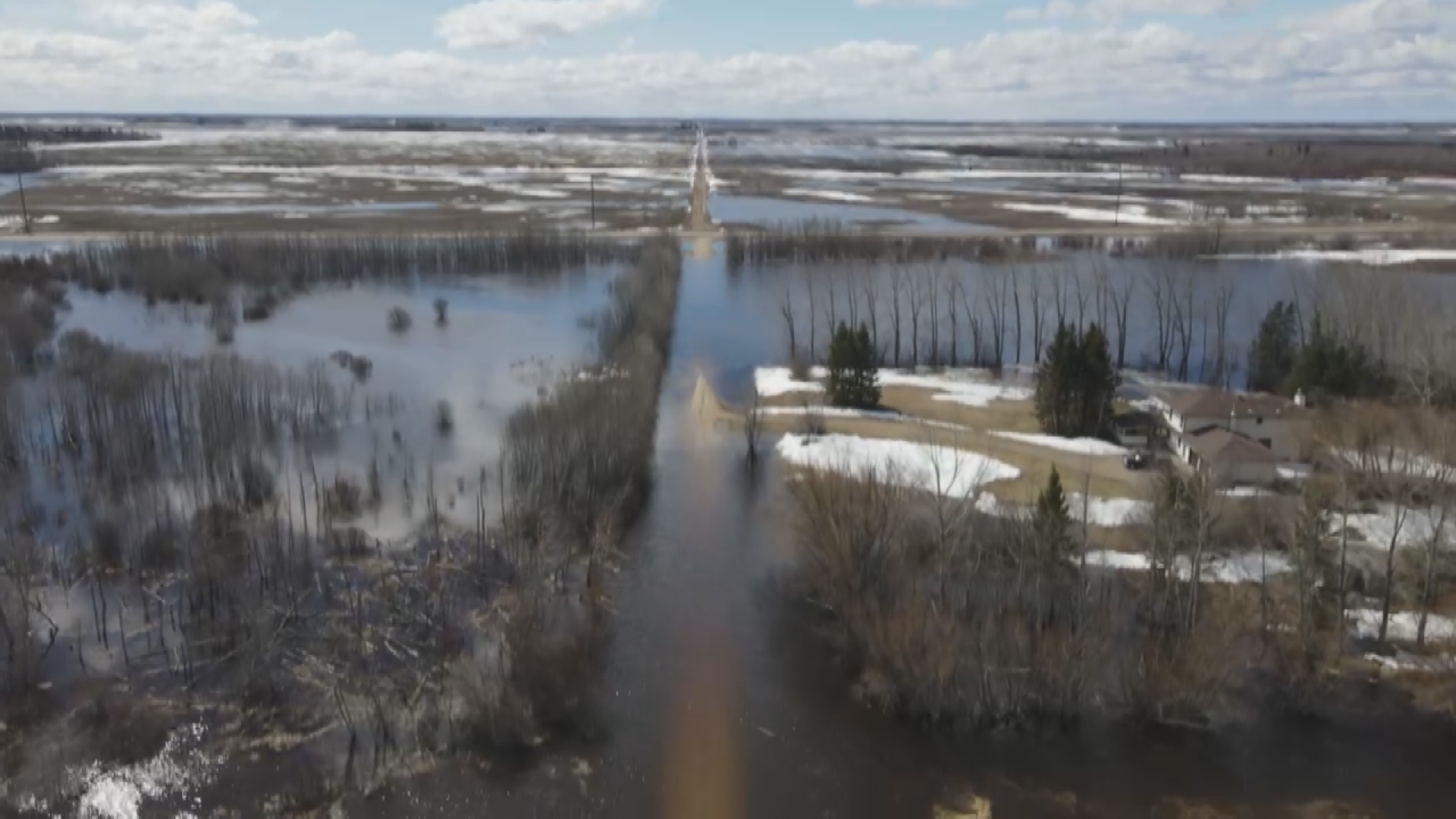
Saskatchewan Rural Municipalities (RMs) are panicking. They are looking at washed-out grid roads, crumbled culverts, and water-logged infrastructure, and they are doing what every local government does when nature fights back: they are reaching for the taxpayer's wallet. They want more Provincial Disaster Assistance Program (PDAP) funding. They want federal intervention. They want to rebuild the exact same gravel road that has washed out three times in the last decade.
The "lazy consensus" says this is a tragedy of underfunding. The truth is far more uncomfortable. We aren't suffering from a lack of repair money; we are suffering from a lack of basic geographical literacy and a refusal to acknowledge that some land isn't meant to be tamed. Expanding on this idea, you can also read: The Ash That Falls Like Snow.
Every dollar we pour into "fixing" flood damage in low-lying, high-risk drainage basins is a sunk cost in the most literal sense. It is time to stop pretending that every RM road is sacred and start admitting that some infrastructure is a liability we can no longer afford to carry.
The Myth of the One Hundred Year Flood
RMs often frame these events as "unprecedented" or "freak occurrences." They use terms like "1-in-100-year flood" to justify rebuilding, implying that since the disaster happened today, they are safe for the next 99 years. Experts at The Guardian have shared their thoughts on this situation.
This is a fundamental misunderstanding of probability. A $1/100$ event means a $1%$ chance every single year. When you factor in the shifting hydrologic cycles of the prairies—moving from the dry decades of the mid-20th century into a more volatile, moisture-heavy era—those odds are shortening.
I have watched local councils vote to spend $250,000 to repair a section of road that serves two farmyards and a handful of section acres, only to see that same section underwater two springs later. This isn't "maintenance." It’s gambling with public funds where the house—in this case, Mother Nature—always wins.
The PDAP system actually encourages this cycle of failure. Because the program is designed to "restore to pre-disaster condition," it actively prevents RMs from innovating. If you want to build a bridge where a culvert failed, or if you want to elevate a road bed to actually survive the next surge, you often find yourself fighting red tape because the funding is tied to the status quo. We are legally mandated to be mediocre.
Stop Building Roads to Nowhere
Saskatchewan has more road miles per capita than almost anywhere else on the planet. We inherited a grid system designed in an era of horse-drawn carriages and quarter-section homesteads. That world is gone. We now have massive, consolidated farm operations using equipment that weighs as much as a small house.
When an RM complains they don't have the "repair money" to fix flood damage, the response shouldn't be a blank check. It should be an audit.
- Traffic Count Reality Checks: If a road washes out and it only carries three trucks a week, why is it being rebuilt?
- Strategic Abandonment: We need to identify "low-service" zones. If a particular valley or basin is prone to chronic flooding, the RM should have the authority—and the political backbone—to decommission that infrastructure and return the land to pasture or wetland.
- User-Pay Infrastructure: If a private enterprise requires access through a flood-prone zone that the public cannot afford to maintain, the cost of that "resilience" must shift to the beneficiary.
The current model is a massive hidden subsidy for inefficient land use. We are socializing the risk of farming in floodplains while privatizing the profits.
The Engineering Fallacy: Culverts are Not Solutions
The knee-jerk reaction to a washed-out road is to put in a bigger pipe.
Engineers love bigger pipes. Contractors love bigger pipes. But bigger pipes just move the problem downstream faster. When RM "A" upsizes their culverts to save their roads, they are effectively firing a water cannon at RM "B."
This localized approach to water management is a disaster. We treat drainage as an individual RM problem when it is a watershed reality. By forcing water through artificial channels and rigid road grids, we increase the velocity and destructive power of the runoff.
The contrarian move? Stop fighting the water and start holding it.
Instead of demanding millions for road repairs, RMs should be demanding millions for natural infrastructure. We need to pay producers to keep wetlands intact. We need to incentivize the restoration of natural basins that act as sponges. It is significantly cheaper to pay a farmer to let 50 acres of his lower quarter-section stay under water than it is to rebuild the three miles of road that would be destroyed if that water were drained into the ditch.
The High Cost of "Resilience"
There is a downside to this take, and it’s one that politicians are too scared to voice: it means some land will become less profitable. It means some commutes will get longer. It means some homesteads will become inaccessible during the spring thaw.
That is a hard sell in a province where the "pioneer spirit" is often code for "I can do whatever I want with my land and the government should pay for the consequences."
But the alternative is fiscal insolvency. Saskatchewan’s rural tax base is shrinking as farms consolidate. The cost of materials—gravel, fuel, steel, and labor—is skyrocketing. The math doesn't work anymore. We are trying to maintain a 1920s grid on a 2026 budget during a period of climatic volatility.
Practical Steps for a Post-Flood Reality
If we actually want to solve the "repair money" crisis, we have to stop asking for more money and start asking for more control over how it is spent.
- PDAP Reform: Change the mandate from "restore to pre-disaster" to "improve for future resilience or decommission." If a road is going to wash out again, the funding should be used to buy out the affected land owners or reroute the access permanently.
- Watershed Levies: If an RM allows extensive private drainage that increases the flow into public ditches, they should be taxed for the increased infrastructure strain.
- The "Three-Strikes" Rule: If a piece of infrastructure is damaged by the same natural force three times in twenty years, it is officially designated as "untenable." No more provincial funding. No more federal bailouts.
The Brutal Truth
The RMs are right to be concerned about the money. They are just wrong about where it should come from.
The money shouldn't come from the province to fix the roads; the "money" is already there, currently being wasted on a futile war against geography. Every time we "fix" a flood-damaged road in a basin that wants to be a lake, we are throwing a brick into a bottomless well.
The most "pro-business" and "pro-taxpayer" move a rural council can make is to look at a map, look at the water, and admit defeat.
Stop rebuilding. Start retreating. Let the water win, because it’s going to win anyway—and it doesn’t send you a bill for the demolition.