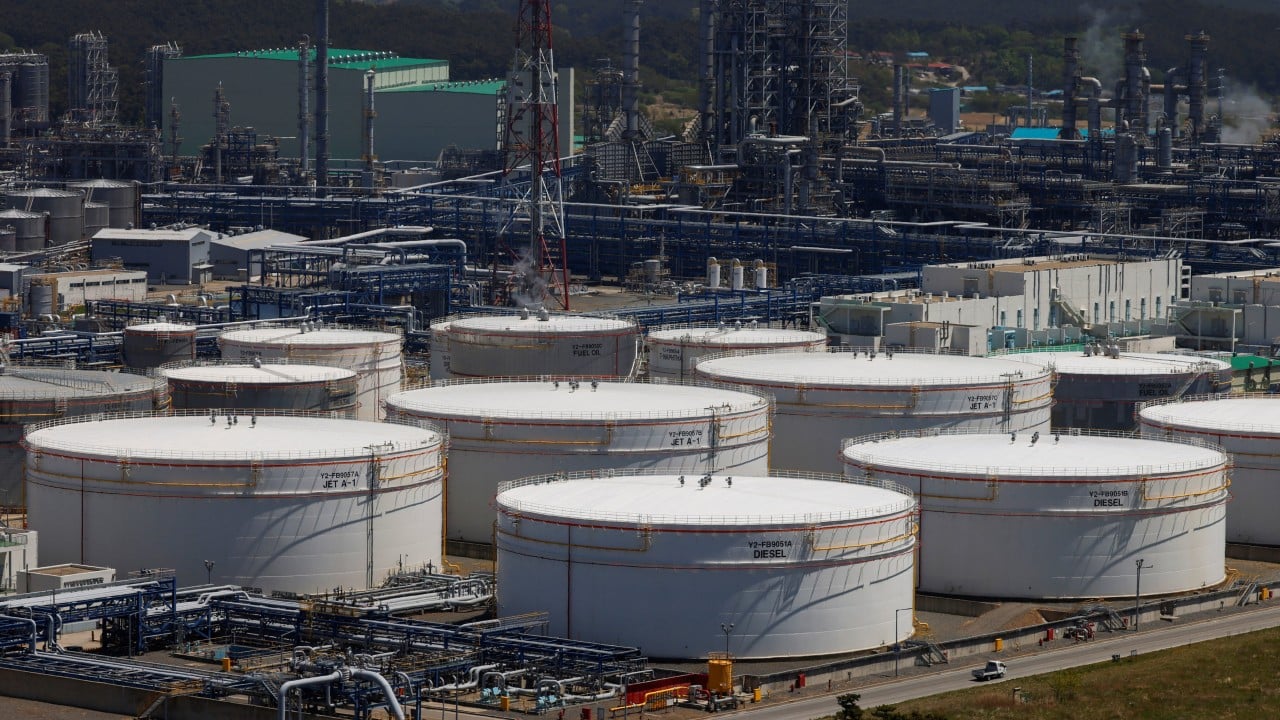
The physical closure or sustained disruption of the Strait of Hormuz—through which roughly 20% of global petroleum liquids flow—instantly shifts the valuation of "oil in the ground" to "oil in the tank." For Gulf producers, the inability to transit the Musandam Peninsula transforms their upstream dominance into a stranded asset risk. South Korea is positioning itself as the primary hedge against this geographic bottleneck. By leveraging its 200-million-barrel storage infrastructure, the Korea National Oil Corporation (KNOC) is transitioning from a domestic strategic reserve manager into a global liquidity provider for Middle Eastern National Oil Companies (NOCs).
The Structural Mechanics of Geopolitical Arbitrage
The current migration of Gulf crude toward South Korean storage tanks is not a mere logistical convenience; it is a calculated risk-mitigation strategy based on the Decoupling of Extraction and Delivery. When the Strait of Hormuz faces a kinetic threat, the price of crude does not rise uniformly. Instead, a massive spread develops between "wet barrels" already east of the choke point and "paper barrels" representing oil that cannot physically leave the Persian Gulf.
South Korea’s infrastructure offers three distinct structural advantages that make it the optimal node for this decoupling:
- Terminal Proximity to Demand Sinks: Ulsan and Yeosu are positioned within short-haul steaming distance of the world’s most intensive refining clusters in China and Japan.
- Regulatory Joint-Oil Storage Agreements: These frameworks allow NOCs to store crude in South Korean tanks without paying immediate import duties, retaining the "bonded" status of the cargo until it is sold to a third party or released into the Korean market during an emergency.
- Deep-Water VLCC Accessibility: Unlike many regional ports, South Korean terminals can handle Very Large Crude Carriers (VLCCs) at high discharge rates, minimizing the "laytime" costs that erode the margins of long-term storage plays.
The Three Pillars of Strategic Buffer Efficacy
The shift in Gulf interest toward South Korea is driven by three specific economic and operational pillars that define the utility of a strategic reserve in a high-volatility environment.
1. The Insurance Alpha Pillar
For Saudi Arabia (Aramco) or the UAE (ADNOC), holding inventory in South Korea acts as a physical insurance policy. If the Strait is blocked, their revenue stream remains active through the liquidation of "pre-positioned" stocks. This maintains market share in North Asia even when production at the wellhead is curtailed by shipping constraints. The "Alpha" here is the premium price these barrels command during a supply shock, often exceeding the cost of storage fees and the cost of capital tied up in the inventory.
2. Operational Optionality and Blending
Storage in South Korea is not static. The technical sophisticated of Korean tank farms allows for "crude cocktailing"—blending various grades to meet specific refinery assays in the region. By moving crude to a South Korean hub, a Gulf producer can transform a generic export grade into a bespoke feedstock for a specific Chinese teapot refinery or a Japanese power utility, increasing the "Netback" value of each barrel.
3. The Security of Sovereign Neutrality
South Korea’s status as a stable democracy with a robust legal framework provides a "Security Premium." Unlike storage options in less stable or more geopolitically aligned regions, South Korea offers a neutral, transparent regulatory environment. This reduces the "Counterparty Risk" for NOCs who must ensure their assets are not subject to sudden seizure, nationalization, or secondary sanctions.
Quantifying the Logistics of Choke Point Bypassing
To understand the scale of this shift, one must analyze the Time-Distance Decay of Crude Value. A barrel of Murban or Arab Light crude trapped behind the Strait of Hormuz during a crisis has a functional value of $0 for the duration of the closure, minus the cost of shutting in the well. Conversely, a barrel stored in Yeosu experiences a "Scarcity Multiplier."
The logic follows a basic cost function:
$$C_s = (I_r + L_f + B_c) - P_m$$
Where:
- $C_s$ = Net cost of storage
- $I_r$ = Interest rate (opportunity cost of capital)
- $L_f$ = Leasing fees for the tankage
- $B_c$ = Boil-off or degradation costs (minimal for crude)
- $P_m$ = Proximity Market Premium (the extra value gained by being near the buyer)
When the risk of a Hormuz closure increases, $P_m$ scales exponentially, frequently flipping the equation so that $C_s$ becomes a negative value—meaning the storage pays for itself several times over before a single drop is sold.
The Bottleneck Shift: From Shipping to Storage Capacity
As Gulf nations move to secure more space, the primary constraint is no longer the availability of oil, but the availability of High-Turnover Tankage. South Korea’s total storage capacity is approximately 200 million barrels, but much of this is earmarked for the International Energy Agency (IEA) mandates or domestic strategic reserves.
The remaining "Commercial-Strategic" hybrid space is becoming a finite commodity. This creates a secondary market for storage rights. We are seeing a transition from "Spot Storage" (short-term leases) to "Long-Term Capacity Reservations" where NOCs pay a premium to ensure they have the exclusive right to use specific tanks for 5 to 10 years. This provides South Korea with steady, non-cyclical revenue while providing the Gulf with a "Trans-Oceanic Pipeline" that exists in the form of a constant rotation of stored barrels.
Factual Constraints and the Limits of Buffer Strategies
While the strategy is robust, it is not a total solution to a Hormuz closure. Several limiting factors determine the ceiling of this partnership:
- Volume Mismatch: Even if South Korea filled every spare commercial tank with Gulf crude, the total volume would likely represent less than 30 days of the disrupted flow. It is a buffer, not a replacement.
- Refinery Assay Specificity: Not all Korean storage is equipped to handle the high-sulfur "sour" crudes typically produced in the Gulf without significant infrastructure investment.
- The "Double-Key" Problem: Many of these storage agreements include clauses that allow the South Korean government to seize the oil for domestic use in a "National Emergency." For a Gulf NOC, this introduces a sovereign risk where their inventory might be liquidated at a state-set price rather than the global market peak during a crisis.
Strategic Reconfiguration of the Energy Silk Road
The "Energy Silk Road" is being re-engineered. Traditionally, this was a one-way flow of commodities from West to East. It is now becoming a Distributed Inventory System. In this model, the producer (Gulf) and the consumer (Korea/Asia) share the burden of holding inventory at the point of consumption rather than the point of production.
This shift has profound implications for global oil pricing. As more inventory moves "East of Hormuz," the global oil market’s sensitivity to daily headlines about the Strait may actually decrease. If the market knows there are 50 million barrels of ADNOC crude sitting in Ulsan, a 48-hour naval skirmish in the Gulf will not trigger the same panic-buying it would have twenty years ago. South Korea is essentially providing "Volatility Dampening as a Service."
The Competitive Displacement of Singapore
Historically, Singapore has been the premier oil hub of Asia. However, Singapore faces severe land constraints, limiting its ability to expand bulk crude storage. South Korea is aggressively filling this void by utilizing unmined salt caverns and massive coastal tank farms that Singapore cannot replicate.
The second limitation for Singapore is its role as a "Trading Hub" rather than a "Refining Powerhouse." South Korea’s massive domestic refining capacity (the 5th largest in the world) provides a "Natural Floor" for the oil stored there. If a trader cannot find a buyer in China, they can almost always sell the cargo to an on-site Korean refinery. This "Integrated Storage-Refining Ecosystem" creates a level of liquidity that Singapore’s merchant-heavy model struggles to match in a true supply crisis.
Executive Action for Energy Stakeholders
The migration of Gulf crude to South Korea necessitates a shift in procurement and risk management for regional players.
- For Refiners: Shift from "Just-in-Time" procurement to "Inventory-Linked Contracts." By partnering with NOCs who have reserved South Korean storage, refiners can reduce their exposure to maritime transit risks.
- For Infrastructure Investors: The focus should move toward "Brownfield Expansion" of existing Korean terminals. Building new tanks is environmentally and regulatorily difficult; however, upgrading existing sites with faster pumping technology and better blending capabilities offers immediate ROI as the "Turnover Velocity" of stored crude increases.
- For Policy Makers: The "Joint-Oil Storage" model should be expanded into a multilateral framework involving Japan. A synchronized Korea-Japan storage corridor would create a massive 400-million-barrel buffer, effectively neutralizing the immediate economic leverage of any state threatening to close the Strait of Hormuz.
The strategic play is clear: South Korea is no longer just a buyer of energy; it is the central clearinghouse for the Middle East’s maritime risk. The value is not in the oil itself, but in where that oil is parked when the music stops in the Persian Gulf.