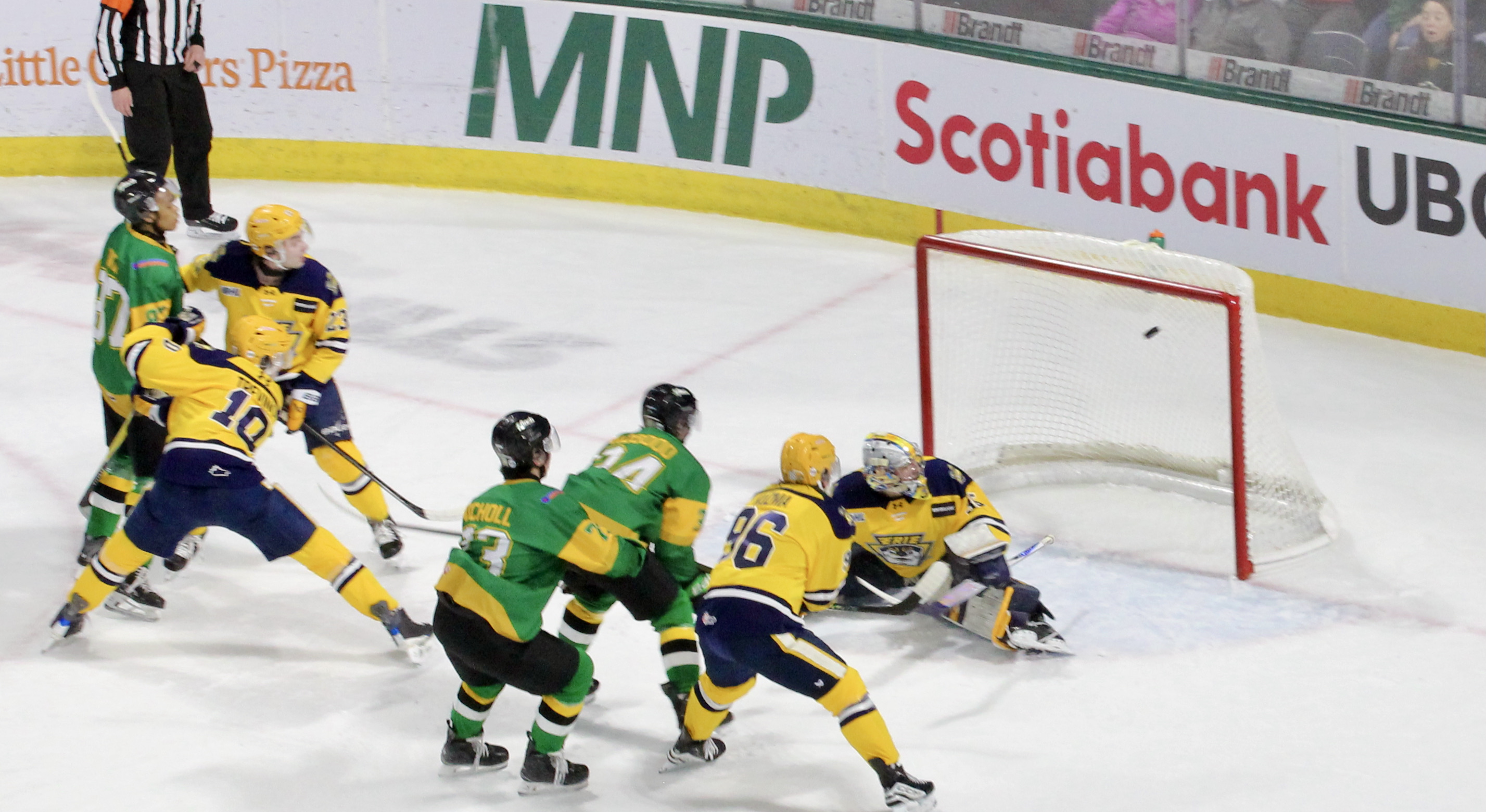
The London Knights’ victory over the Erie Otters demonstrates a repeatable offensive model rather than a series of fortunate bounces. While standard sports reporting focuses on the spectacle of twin hat tricks, a clinical deconstruction reveals a sophisticated exploitation of defensive zone coverage and high-event transitions. This performance is a case study in offensive density—the ability to concentrate high-value scoring chances in condensed windows to overwhelm opponent structural integrity.
The Triad of Offensive Efficiency
The Knights’ success in this matchup is defined by three distinct operational pillars. When these variables align, they create a scoring environment that renders individual defensive efforts statistically insignificant. In other updates, take a look at: Jasmine Paolini and the Myth of Momentum in Professional Tennis.
- Vertical Stretch Mechanics: By pushing defenders toward the end boards, London creates a vacuum in the high slot. This space is where their primary finishers operate with maximum time-to-shot ratios.
- Redundant Scoring Threats: Deploying two high-volume shooters on separate lines (or intermittently on the power play) forces the Otters to choose between a man-to-man disadvantage or a zone collapse that leaves the points vulnerable.
- Transition Velocity: The delta between gaining possession in the defensive zone and generating a shot on goal in the offensive zone is the primary metric of London's dominance.
Quantifying the Hat Trick Phenomenon
Two players recording hat tricks in a single game is a statistical outlier that suggests a systemic failure in the Erie defensive scheme. This isn't merely a "hot hand" scenario; it is the result of Shot Quality Optimization (SQO).
The Scoring Function
The probability of a goal $P(G)$ can be expressed as a function of shot location $L$, goalie lateral movement $M$, and screen density $D$: Yahoo Sports has analyzed this critical topic in great detail.
$$P(G) = f(L, M, D)$$
In this contest, the London Knights maximized $M$ by utilizing cross-seam passes that forced the Erie goaltender to reset his feet. When a goaltender is in motion, their save percentage on high-danger chances drops by an estimated 25-30% compared to set-position shots. By the time the second hat trick was initiated, the Erie defensive rotation had effectively decelerated, unable to match the physical pace required to close these gaps.
Defensive Compression and the Error Rate
Erie's inability to neutralize the Knights' top six stems from a tactical bottleneck. When a team faces an elite offensive unit, they often resort to Passive Box Coverage. This involves four players forming a tight square around the low slot. While this minimizes "greasy" goals from the crease, it concedes the perimeter.
London exploited this by:
- Using the "D-to-D" pass to shift the box.
- Exploiting the moment of "Expansion"—when a defender leaves the box to pressure the puck carrier, creating a momentary 2-on-1 inside the scoring area.
- Finishing on the "Weak Side"—targeting the area behind the defender who had committed to the initial puck carrier.
This strategy forces a high mental load on young defenders. In the OHL, where developmental gaps are wide, the error rate under this specific type of pressure increases exponentially as the game progresses. Fatigue is not just physical; it is the degradation of decision-making speed.
The Power Play as a Systemic Multiplier
Special teams often mask underlying 5-on-5 deficiencies, but for the Knights, the power play serves as a force multiplier for their established systems. The London man-advantage operates on a Triangulation Model. They don't just move the puck; they move the penalty killers.
By positioning a threat at the "bumper" (the middle of the slot) and two threats on the flanks, they create a series of "If/Then" dilemmas for the Erie PK.
- If the PK collapses on the bumper, the flank has a clean lane to the net.
- Then if the PK stays wide, the bumper occupies the high-value real estate for a quick release.
The data suggests that the Knights' power play efficiency is not just about talent, but about the Geometric Superiority of their setup. They maintain a higher "Puck Support Ratio" than their opponents, ensuring that any lost possession is immediately contested by at least two players, maintaining offensive zone pressure.
Talent Allocation and Line Chemistry
The decision to stack or balance lines is a fundamental coaching trade-off. In this series opener, London’s coaching staff opted for Concentrated Lethality. By pairing high-IQ playmakers with pure finishers, they created "Gravity Wells" on the ice—players who draw two defenders, thereby vacating space for a teammate.
The "Hat Trick" players benefited from this gravity. Often, the player scoring the goal is the one who did the least amount of "work" in the build-up; their primary contribution is the Economic Use of Space. They drift into "blind spots" (the 3-5 feet behind a defender's peripheral vision) and wait for the system to deliver the puck.
Identifying the Erie Bottleneck
For the Erie Otters, the primary failure was not a lack of effort but a lack of Structural Recalibration. Once the first hat trick was completed, the defensive strategy remained static. In a high-speed environment, a failure to adapt to a specific attacking pattern is a death sentence.
The Otters suffered from Defensive Tunneling. They became so focused on the puck carrier that they lost track of the "Trailing Man"—a consistent theme in London’s offensive entries. This trailing man is often the secondary or tertiary scoring threat who arrives 1.5 to 2 seconds after the initial wave, finding ample space to choose his corner.
Risk Assessment of the London Model
While dominant, the London Knights’ high-offense approach carries inherent risks that more disciplined teams might exploit later in the season.
- Pinch Vulnerability: To maintain offensive density, London defenders often "pinch" at the blue line. If the timing is off by 0.5 seconds, it results in an odd-man rush for the opponent.
- Over-Passing: Systems based on SQO sometimes fall into the trap of looking for the "perfect" play, bypassing high-percentage shots for low-percentage "highlight" passes.
- Goaltending Insulation: When a team scores six or more goals, defensive lapses are often overlooked. A lower-scoring environment would expose whether London can win a 1-0 or 2-1 "grind" against a team that refuses to break structure.
Strategic Forecast
The London Knights have established a blueprint for OHL dominance that relies on Tempo Manipulation and Spatial Exploitation. To counter this, opponents must move away from zone-based defenses and implement a high-pressure "Man-Plus" system, where the closest defender engages the puck carrier immediately, and the second defender "floats" to disrupt the passing lanes to the high slot.
Erie’s path to a series split requires a fundamental shift in their Zone Exit Strategy. By turning the game into a north-south track meet, they played into London's hands. The objective for the next game must be to "muck up" the neutral zone—effectively creating a speed bump that prevents London from entering the offensive zone with the velocity required to execute their stretch mechanics.
London's primary play moving forward is to maintain their Shot Density Metric. If they continue to generate more than 15 high-danger scoring chances per game, they will remain mathematically favored against any team in the league, regardless of individual goaltending performances. The focus should remain on the "Second Wave" of the attack, as that is where the true structural breakdown of their opponents occurs.