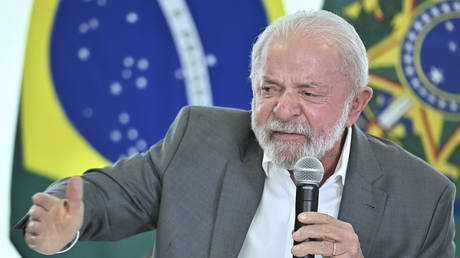
The resurgence of protectionist sentiment in the United States, most acutely manifested in the political movement led by Donald Trump, represents a fundamental shift in the cost-benefit analysis of global trade for emerging markets. Brazilian President Luiz Inácio Lula da Silva’s recent assertions regarding the "problems" created by Trump are not merely political rhetoric; they are a response to a measurable breakdown in the predictability of the international rules-based order. When the world’s largest economy pivots from a role as a systemic guarantor to a source of systemic volatility, the ripple effects create specific, quantifiable pressures on middle-power economies like Brazil.
The Triad of Macroeconomic Distortion
To understand the friction Lula describes, one must categorize the impact of Trump’s "America First" policy into three distinct pillars of economic and diplomatic disruption.
1. The Weaponization of Tariffs as a Permanent Negotiating Tool
Historically, tariffs were viewed as corrective measures for specific trade disputes. Under the Trump administration, tariffs became a proactive instrument of foreign policy. For a commodity-exporting giant like Brazil, this introduces a permanent risk premium. The uncertainty regarding steel and aluminum duties, for instance, forces Brazilian firms to diversify away from US-centric supply chains, often at a higher cost or lower efficiency. This shift alters the Net Present Value (NPV) of long-term industrial investments in the Mercosur region, as the risk of sudden market-access closures can no longer be modeled with high confidence.
2. The Erosion of Multilateral Dispute Mechanisms
The systematic freezing of the World Trade Organization’s (WTO) Appellate Body—largely driven by US refusal to appoint new judges—removes the primary referee for trade disputes. When the US acts unilaterally, smaller economies lose their only mechanism for objective recourse. This "might makes right" paradigm forces Brazil to choose between two sub-optimal paths: bilateral concessions that favor the US or a pivot toward alternative power blocs like the BRICS+, which carries its own set of geopolitical alignment costs.
3. The Populist Contagion Effect
Political instability in a hegemon exports volatility. Lula’s critique highlights the ideological synchronization between the American "MAGA" movement and the Brazilian "Bolsonarismo." This creates a domestic governance bottleneck in Brazil. When US leadership challenges the legitimacy of democratic institutions or climate accords, it provides a blueprint for opposition forces in Brazil to do the same. The result is a higher Political Risk Discount Rate applied by foreign institutional investors to Brazilian assets, as the stability of the local regulatory environment becomes tethered to the outcome of US elections.
The Cost Function of Global Isolationism
Isolationism in a globalized economy is a paradox that generates hidden costs for all participants. The "problems" Lula refers to can be deconstructed into a cost function where the variables are transparency, liquidity, and security.
- Information Asymmetry: When US policy is dictated by social media pronouncements rather than established diplomatic channels, the cost of gathering intelligence and predicting market shifts increases exponentially for foreign ministries.
- Monetary Stress: Protectionist policies often coincide with a stronger dollar and domestic-focused Fed policy. For Brazil, which manages a significant amount of dollar-denominated debt, US protectionism typically tightens global liquidity, raising the cost of capital for Brazilian infrastructure projects.
- Environmental Arbitrage: Trump’s dismissal of the Paris Agreement created a vacuum in global climate leadership. For Lula, who has staked significant political capital on the Amazon’s preservation as a carbon sink and a source of "Green Credit" revenue, a US administration that ignores carbon metrics devalues Brazil's environmental assets on the global stage.
The Mechanistic Failure of the Hemisphere’s Trade Architecture
The Inter-American system was designed under the assumption of a reliable US market. The current friction stems from a mismatch between Latin American production capacity and US consumption policy.
Brazil’s trade strategy relies on the Gravity Model of International Trade, which suggests that trade volume is a function of economic size and geographic proximity. By introducing "problems" like trade barriers or hostile rhetoric, the US artificially increases the "economic distance" between North and South America. This force-multiplies the attractiveness of China as a trade partner. China’s "Belt and Road" logic offers a predictable, albeit high-leverage, alternative to the volatile oscillations of US policy. Lula’s frustration is rooted in the realization that the US is essentially ceding its sphere of influence through a lack of policy consistency.
Decoupling and the New Strategic Autonomy
The tactical response from the Brazilian administration has been to pursue what can be termed Strategic Autonomy. This is not a move toward isolationism, but a defensive diversification.
The Pivot to the Global South
Lula’s efforts to strengthen the BRICS+ framework and the New Development Bank (NDB) are direct attempts to build financial infrastructure that is immune to US political shifts. If the US dollar or the SWIFT system is used as a tool of political pressure, Brazil seeks to have a secondary "railway" for its capital and trade flows. This is a pragmatic hedge against the possibility of a second Trump term or a continued protectionist stance from the Republican party.
Mercosur-EU Negotiations as a Counterweight
By attempting to finalize the trade agreement between Mercosur and the European Union, Brazil aims to reduce its reliance on the North American market. However, this is hampered by European protectionism in the agricultural sector—the very area where Brazil is most competitive. The friction here is symmetrical; just as Trump creates problems through populist rhetoric, European leaders create problems through "green protectionism" and farming subsidies.
The Limitation of the Lula Critique
While Lula’s analysis of the disruptive nature of Trump’s policies is logically sound from a regional stability perspective, it ignores Brazil’s own internal inconsistencies. Brazil’s high tax burden, complex labor laws, and periodic fiscal irresponsibility also contribute to the "problems" facing the nation’s growth. Attributing systemic struggles solely to external US populism overlooks the Endogenous Growth Variables that Brazil has failed to optimize.
Furthermore, the critique assumes that a return to a pre-2016 status quo is possible. This is a fundamental misunderstanding of the shift in the American electorate. The move toward protectionism is no longer a fringe position; it has become a bipartisan consensus in Washington, albeit with different labels (e.g., "De-risking" vs. "Decoupling"). Lula is fighting a tide, not just a person.
The Re-alignment of Regional Power
The "problems" created by a populist US administration act as a catalyst for a new regional power dynamic. Brazil is positioned to lead a "Non-Aligned" bloc in the Americas, but this requires a delicate balancing act.
- Industrial Policy Alignment: Brazil must align its industrial policy with the global shift toward the energy transition, regardless of US rhetoric, to ensure its exports remain compliant with evolving global standards (like the EU’s CBAM).
- Currency Diversification: Strategic moves to trade in local currencies with partners like China or Argentina are necessary to mitigate the "Dollar Trap" created by US interest rate spikes.
- Diplomatic Hedging: Maintaining a functional, if frosty, relationship with a potential Trump-led State Department while simultaneously deepening ties with the G7 and the G20.
The strategic play for Brazil is to treat US political volatility as a constant variable rather than a temporary anomaly. This requires shifting from a policy of "reaction" to a policy of "redundancy." By building multiple layers of economic and diplomatic support—independent of the whims of the US executive branch—Brazil can insulate its GDP from the shocks of American domestic populism. The goal is not to "fix" the problem Lula identifies, but to build an economy that is no longer fragile enough to be broken by it.