The NCAA Gymnastics Championship functions as a high-pressure optimization problem where success is determined by the intersection of technical precision, psychological load management, and the rigid constraints of a 10.0-scoring ceiling. Unlike the elite international circuit, which rewards difficulty through an open-ended scoring system, the collegiate environment shifts the focus toward the minimization of execution errors. When evaluating a competition of this magnitude, the analysis must move beyond general commentary on athlete talent and instead focus on the three primary variables that dictate the podium: rotational sequence logistics, the physics of landing stability, and the team-wide distribution of mental fatigue.
The Mathematical Constraint of the 10.0 Scoring Ceiling
The fundamental difference between NCAA gymnastics and Olympic-level competition lies in the scoring architecture. In international elite gymnastics, the score is a sum of Difficulty (D) and Execution (E). In the NCAA, the score is a fixed maximum of 10.0, where deductions are subtracted from a starting value. This creates a "precision-first" economy. If you found value in this post, you might want to read: this related article.
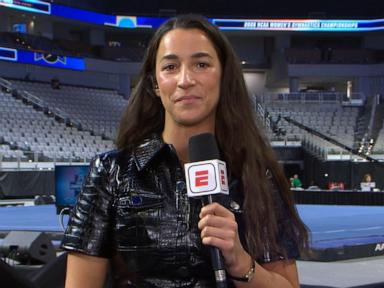
Teams do not win by performing the most difficult skills; they win by performing skills they can execute with zero technical flaws. The competitive advantage shifts from the "power" athlete to the "perfectionist" athlete. When an analyst like Aly Raisman discusses the championship, the underlying reality is a battle of marginal gains. A 0.05 deduction for a small hop on a landing or a slight separation of the legs in a transition is the difference between a national title and a third-place finish.
The strategy for coaching staffs becomes a risk-reward calculation: Is the extra 0.1 in "bonus" difficulty worth the 0.2 risk of a balance check? Most championship-winning programs—such as Oklahoma, LSU, or Utah—opt for the "Clean Sweep" model. This model prioritizes routines with a 100% success rate in training over those with higher peak potential but lower consistency. For another look on this story, refer to the latest update from CBS Sports.
Rotational Sequence Logistics and Momentum Modeling
The order in which a team competes on the four events—Vault, Uneven Bars, Balance Beam, and Floor Exercise—is not merely a scheduling formality; it is a significant factor in physiological energy expenditure. The "Olympic Order" (Vault-Bars-Beam-Floor) is often considered the gold standard for psychological pacing.
The Anchor Effect
In NCAA gymnastics, the "lineup" consists of six athletes per event, with the lowest score dropped. This creates a specific pressure gradient:
- The Lead-Off: The primary objective is a "hit" routine to set a scoring floor, usually around 9.85.
- The Middle Pack: These athletes are tasked with building the score incrementally.
- The Anchor: The final athlete is typically the highest-scoring individual, tasked with capitalizing on the "judge’s upward trend."
If the lead-off athlete fails, the psychological load on the remaining five increases exponentially. The "Anchor Effect" refers to the phenomenon where a team’s score tends to trend upward throughout a rotation as judges calibrate their expectations against the initial performances. A failure in the first three spots often leads to a "tightening" of the later athletes, resulting in uncharacteristic errors on simple technical elements like handstands or leaps.
The Physics of Landing Stability and Center of Mass Control
The most visible separator in the NCAA Championship is the "stick." A stuck landing signifies that the athlete has perfectly compensated for the rotational inertia and downward velocity of their dismount.
From a biomechanical perspective, a successful landing requires the athlete to align their center of mass directly over their base of support upon impact. If the center of mass is even two centimeters too far forward, the resulting momentum necessitates a step to prevent a fall.
Kinetic Energy Dissipation
The NCAA championship floor and mats are designed to absorb energy, but the athlete's joints must perform the final stage of dissipation. Analysts often highlight "power" gymnasts, but the true experts are those who manage "deceleration." On the Vault, for example, the Yurchenko full or double twist involves high horizontal velocity. The transition from that horizontal flight to a vertical, stationary stop is a masterclass in eccentric muscle contraction. A team that "sticks" 75% of its landings will almost invariably outscore a more powerful team that "hops" out of every pass.
The Psychological Load of the Four-Team Format
The NCAA Finals use a "Four on the Floor" format, which creates a unique atmospheric pressure. Unlike a dual meet where focus is divided between two teams, or a preliminary round with many, the finals are a simultaneous pressure cooker.
This format introduces a variable known as "Environmental Noise." A team on the Balance Beam—the most mentally taxing event—may be performing their most delicate movements while a rival team on the Floor Exercise is finishing a high-energy routine to a roaring crowd. The ability to compartmentalize external stimuli is a prerequisite for championship performance.
The psychological bottleneck occurs during the transition between the third and fourth rotations. This is where "Cumulative Fatigue" manifests. While gymnastics is an anaerobic sport, the mental focus required to maintain rigid form over two hours of competition drains glycogen stores and increases the likelihood of "cognitive slips," such as forgetting a choreographic requirement or misjudging a turn.
Specialized Equipment Sensitivity and Apparatus Nuance
While the equipment is standardized, environmental factors at the championship venue—such as humidity affecting the grip on the Uneven Bars or the "springiness" of the Floor Exercise platform—require immediate adaptation.
- Bars: High humidity can make the wooden bars "slick," requiring more frequent applications of chalk and honey to maintain friction.
- Beam: The lighting in large arenas can create depth perception issues during acrobatic series.
- Vault: The runway speed is affected by the type of sub-flooring used in the arena, impacting the athlete's "entry" into the springboard.
Elite analysts recognize that a team's performance in the warm-up gym is often a better predictor of their adaptation than their season average. A team that fails to adjust their handstand timing to a "fast" set of bars will struggle to break the 9.9 threshold regardless of their talent level.
The Judging Bias and the Perception of Perfection
While judging is intended to be objective, the NCAA system is vulnerable to "reputation bias." Teams that have historically performed at a high level often receive the benefit of the doubt on "subjective" deductions, such as artistry on Floor or rhythm on Beam.
The "Artistry" deduction is a specific area of contention. In the quest for a 10.0, an athlete must demonstrate not only technical mastery but also a performance quality that masks the effort involved. This is where the "Expertise" component of E-E-A-T becomes visible in analysis. A gymnast who looks "labored" in their movements, even if they hit every requirement, will rarely see a perfect score. The illusion of ease is a scored metric, albeit an informal one.
Strategic Deployment of the Sixth Spot
The most critical decision for a coach during the Championship is the "last-minute substitution." If an athlete in the five-spot suffers a minor injury or shows signs of mental cracking during the warm-up, the coach must decide whether to play the "high-ceiling" backup or the "safe-floor" backup.
This is a classic game theory scenario. If the trailing team needs a 9.95 to overtake the leader, they must use the high-risk athlete. If they are leading, the objective is "Risk Mitigation"—playing the athlete who is guaranteed a 9.85 but has no chance of a 10.0. The championship is won or lost on these microscopic personnel shifts.
The Breakdown of Scoring Volatility by Event
- Vault: Lowest volatility. Scores are tightly packed. It is difficult to make up ground here.
- Bars: Moderate volatility. Handstand angles are the primary source of deductions.
- Floor: High volatility. Boundary violations and landing errors are frequent.
- Beam: Highest volatility. The "fall risk" is ever-present, capable of swinging a team score by 0.5 in seconds.
Structural Recommendation for Performance Evaluation
To accurately forecast the winner of an NCAA Gymnastics Championship, ignore the "star power" of individual All-Americans. Instead, calculate the "Standard Deviation of Landing Success" across the entire six-person lineup. A team with a low standard deviation—meaning every athlete, from lead-off to anchor, consistently lands within a five-centimeter margin—is statistically favored to win over a team with two superstars and four inconsistent contributors.
The ultimate strategic play in this environment is the mastery of "Control." In a sport where the ceiling is fixed, the only way to rise is to ensure you never drop below the level of perfection. The championship belongs to the team that treats the 10.0 not as an aspiration, but as the baseline from which they refuse to deviate. Focus on the transition zones: the split second between the flight phase and the landing, and the silent moments between the judge's salute and the first movement. That is where the title is secured.