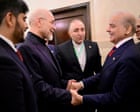
The humidity in Islamabad has a way of pressing against the chest, heavy and expectant, like the air in a room where a secret is about to be told. In the marbled corridors of Pakistan’s capital, the air conditioning hums a constant, low-frequency drone, a mechanical attempt to mask the tension of a world holding its breath. Outside, the Margalla Hills stand guard, indifferent to the fact that within the city’s diplomatic enclave, the trajectory of the twenty-first century is being nudged by a few millimeters.
Diplomacy is rarely about the grand, televised handshake. It is about the porcelain cup. It is about the specific way a diplomat from Washington stirs his sugar while seated across from a counterpart from Tehran—two men whose nations have spent decades communicating through proxy fires and economic strangulation. In Islamabad, Pakistan is currently playing the role of the reluctant but necessary host, trying to keep the tea warm and the voices low.
The Architect of the Middle Ground
Consider the Pakistani mediator. We will call him Malik. Malik does not exist in the dry press releases, but he is the personification of the Pakistani foreign service’s current tightrope walk. Malik knows that when the United States and Iran are in the same zip code, the gravity of the room changes.
Pakistan occupies a precarious geography. To its west lies Iran, a neighbor with whom it shares a porous, often volatile border and a complex web of energy needs. To the global north and west sits the United States, a long-term, if mercurial, security partner and the gatekeeper of the international financial systems Pakistan desperately needs to navigate. For Malik, these talks are not just about "regional stability." They are about whether his children grow up in a country defined by trade or by the fallout of a neighbor’s war.
The stakes are invisible until they are catastrophic. If the bridge between Washington and Tehran collapses entirely, the tremors are felt first in the markets of Peshawar and the shipping lanes of the Arabian Sea. Pakistan isn't brokering this deal out of pure altruism. It is doing so because it is the only way to stop the walls of its own house from cracking.
The Ghost at the Table
The history between the U.S. and Iran is a ghost that sits at every table. It is the memory of 1953, of 1979, of the scorched remnants of drones and the cold ink of scrapped nuclear deals. When these two powers meet in Islamabad, they aren't just discussing current policy; they are litigating forty years of grievances.
The American side arrives with the weight of a superpower that has found that its traditional tools—sanctions and carrier groups—are increasingly blunt instruments in a multipolar world. They need a "win" that doesn't look like a retreat. They need to ensure that the Middle East doesn't ignite just as they are trying to pivot their attention toward the Pacific.
The Iranians arrive with the weary defiance of a nation that has learned to survive under a state of permanent siege. For them, every concession is a potential trap, and every handshake is a risk to the internal optics of their revolution.
In the middle sits Pakistan, the "bridge." It is an exhausted metaphor, but in the heat of Islamabad, it feels literal. A bridge carries the weight of everyone who crosses it, and it receives none of the credit for the journey.
The Language of the Unspoken
Talks like these don't start with the nuclear program or the lifting of oil sanctions. They start with the "small things." They start with the fate of detainees, the safety of maritime routes, and the mutual recognition that neither side can afford a total collapse of the status quo.
The Pakistani facilitators have mastered the art of the "non-paper"—documents that don't officially exist, containing suggestions that no one has to admit to making. This is how the real work is done. It is a dance of deniability.
Imagine the American representative looking out the window at the Islamabad skyline. He is thinking about his briefing in D.C. next week. He is thinking about how to frame a "de-escalation" as a "strategic repositioning." Across from him, the Iranian representative adjusts his collar. He is calculating the exact price of a barrel of oil if the tension drops by even five percent.
They are both trapped by their own rhetoric. They have spent so long calling each other "The Great Satan" and "The Axis of Evil" that the vocabulary of peace feels foreign, like a language they learned in school but haven't spoken in years. Pakistan's job is to be the translator—not of words, but of intent.
The Cost of the Empty Chair
What happens if Malik fails? What happens if the tea goes cold and the delegates leave through separate exits without a second meeting scheduled?
The world often views these diplomatic efforts as academic exercises, but for the person living in the border regions of Balochistan, the failure of Islamabad is a death sentence. It means more insurgencies fueled by regional instability. It means the price of flour and fuel continues to climb as the "war risk" premium is tacked onto every invoice.
We tend to think of international relations as a game of chess played by giants. We forget that the board is made of people. When the U.S. and Iran refuse to speak, the vacuum is filled by those who profit from chaos—smugglers, extremists, and those who thrive in the shadows of "maximum pressure."
Pakistan’s push for a peace deal is a desperate attempt to turn the lights back on. By bringing these two antagonists to the same city, Islamabad is asserting that the regional players are tired of being the collateral damage of a forty-year-old grudge match.
The Weight of the Porcelain
There is a specific silence that occurs during high-stakes negotiations. It is the silence that follows a hard truth. In one of these sessions, an official reportedly noted that the geography of the region is a permanent reality, while the politics of the day are a passing weather pattern.
You cannot move Iran. You cannot move Pakistan. And the United States, for all its desire to look elsewhere, cannot simply wish the Persian Gulf out of existence.
The talks in Islamabad are an admission of this permanence. They represent the grueling, unglamorous work of realizing that "winning" is no longer an option—only "surviving" is. The victory isn't a signed treaty on a podium; the victory is the fact that the phone lines stay open for one more week.
As the sun sets over the Margalla Hills, casting long, purple shadows over the city, the motorcades begin to move. The delegates head back to their respective embassies to secure their communications and brief their capitals. Malik remains in the conference room for a moment, looking at the empty cups and the scattered notes.
The air is still heavy. The secret hasn't been told yet. But for the first time in a long time, the two sides are in the same room, breathing the same humid air, realizing that the bridge, however fragile, is the only thing keeping them both from the abyss.
Somewhere in the distance, the call to prayer echoes through the city, a reminder of the persistence of life beneath the high-altitude maneuvering of states. The diplomats are gone, but the stakes remain, etched into the faces of the people in the markets who have no idea what was said today, but whose entire future depends on the way those porcelain cups were handled.
The world waits. It is all we can do. We wait for the next cup of tea, for the next non-paper, for the moment when the silence of the spheres is finally broken by the sound of a door opening instead of closing.



