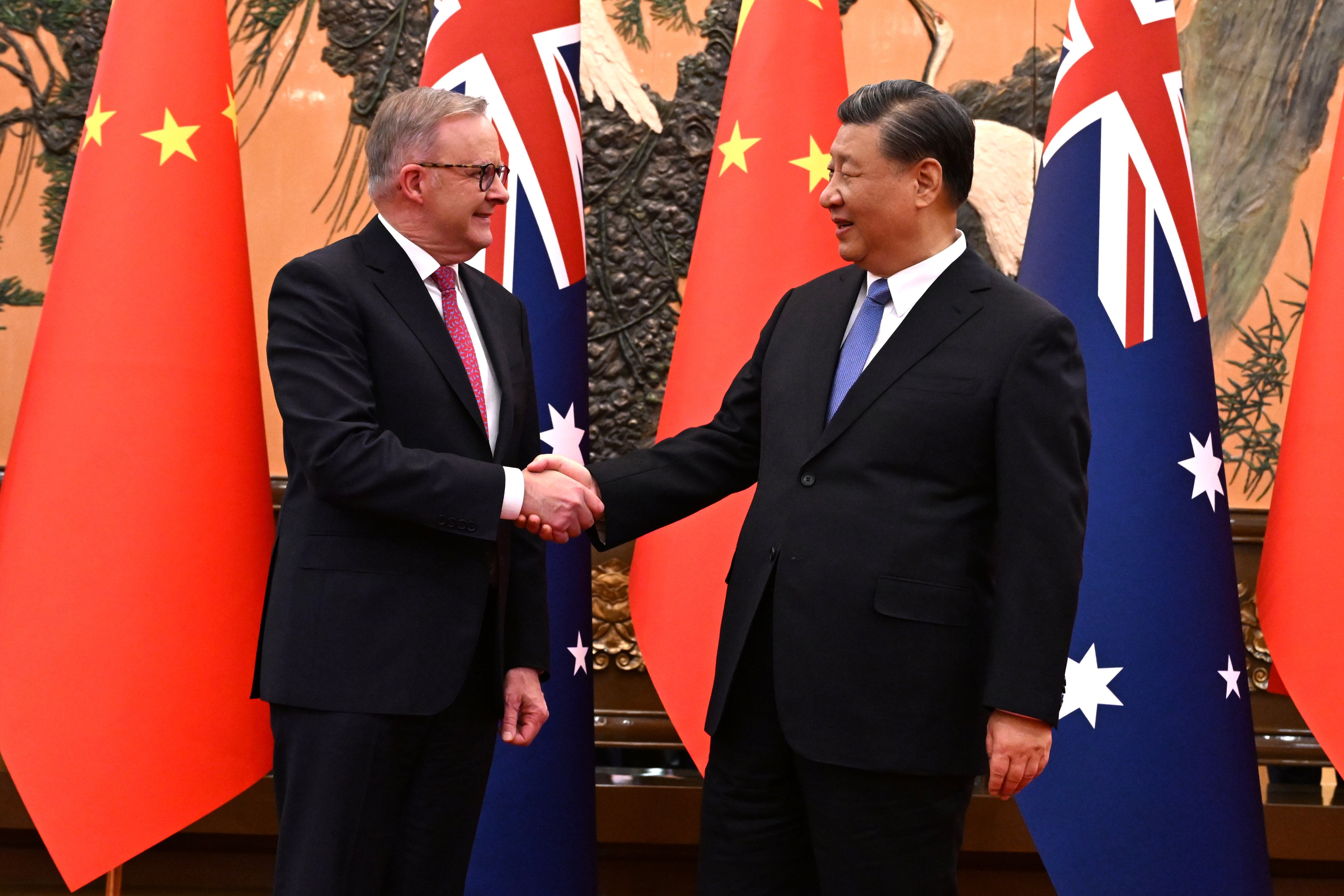
The headlines are predictable. They paint a picture of a world where a stern warning from Washington stops the gears of global arms proliferation. They suggest that the "America First" doctrine can simply flip a switch and de-link the military cooperation between a hungry superpower and a regional hegemon.
It is a comforting narrative. It is also entirely wrong.
When Trump warns China not to supply arms to Iran, he is playing a game of 20th-century geopolitical checkers in a 21st-century world defined by multi-polar technical interdependence. The mainstream media treats these warnings as if we are still in the 1990s, where the U.S. dollar and the threat of secondary sanctions were the only gravity in the room. That gravity has weakened.
The Myth of the Unilateral Lever
The "lazy consensus" among political pundits is that China is terrified of losing access to Western markets and will therefore buckle under the threat of trade penalties. This ignores the reality of the Petrodollar erosion and the rise of the BRICS+ infrastructure.
China isn't just selling "arms" in the traditional sense. They aren't just shipping crates of rifles or tanks that can be intercepted at a port. They are exporting dual-use technology, telecommunications infrastructure, and AI-driven surveillance systems. These are the "invisible arms" that modern regimes crave more than ballistic missiles.
When Washington threatens sanctions over hardware, Beijing pivots to software and logistics. I’ve watched analysts miss the forest for the trees for a decade: they look for a smoking gun in a shipping container, while China is busy integrating Iran’s entire defensive grid into a localized, non-Western tech stack.
Why Sanctions are the Best Marketing for Chinese Tech
Here is the counter-intuitive truth: Every time the U.S. weaponizes the financial system against a nation like Iran, it creates a massive, guaranteed market for Chinese alternatives.
If you are a pariah state, you don't care about the "best" technology. You care about the technology that cannot be turned off by a server in Northern Virginia. By threatening China, the U.S. actually accelerates the development of a "shadow supply chain" that is entirely immune to Western pressure.
- Payment Independence: China's CIPS (Cross-Border Interbank Payment System) is no longer a pilot program. It is an escape hatch.
- Resource Swaps: Iran has what China needs—hydrocarbons. China has what Iran needs—asymmetric military tech. No "warning" from a podium in Mar-a-Lago changes the math of survival.
- The Silicon Shield: China is rapidly achieving lithography independence. Once they don't need Western chips to build high-end guidance systems, the U.S. loses its last piece of leverage.
The "Arms" Misconception
Most people hear "arms supply" and think of the Cold War. They think of the Iran-Contra era. They are asking the wrong question. They ask, "Will China send missiles?"
The real question is: "Is China providing the digital backbone that makes Western kinetic intervention impossible?"
The answer is yes. They are doing it through 5G contracts, satellite data sharing via the Beidou constellation, and cyber-security "consulting." These aren't weapons that fall under traditional arms embargoes. They are "utilities." Try sanctioning a utility that a country uses to run its hospitals and power grids. It’s a messy, diplomatic nightmare that the U.S. isn't prepared to handle.
The Cost of the Bluff
I have seen the internal risk assessments of firms operating in the Straits of Hormuz. They aren't worried about a sudden influx of Chinese tanks. They are worried about denial-of-access technology.
China’s strategy isn't to help Iran win a war. It’s to make a war with Iran too expensive for the West to contemplate. If China supplies Iran with advanced anti-ship missile components or electronic warfare suites, the U.S. Navy's cost-benefit analysis changes overnight.
Trump’s rhetoric assumes China views this as a transaction. It isn't. China views it as a geopolitical hedge. For Beijing, an embattled Iran keeps the U.S. bogged down in the Middle East, distracting from the South China Sea. Why would they give up that strategic advantage because of a threat to their appliance exports?
The Fallacy of "Maximum Pressure"
The premise of "Maximum Pressure" is that there is a breaking point. But in a world where the East is decoupling from the West, "Maximum Pressure" only forces the targets to bond together more tightly.
Imagine a scenario where China decides to ignore the warnings entirely. What is the actual recourse? A total trade embargo on the world’s second-largest economy? The global supply chain would shatter within 72 hours. Walmart shelves would be empty, and the American tech sector would go dark.
The U.S. is holding a hand of cards that worked in 2005. The deck has been reshuffled since then.
Actionable Reality for the C-Suite
If you are an executive or a strategic investor, stop listening to the political theater.
- Diversify away from "Choke Point" dependencies. If your supply chain relies on the U.S. having total control over global shipping lanes, you are over-exposed.
- Watch the Beidou adoption rates. Any country switching from GPS to Beidou is signaling they are moving into the Sino-sphere of influence, where U.S. sanctions have zero bite.
- Ignore the "Arms" labels. Look at "Defense-Adjacent Technology." That is where the real trade is happening.
The U.S. government is attempting to police a digital-age alliance with an analog-age toolkit. Warning China not to arm Iran is like warning the ocean not to be wet. It is an inherent property of the current geopolitical climate. Beijing knows the U.S. cannot afford the fallout of a true confrontation, and Tehran knows that as long as they have oil, they have a friend in the East.
The era of the "global policeman" is being replaced by the era of the "global landlord." China is the landlord now, and they don't care about your noise complaints.
Stop expecting a "deal" to fix this. The deal was broken the moment the first yuan was traded for Iranian crude outside of the SWIFT network.
The warning isn't a strategy. It's a eulogy for a lost era of dominance.