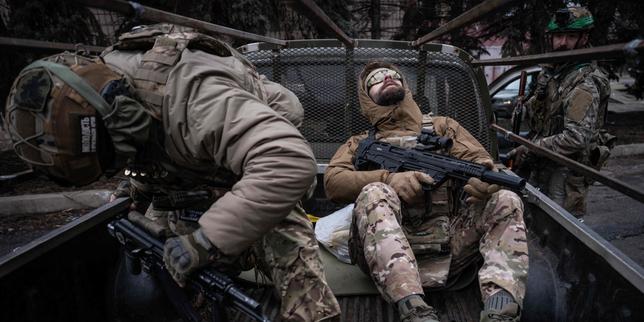
Keeping up with the war in Ukraine feels like drinking from a fire hose. One minute it's a drone strike on a refinery, the next it's a diplomatic row in Brussels. If you're looking for the standard play-by-play, you can find that anywhere. But if you want to understand why the front lines haven't moved more than a few kilometers despite thousands of shells fired daily, you have to look at the math and the mud.
The reality on the ground in 2026 isn't just about territory. It's about exhaustion. Russia is betting on a long-term war of attrition, hoping the West loses interest before they run out of Soviet-era tanks. Ukraine is betting on precision, trying to make the cost of every inch of ground so high that the Kremlin eventually hits a breaking point. It's a brutal, high-stakes calculation where the variables change every hour. For a deeper dive into this area, we recommend: this related article.
Why the Current Stalemate is Deceptive
Don't let the lack of massive red arrows on the map fool you. This isn't a frozen conflict. It's a high-intensity war of position. Both sides are burning through resources at a rate rarely seen since the mid-20th century. While headlines focus on the "line of contact," the real damage is happening hundreds of miles behind it.
Logistics wins wars. Ukraine has shifted its focus toward dismantling the Russian "rear." By hitting oil depots, ammunition dumps, and bridge infrastructure, they're trying to starve the front line. It's a slow process. You don't see the results in a day. You see them three months later when a Russian unit can't counter-attack because their fuel trucks were turned into scrap metal weeks ago. For additional context on this development, in-depth coverage can also be found at TIME.
Russia, meanwhile, continues its "meat grinder" tactics. They’ve shown a startling—and frankly horrific—willingness to trade lives for tiny tactical gains. In places like the Donbas, they’re still using massed infantry charges supported by heavy gliding bombs. These FAB-500 and FAB-1500 bombs are devastating. They aren't precise, but when you drop a ton of explosives on a trench system, precision doesn't matter as much.
The Drone Revolution is Changing Everything
If you think this is just World War I with better cameras, you're wrong. The sheer density of First-Person View (FPV) drones has made movement almost impossible during the day. If a tank rolls out into the open, it's spotted in seconds. Within minutes, it's being chased by a $500 quadcopter carrying a shaped charge.
This has led to a strange "no-man's land" that extends several kilometers back from the actual trenches.
- Supply runs are done at night.
- Medevacs are incredibly dangerous.
- Large-scale armored breakthroughs are basically a thing of the past for now.
Electronic Warfare (EW) is the invisible front. It's a constant game of cat and mouse. One side develops a new frequency for their drones, and the other side builds a jammer to block it two weeks later. This cycle is so fast that traditional defense procurement can't keep up. The most effective tech on the battlefield right now isn't coming from massive defense contractors; it's being soldered together in garages in Kyiv and Kharkiv.
The Shell Scarcity Problem
Artillery is still the king of battle. In 2024 and 2025, the narrative was all about the "shell gap." Russia was outfiring Ukraine five to one, or sometimes ten to one. That gap has narrowed slightly as European production finally started to kick in, but it's still a massive hurdle.
Ukraine needs roughly 200,000 shells a month just to hold the line effectively. To go on the offensive, they need significantly more. The US and EU have made big promises, but building factories takes time. In the meantime, Ukraine is forced to be surgical. They use Western-supplied Excalibur rounds or HIMARS to hit high-value targets, while Russia uses volume to saturate entire grid squares.
Russia has its own problems. Their barrels are wearing out. You can't just keep firing an artillery piece forever; the rifling inside the barrel eventually smooths out, and the gun becomes useless. Russia is cannibalizing old storage depots, but the quality of their ammunition—especially the stuff coming from North Korea—has been spotty at best. Reports of shells exploding inside the barrel or simply failing to detonate are common.
The Geopolitical Chessboard
The war doesn't happen in a vacuum. What happens in Washington D.C. or Berlin matters as much as what happens in the trenches. There's a palpable tension in the air regarding long-term support.
Public opinion is a fickle thing. In the early days, the yellow and blue flag was everywhere. Now, fatigue is real. Russia knows this. Their entire strategy is built on outlasting the political will of the West. They don't need to win a decisive military victory if they can just wait for a change in government in a key NATO country that decides to cut off the tap.
However, the "escalation" argument is starting to wear thin. For two years, there were fears that sending tanks, then missiles, then F-16s would trigger a wider war. Those lines have been crossed repeatedly, and the sky hasn't fallen. This has emboldened some European leaders, particularly in the Baltics and Poland, who argue that the only way to end the war is to give Ukraine everything it needs to actually win, not just "not lose."
Economic Endurance Test
Russia's economy has proven more resilient than many expected, but it's a brittle kind of strength. They’ve pivoted to a total war economy. Unemployment is low because everyone is either in the army or making shells. This looks good on a GDP chart, but it's terrible for long-term growth. They're neglecting education, technology, and infrastructure to feed the war machine.
Inflation is biting hard in Russia. The central bank has hiked interest rates to levels that would crash a normal economy. They’re burning through their National Wealth Fund to keep the ruble from collapsing. It’s a race against time. Can they force a Ukrainian collapse before their own economy overheats and starts to smoke?
Ukraine's economy is effectively on life support from the IMF and the World Bank. They've shown incredible ingenuity—keeping the trains running and the lights on despite constant missile strikes—but they can't do it alone. The private sector in Ukraine is struggling, yet people are still starting businesses and trying to maintain a sense of normalcy. That's a form of resistance in itself.
Human Cost and the Mobilization Dilemma
Both countries are facing a demographic nightmare. Ukraine is protective of its youth, hesitant to draft men in their early 20s because they are the future of the country. But the average age of a soldier on the front line is now over 40. These are men with families and established lives, not 19-year-olds with nothing to lose.
Russia has more people, but mobilization is politically risky for Putin. He prefers to recruit from the poorest regions and prisons to keep the "elite" in Moscow and St. Petersburg from feeling the pinch. But as the casualties mount—estimated in the hundreds of thousands—the impact is becoming impossible to hide. The "Union of Soldiers' Mothers" is a ghost that still haunts the Kremlin from the Afghan and Chechen wars.
What to Watch Next
The next few months will likely see a focus on the skies. As F-16s become more integrated into Ukrainian operations, they'll try to push back the Russian aircraft that are dropping those devastating glide bombs. It won't be a "Silver Bullet"—nothing is—but it could change the math for Russian ground troops.
Watch the Black Sea too. Ukraine has effectively neutralized the Russian Black Sea Fleet using sea drones and missiles, despite not having a functional navy of their own. This has allowed grain exports to continue, which is a massive win for the Ukrainian economy and global food security. If they can maintain this pressure, they might make Crimea untenable for Russian forces.
Don't expect a sudden, clean end to this. We are in a period of grinding, attritional warfare where "victory" is measured in the depletion of the enemy's will and capacity. The most important thing you can do is look past the daily maps and understand the underlying logistics and political pressures.
If you want to stay informed, stop looking for "breakthrough" headlines and start looking for reports on industrial production and ammunition shipments. That's where the war will be won or lost. Check credible sources like the Institute for the Study of War (ISW) for daily tactical breakdowns, but always keep the broader economic and political context in mind. The map is just the scoreboard; the real game is being played in the factories and the halls of government.