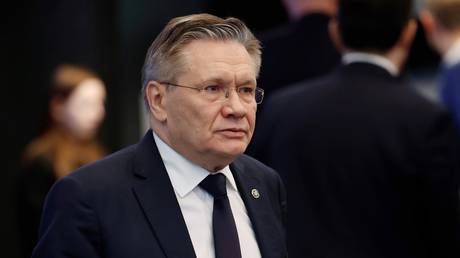
Alexei Likhatchev does not sound like a man weighed down by the crushing gravity of global isolation. When the head of Rosatom, Russia’s state-owned nuclear giant, speaks about the future of Iranian energy, his tone carries the practiced calm of a master chess player who knows his opponent’s clock is ticking. He recently stood before the microphones to deliver a message that was less of a technical update and more of a geopolitical signal flare: the offer to enrich Iranian uranium on Russian soil remains on the table.
It sounds like a dry piece of bureaucratic accounting. In reality, it is a high-stakes play for control over the invisible atoms that dictate the balance of power in the Middle East. Meanwhile, you can explore related developments here: The $1 Million Toll and the Invisible Blockade: Why the Strait of Hormuz Closure is Final.
The Weight of a Single Pellet
To understand why this offer matters, you have to look past the spreadsheets and the diplomatic cables. Think of a single ceramic fuel pellet, no larger than the tip of your pinky finger. It feels light in your hand, almost insignificant. Yet, that tiny cylinder contains the energy equivalent of a ton of coal. It represents the difference between a hospital that stays dark during a heatwave and one where the ventilators keep humming.
For Iran, these pellets are more than fuel. They are symbols of sovereignty. For the rest of the world, they are a source of profound anxiety. To see the bigger picture, check out the detailed article by The Guardian.
The central tension of the nuclear age is the "dual-use" nature of the technology. The same centrifuges that spin to create low-enriched uranium for a power plant can, with enough time and adjustment, spin faster and longer to create the material for a weapon. This is the tightrope Iran has walked for decades. Russia, sitting on some of the world's most advanced enrichment infrastructure, is offering to take the rope away and replace it with a bridge.
By enriching Iran’s uranium in Russia, Likhatchev is proposing a closed loop. Iran gets the fuel it needs for its reactors at Bushehr, but the raw material never reaches the levels of refinement that keep Pentagon planners awake at night. It is an elegant solution on paper. In practice, it is a tether.
A Partnership Born of Necessity
The relationship between Moscow and Tehran wasn't always this cozy. Historically, they were rivals for influence in the Caspian and the Caucasus. But pressure has a way of fusing unlikely materials together. Under the weight of Western sanctions, both nations have found themselves shoved into the same corner of the global playground.
Russia isn't making this offer out of a sense of altruism. The nuclear industry is one of the few sectors where Moscow still maintains a dominant global lead. They don't just build reactors; they build dependencies. When a country buys a Russian VVER-1000 reactor, they aren't just buying hardware. They are signing up for a sixty-year relationship involving fuel supply, technical maintenance, and waste management.
Rosatom is currently the world's only company that offers the full nuclear fuel cycle on a commercial scale. Likhatchev knows that by keeping the enrichment offer open, he is ensuring that Russia remains the indispensable middleman. If Iran accepts, Russia becomes the guarantor of Iranian energy security—and the gatekeeper of its nuclear ambitions.
The Ghost in the Centrifuge
Imagine a technician in the Natanz enrichment facility. He watches the gauges, listening to the high-pitched whine of thousands of centrifuges spinning at supersonic speeds. He knows that every gram of material processed is a point of contention in a UN Security Council meeting thousands of miles away.
The Russian proposal seeks to quiet that whine. By moving the enrichment process to a facility like the one in Angarsk, Siberia, the physical evidence of the process is removed from the volatile heart of the Middle East. It satisfies the Iranian need for a functioning nuclear program while providing the "transparency" the West demands.
But the real story isn't about the physics. It’s about trust—or the total lack of it.
The Iranians remember 1979. They remember when the French and the Germans pulled out of nuclear contracts after the Revolution, leaving half-finished concrete shells on the coast of the Persian Gulf. They are wary of relying on any foreign power for their energy needs. To them, domestic enrichment is an insurance policy against a world that has proven it can turn its back at a moment’s notice.
Russia’s challenge is to convince Tehran that a Russian insurance policy is better than a homegrown one.
The Invisible Stakes of the "Table"
Likhatchev’s statement that the offer is "on the table" implies a static reality, but the ground is shifting. Since the collapse of the 2015 nuclear deal (the JCPOA), the "table" has become increasingly crowded with new grievances and higher stakes.
Russia’s own position has changed. A few years ago, Moscow was a partner with the West in containing Iran’s nuclear program. Today, with the conflict in Ukraine draining Russian resources and hardening its stance against the G7, the nuclear offer takes on a more defiant edge. It is a way for Russia to demonstrate that it can still dictate terms in one of the world’s most sensitive regions, regardless of what Washington or Brussels thinks.
Consider the math of the enrichment process. Uranium ore contains less than 1% of the isotope U-235. To work in a power plant, that concentration needs to be bumped up to about 3% to 5%. To make a bomb, you need 90%.
$$U_{enrichment} = \frac{m_{235}}{m_{total}} \times 100$$
The difference between 5% and 90% is a matter of time and "separative work units." Russia is essentially offering to do the work, hold the 5%, and keep the 90% out of the equation entirely. It is a technical fix for a psychological problem.
The Silence of the Negotiating Room
When the cameras are turned off, the conversations are likely much grittier. There is the question of the "spent" fuel—the radioactive remains of the pellets after they’ve been used. Russia has traditionally insisted that this waste be returned to its territory, preventing any possibility of plutonium extraction.
This is the ultimate human element of the story: the fear of what we cannot see. We fear the radiation, we fear the explosion, but most of all, we fear the intentions of the person holding the switch.
Likhatchev is gambling that the practical need for electricity will eventually outweigh the ideological need for total nuclear independence. Iran’s power grid is aging. Blackouts are a recurring nightmare for the government in Tehran, leading to public unrest and economic stagnation. A reliable, Russian-backed nuclear stream is a tempting escape hatch.
The CEO’s words weren't just for the Iranian government, though. They were a reminder to the global community that while the West tries to de-couple from the Russian economy, the nuclear world is too deeply interconnected to be severed with a single stroke of a pen. You can stop buying Russian oil with enough preparation, but you cannot easily replace the specialized fuel rods designed for a specific Russian-built reactor.
The Long Shadow of the Atom
The sun sets over the Bushehr plant, casting long shadows across the Persian Gulf. For the people living nearby, the plant is a landmark of national pride and a promise of a modernized future. They don't see the diplomatic maneuvering or the "Separative Work Units." They see a light switch that works.
Russia’s offer remains on the table because it is the only one that acknowledges the reality of the 21st century: power is no longer just about who has the biggest army. It’s about who controls the flow of specialized knowledge and the fuel that powers civilization.
By holding onto this offer, Rosatom is holding onto a piece of the future. They are betting that eventually, the need for stability will force a handshake. It is a cold, calculated patience.
The centrifuges continue to spin, and the diplomats continue to dance, but the ceramic pellets are what will ultimately decide the fate of the region. They are the smallest pieces on the board, yet they carry the weight of entire nations. Russia is simply waiting for the moment when the cost of saying "no" finally becomes higher than the price of the fuel.
The table is set. The chairs are empty. But the atoms are already moving.