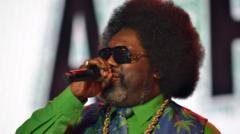
The rain in Swansea doesn’t just fall. It leans in. It’s a persistent, grey weight that smells of salt and old industry, a reminder that this was once the "Copperopolis" of the world. But lately, a different kind of fog has settled over the Mumbles and the city’s concrete veins. It’s a haze of gin, juice, and the improbable scent of Long Beach, California.
Snoop Dogg—the D-O-double-G, the man who once defined the sharp, dangerous edge of Gangsta Rap before becoming everyone’s favorite Olympic-commentating uncle—has turned his gaze toward South Wales. He wants to turn Swansea into the next Las Vegas. Read more on a related issue: this related article.
To some, this sounds like a fever dream born of too much high-grade medicinal herb. To others, it sounds like a threat to the very soul of a town that has already survived the Blitz and the slow death of the coal trade.
Imagine a man named Gwilym. He’s sixty-four. He has spent forty of those years walking the same stretch of the promenade, watching the tide pull away from the mudflats. Gwilym doesn’t know who "Snoop" is, really, beyond a vague association with baggy trousers and a specific cadence of speech. For Gwilym, the idea of a "Welsh Vegas" isn’t an economic opportunity. It is a neon-lit intrusion on a life built on the quiet, steady rhythm of the sea. More reporting by GQ delves into related perspectives on this issue.
"We don't need the glitz," Gwilym might say, clutching a lukewarm tea. "We need the jobs, aye, but not the noise."
The clash isn't just about celebrity. It is about the friction between globalized fantasy and localized reality.
Snoop Dogg’s interest in Swansea isn't entirely random. He’s expressed a genuine affinity for the place, stemming from his friendship with local figures and a bizarrely earnest appreciation for the Welsh spirit. He sees a canvas. He sees a waterfront that could sparkle with high-end hotels, casinos, and the kind of nightlife that draws private jets instead of budget coaches. He sees a brand.
But a city is not a brand. A city is a collection of scars and memories.
When a global superstar looks at a map, they see "untapped potential." They see "scalability." They see a "destination." But the people living in the terraced houses of Sandfields or the shops in the Uplands see their homes. They see the streets where they learned to ride bikes and the pubs where they toasted their fathers.
The Vegas model is built on the erasure of the local. In Las Vegas, you don't know if it’s noon or midnight. You don't know if you’re in a desert or a simulation of Venice. It is a vacuum of geography. Swansea, by contrast, is defined by its geography. It is tucked between the rugged beauty of the Gower Peninsula and the industrial grit of the docks. To "Vegas-ify" it is to suggest that what is currently there is not enough.
Consider the mechanics of the dream. Snoop’s vision involves a massive influx of capital. On paper, it’s a miracle. Construction jobs. Service sector growth. Tourism revenue. The "Snoop Effect" could, theoretically, do for Swansea what Ryan Reynolds and Rob McElhenney did for Wrexham.
But Wrexham was a rescue mission for a football club. This is a proposal to rewrite the cultural DNA of a city.
There is a specific kind of fear that comes with "regeneration." It’s the fear of being priced out of your own history. If the waterfront becomes a playground for the international elite, where does the local fisherman go? If the prices in the bars start reflecting Los Angeles instead of Lower Swansea Valley, who are these spaces actually for?
The invisible stakes are found in the Sunday morning silence. Right now, Swansea has a certain ragged charm. It’s honest. It’s a place where the wind can whip the skin off your face, but the greeting in the bakery is warm enough to compensate.
The resistance to Snoop's plan isn't necessarily a resistance to progress. It’s a defense mechanism. It’s the collective intuition of a community that has seen "saviors" come and go, usually leaving behind empty shells and broken promises.
Think of a young woman named Elin. She’s twenty-two, working three jobs, and trying to start a small graphic design business in a shared studio space near the docks. To her, Snoop Dogg is a legend. She grew up with his music. The idea of him bringing glamour to her hometown is electrifying.
"Why shouldn't we have nice things?" she asks. "Why does Swansea always have to be the 'ugly, lovely town' of Dylan Thomas? Why can't it just be lovely? Why can't it be famous for something other than being rain-soaked and forgotten?"
Elin represents the hunger for change. She sees the decay in the city center—the boarded-up windows and the hollowed-out department stores—and she sees Snoop as a lightning bolt. A way to bypass the slow, grinding gears of local government and leapfrog into the future.
This is the tension. It’s the gap between Gwilym’s preservation and Elin’s aspiration.
Snoop Dogg, for his part, seems to believe he can bridge this gap. He talks about "giving back" and "community engagement." He isn't some faceless hedge fund; he’s a man with a personality that fills a room before he even enters it. There is a charisma there that makes the impossible feel plausible.
But charisma doesn't fix a crumbling pier. Charisma doesn't navigate the complex environmental protections of the Gower.
If you look at the history of urban development, the projects that succeed are the ones that grow from the soil up, not the ones dropped from a helicopter. The fear among the "leave us alone" crowd is that Snoop’s Vegas is a prefab fantasy. They worry it’s a gold-plated sticker placed over a rusted engine.
The irony is that Snoop Dogg himself comes from Long Beach—a place with its own history of grit, sea air, and struggle. You would think he, of all people, would understand the value of authenticity.
Perhaps that’s the real gamble.
If this happens, will we see the "Snoop-a-Loop" casino standing where a community center used to be? Will the local dialect start to morph under the weight of imported cool? Or will the stubborn, resilient spirit of Wales simply absorb the rap icon, turning him into just another character in the long, strange history of the Bristol Channel?
The rain continues to fall in Swansea. It washes over the statues and the chip shops. It doesn't care about celebrity endorsements or five-year business plans.
Down by the Marina, the water is dark and deep. It’s been there long before the copper, long before the rap stars, and it will be there long after the neon lights have flickered and died.
The question isn't whether Snoop Dogg can change Swansea.
The question is whether Swansea will allow itself to be changed, or if it will simply wait for the smoke to clear, revealing the same grey, beautiful, stubborn town it has always been.
The tide is coming in. It doesn’t ask for permission. It just arrives.
Somewhere in a studio in California, a man is looking at a blueprint of a Welsh pier. Somewhere in a terrace in Sketty, a woman is putting on her coat to face the drizzle. They are looking at the same map, but they are seeing two different worlds.
One world is paved with gold and soundtracked by heavy bass.
The other is paved with wet slate and soundtracked by the cry of a lone gull.
Between them lies a bridge made of ego, hope, and the desperate desire to be seen.
Swansea is waiting. The gamble has already begun.
The dice are in the air, spinning over the salt spray, waiting to land on a shore that has seen it all before.