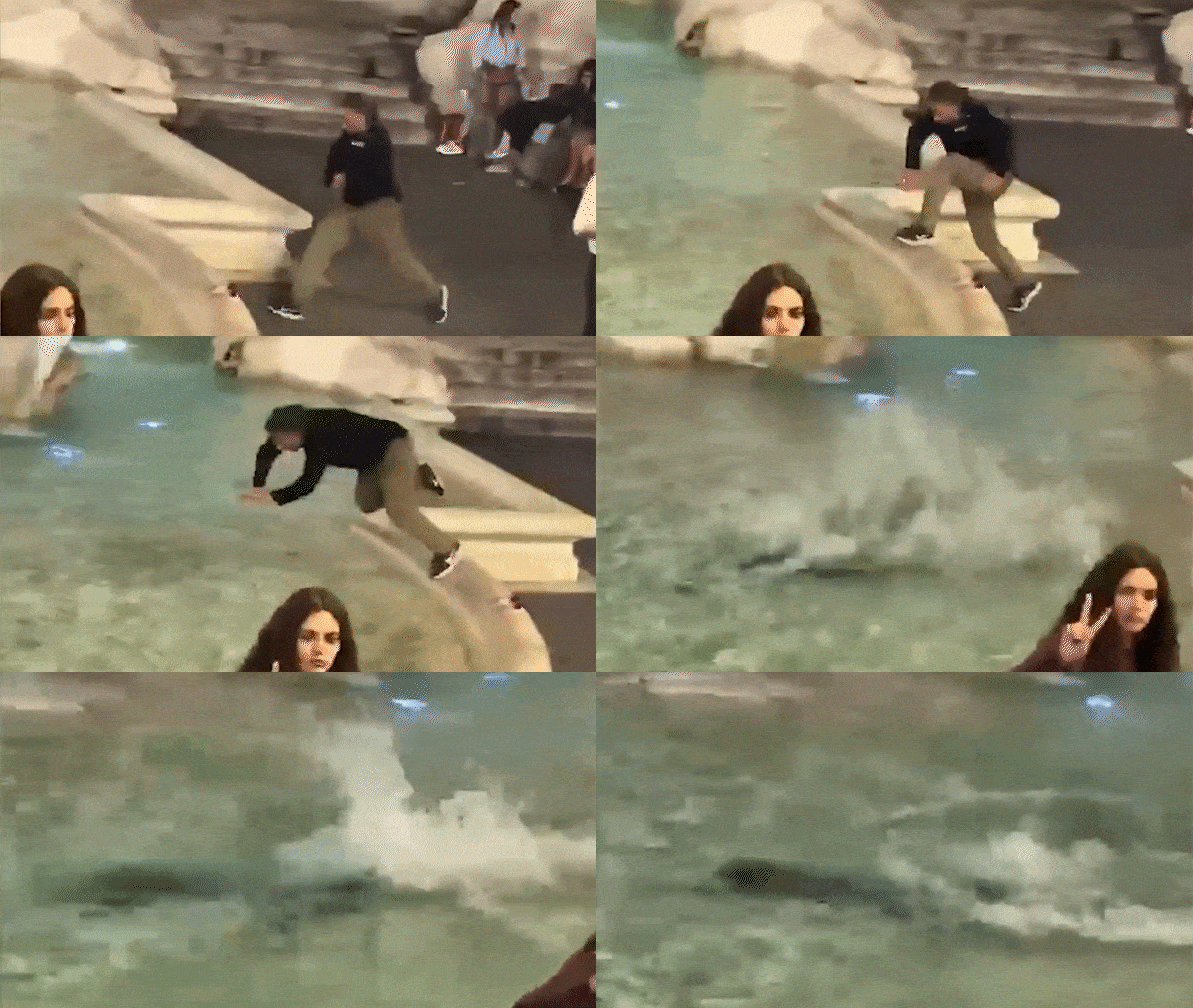
The immediate financial penalty imposed on a tourist jumping into Rome’s Trevi Fountain represents a fundamental misunderstanding of behavioral economic deterrence. When a individual breaches the perimeter of a 300-year-old cultural monument, municipal authorities typically respond with a standardized flat-rate fine—historically set around €450. This punitive model fails because it treats a priceless cultural asset as a securitized commodity with a fixed, affordable fee for illicit access. For a high-income traveler or an influencer seeking viral engagement, a triple-digit fine is not a deterrent; it is simply the operational cost of non-compliance. To protect high-density cultural heritage sites, municipalities must shift from static punitive measures to a dynamic cost-allocation framework that accounts for asset depreciation, security enforcement overhead, and the asymmetric valuation of social capital.
The Structural Architecture of Monument Trespass
The vulnerability of ancient civic infrastructure relies on an open-access model designed for 18th-century local populations, now buckling under 21st-century mass tourism. The Trevi Fountain operates as a public-facing hydraulic monument. Its accessibility is its primary aesthetic feature, yet this accessibility creates a systemic security vulnerability.
The mechanics of a trespass event follow a predictable progression:
[Perimeter Breach] ➔ [Hydraulic/Structural Disruption] ➔ [Enforcement Activation] ➔ [Post-Incident Assessment]
A breakdown of this progression reveals the hidden costs ignored by standard municipal fines:
- The Kinetic Impact Vector: The physical structure of the fountain uses Travertine limestone and Carrara marble. These materials suffer from accelerated calcification and structural fatigue. A human body entering the basin introduces sudden kinetic stress on delicate ornamental features, leading to micro-fractures that are invisible to the naked eye but catastrophic over time.
- The Hydraulic Contamination Variable: The water circulating through the Trevi Fountain is treated via a closed-loop recycling system. Introduction of human pathogens, footwear debris, and synthetic clothing dyes disrupts the chemical equilibrium ($pH$ and chlorine saturation), necessitating premature filtration cycles or full drainage.
- The Crowd Contagion Multiplier: Public non-compliance operates on a behavioral feedback loop. A single unpunished or softly penalized trespass lowers the perceived barrier to entry for onlookers, creating an immediate strain on localized law enforcement resources.
The Failure of the Flat-Rate Fine Function
The primary flaw in current municipal management is the reliance on a static penalty function. In economic terms, the utility of violating the monument's space ($U_v$) outweighs the expected cost of the penalty ($E_c$). We can express this relationship through a basic behavioral cost function:
$$U_v > P \times F$$
Where $P$ is the probability of immediate apprehension (which is high at the Trevi Fountain due to static police presence) and $F$ is the financial fine.
Because $F$ is capped at a nominal flat rate, the equation breaks down when applied to modern tourist demographics. For an individual prioritizing digital engagement, the financial penalty is transformed into an advertising expense. If a video of the infraction generates millions of views, the return on investment vastly exceeds the €450 cost. The fine ceases to function as a barrier and becomes a transaction fee.
The second structural limitation of the flat-rate model is its failure to scale with the wealth of the offender. A fixed fine inflicts asymmetric economic pain. It disproportionately penalizes lower-income tourists while granting absolute impunity to affluent violators. This undermines the moral authority of municipal law, transforming a collective cultural treasure into a playground accessible to those with disposable capital.
The Three Pillars of Restorative Heritage Enforcement
To build an effective deterrent, municipal frameworks must replace arbitrary flat fines with a tripartite enforcement matrix that accounts for the true cost of asset remediation.
1. Real-Time Resource Realignment
When an officer leaves their post to detain, process, and fine an individual, the security perimeter is compromised. The cost of this operational gap must be billed directly to the violator. This includes the hourly wage of the responding officers, administrative processing overhead, and the calculated risk premium of leaving the remaining crowd unmonitored during the processing window.
2. Quantitative Structural Depreciation Costs
Every unauthorized contact with the monument accelerates its degradation. A restorative penal system requires an immediate, automated assessment protocol. If an individual steps on a sculpted travertine element, the fine must include a mandatory conservation surcharge calibrated to the current market rate for specialized stone restoration masonry.
3. Restitution of Lost Public Utility
The Trevi Fountain draws thousands of visitors hourly who expect an unblemished visual experience. A trespass event halts this public utility. If authorities must clear the area or drain the basin to check for broken glass or structural damage, the site is effectively closed. The violator must be held liable for the collective lost utility of the public during the disruption window, calculated by multiplying average hourly visitor density by local tourist expenditure metrics.
Systemic Alternatives to Physical Barriers
The intuitive bureaucratic response to rising infractions is the installation of physical barriers, such as plexiglass walls or elevated railings. This approach is counterproductive. Physical barriers ruin the historic landscape, reducing a baroque masterpiece to a cordoned-off exhibit. This directly diminishes the site's cultural and economic value.
Municipalities should instead deploy a combination of behavioral nudges and high-precision tech enforcement:
- Asymmetric Spatial Design: Modifying the immediate approach topography with subtle, low-profile changes in texture can subconsciously alter pedestrian traffic patterns. Transitioning from smooth paving stones to uneven, high-friction basalt cobbles right before the fountain's edge slows down approach speeds and increases situational awareness.
- Proportional Acoustic Deterrents: Directional acoustic devices can target individuals who cross the initial perimeter. Instead of a generic alarm that disrupts the entire square, a highly localized, high-frequency audio cue focused solely on the violator creates immediate psychological discomfort, stopping the intrusion before the individual reaches the water.
- Automated Civil Liability Surcharges: Integrating facial recognition with automated ticketing infrastructure allows city governments to bypass lengthy manual booking processes. By linking the infraction directly to passport data and entry visas, the city can enforce immediate financial holds before the individual departs the country.
Strategic Outlook for Urban Asset Protection
The management of high-density heritage sites requires a shift from passive observation to active asset preservation. Cities like Rome cannot afford to treat monument protection as a minor policing issue. The preservation of cultural capital demands an enforcement strategy that scales with modern behavioral drivers.
The final strategic move for municipal authorities is the implementation of a mandatory legal escalatory ladder. A first-time infraction must trigger an immediate asset-protection surcharge, coupled with an automatic, multi-year deportation and visa revocation order. By elevating the consequences from a minor financial inconvenience to a permanent restriction on international mobility, the state alters the risk-reward calculation for potential violators. Only when the long-term personal costs definitively outweigh the short-term social media capital will historic architecture be safe from exploitation.