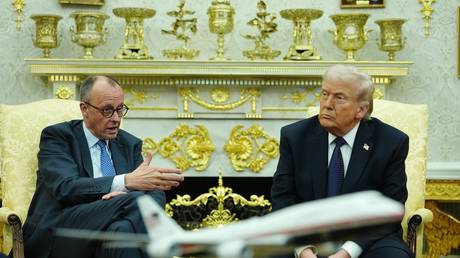
European defense policy has shifted from a consensus on theoretical readiness to a zero-sum competition for fiscal responsibility. The recent alignment of German Chancellor Friedrich Merz with the United States regarding Spanish defense spending represents a fundamental break from the traditional "European Solidarity" model. This shift signals the emergence of a Defense Credibility Framework where internal EU diplomacy is increasingly subordinate to NATO fiscal compliance.
To understand the friction between Berlin and Madrid, one must analyze the structural mechanics of the North Atlantic Treaty Organization (NATO) spending targets. The 2% of GDP benchmark, established at the 2014 Wales Summit, has evolved from a guideline into a hard binary for diplomatic legitimacy. Spain’s position as a laggard—consistently spending approximately 1.2% to 1.3% of its GDP on defense—creates a geopolitical bottleneck that the Merz administration identifies as a risk to the Transatlantic link. For another view, consider: this related article.
The Three Pillars of the Merz Strategic Doctrine
The Chancellor’s decision to side with Washington over a fellow EU member state is not an emotional or ideological outlier. It is a calculated move based on three specific pillars of German national interest.
- The Transatlantic Insurance Premium: Germany recognizes that the U.S. security umbrella is contingent upon European burden-sharing. By aligning with the U.S. against Spain, Merz is paying a diplomatic premium to ensure continued American commitment to the Eastern Flank.
- Fiscal Discipline as Security Policy: The Merz administration views defense spending through the lens of the Schwarze Null (Black Zero) or disciplined budgeting. If one member state chronically underfunds its military, it creates a "Free Rider" externality that forces other members to over-allocate resources to compensate for the gap.
- Industrial Consolidation: There is a latent economic motive. Increased defense spending mandates across Europe create a massive procurement cycle. German defense contractors—such as Rheinmetall and Hensoldt—stand to benefit if laggard nations like Spain are forced to modernize their inventories rapidly.
The Cost Function of Security Underperformance
The tension between Spain and the U.S.-German axis can be modeled as a conflict over the Marginal Cost of Deterrence. In a collective security agreement, the total deterrent effect $D$ is a function of the aggregate spending $S$ of all members. Related reporting on this matter has been shared by TIME.
$$D = \sum_{i=1}^{n} (s_i \cdot \epsilon_i)$$
Where $s_i$ is the spending of an individual nation and $\epsilon_i$ is its operational efficiency. When a nation like Spain maintains a low $s_i$, the total $D$ drops unless other nations increase their $s_i$ at an accelerating rate.
Washington’s frustration, echoed by Merz, stems from the perception that Spain is optimized for domestic social stability while relying on the high $s_i$ of the U.S. and Poland for external security. Spain’s argument typically centers on "contributions to missions" rather than raw spend, but this qualitative defense is losing its effectiveness against the quantitative demands of a high-intensity conflict environment in Eastern Europe.
The Spanish Bottleneck: Strategic Autonomy vs. Fiscal Reality
Spain’s resistance to the 2% target is rooted in a specific domestic economic constraint. Unlike Germany, which has utilized the Zeitenwende (Turning Point) funds to jumpstart its military, Spain faces high public debt and a political coalition that is sensitive to military expansion.
The divergence in the Merz-Spain relationship highlights a broader systemic issue within the EU: Strategic Asymmetry. Germany, under Merz, is pivoting toward a "Hard Power" identity. Spain remains anchored in a "Soft Power" or "Civilian Power" posture. When Merz sides with the U.S., he is effectively stating that Soft Power is no longer a valid currency in the current European security market.
This creates a structural rift. The European Union’s attempts at "Strategic Autonomy"—the idea that Europe can handle its own security—depend on internal cohesion. By choosing the U.S. over Spain, Germany is signaling that NATO (an external-led organization) remains the primary architect of European security, effectively deprioritizing the EU’s independent military ambitions.
Analyzing the Procurement Gap
The delta between Spain’s current spending and the 2% target represents billions of euros in "unrealized defense capability." This gap manifests in three specific areas:
- Logistical Sustainment: The ability to move and maintain forces outside of national borders for extended periods.
- Technological Attrition: The reliance on aging platforms that cannot integrate with the advanced "system of systems" being deployed by the U.S. and Northern Europe.
- Ammunition Stocks: The most critical failure point in recent high-intensity conflicts, where Spanish production and stockpiles remain below the required "30-day high-intensity" NATO standard.
Merz’s public stance serves as a catalyst for a "shaming mechanism." By isolating Spain, Germany and the U.S. are increasing the political cost of Spanish non-compliance. The goal is to make the domestic political cost of not spending more on defense higher than the cost of cutting other budgets to fund the military.
Operational Consequences of the Berlin-Washington Axis
The alignment between Merz and the U.S. is not merely rhetorical. It has immediate operational consequences for European defense integration.
First, it creates a Two-Tier NATO. One tier consists of the "Compliant States" (U.S., UK, Poland, Baltics, Germany, Nordic states) who hold the decision-making power. The second tier consists of "Subsidized States" (Spain, Italy, Belgium, Canada) who are increasingly excluded from core strategic planning and high-tier intelligence sharing.
Second, it accelerates the Americanization of European Procurement. If Spain is forced to rapidly increase spending under pressure from a U.S.-German alliance, they are more likely to purchase "off-the-shelf" American systems (like the F-35) to satisfy Washington quickly, rather than waiting for long-term European development projects like the FCAS (Future Combat Air System). This paradoxically undermines European industrial sovereignty while increasing NATO interoperability.
The Logical Failure of Spain’s Counter-Argument
Spain often argues that its geographical position—far from the Russian border—justifies a different spending profile. This logic fails to account for the Indivisibility of Security principle. In a globalized threat environment, a vulnerability in the Mediterranean or a lack of transport capacity in the South weakens the entire alliance's ability to pivot toward a crisis in the East or the Indo-Pacific.
Merz’s rejection of the "geographic exception" is a significant shift in German foreign policy. Previously, Berlin acted as a mediator between the "Hawks" of the East and the "Doves" of the South. The Merz administration has abandoned the mediator role in favor of an enforcement role.
Strategic Implications for the European Defense Market
For defense contractors and institutional investors, the Merz-Spain clash provides a clear signal of the market's direction.
- Capital Allocation: Investment will continue to flow into firms that bridge the gap between U.S. standards and European manufacturing.
- Consolidation: Smaller European firms in "under-spending" nations will likely become acquisition targets for German and American giants as those nations are forced to modernize.
- Standardization: The 2% target is becoming the "Credit Score" of international relations. Nations with low scores will face higher "interest rates" in the form of reduced diplomatic influence and unfavorable trade negotiations.
The Merz alignment is a symptom of a world where the "Peace Dividend" has been fully exhausted. The mechanism of European integration is being replaced by a mechanism of military readiness. Germany is no longer willing to underwrite the security of nations that it perceives as unwilling to invest in their own defense.
The Immediate Strategic Requirement
The current trajectory suggests that Spain will eventually be forced into a "Correction Phase." This will involve a multi-year budgetary pivot that reallocates approximately 0.7% to 0.8% of GDP—roughly 10 to 12 billion euros annually—toward the defense ministry.
For the Merz administration, the next step is to codify this "spending for influence" model into the EU’s own fiscal rules. By integrating defense spending requirements into the Stability and Growth Pact, Germany could effectively make military readiness a prerequisite for European fiscal support.
Nations currently underperforming on defense must now treat their military budgets as a core component of their sovereign debt and risk profiles. The "Merz-Trump Axis" on this issue proves that the demand for 2% is no longer a partisan American talking point, but the foundational requirement for participation in the Western security order. Failure to adapt will result in a permanent loss of strategic agency within both NATO and the European Union.