The humidity in Dubai doesn't just sit on you; it clings. On a typical Tuesday evening, the air near the Al Seef district smells of salt water, expensive gasoline, and the charcoal from a thousand nearby grills. It is a city built on the promise of absolute safety—a glittering glass sanctuary where the chaos of the Middle East is supposed to stop at the border.
Then came the buzz.
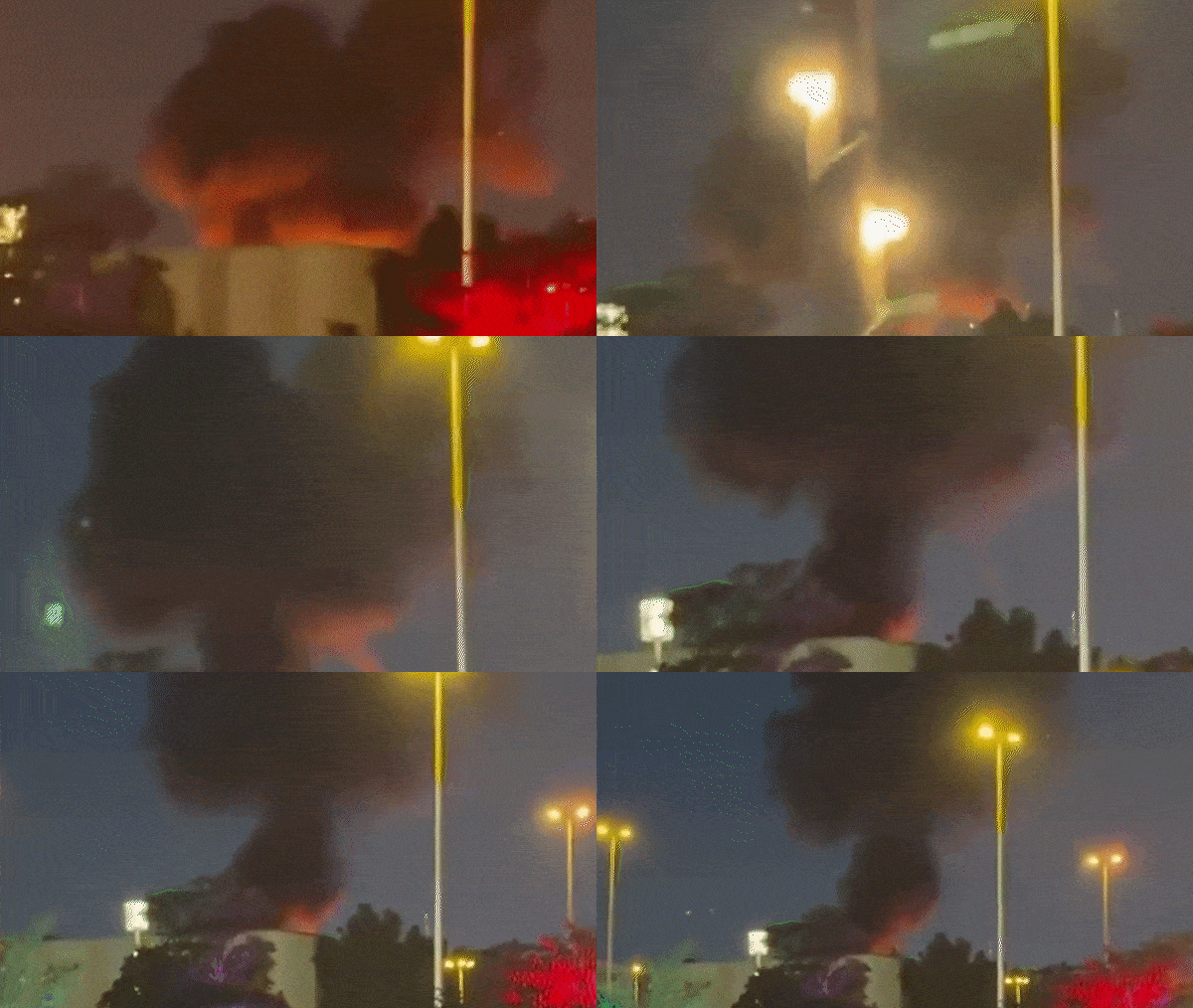
It wasn't the roar of a jet or the familiar thrum of a helicopter. It was a high-pitched, lawnmower-engine whine that felt alien to the sleek skyline. For those standing near the perimeter of the U.S. Consulate grounds, the sound was the first indicator that the invisible shield had cracked. When the Iranian-made delta-wing drone finally made contact with the earth inside the diplomatic compound, the sound wasn't a world-ending boom. It was a sharp, mechanical crunch. Metal meeting sand. Certainty meeting doubt.
The headlines the next morning spoke of "kinetic impact" and "diplomatic escalations." But those are cold words for a hot reality. To understand what happened in that moment, you have to look past the debris and into the terrifyingly simple math of modern warfare.
The Geometry of a Shadow
We often think of international conflict as a clash of titans—billion-dollar carriers, stealth fighters, and sprawling satellite networks. This was different. This was a piece of hardware that costs less than a luxury sedan, launched from hundreds of miles away, guided by consumer-grade GPS, navigating through one of the most heavily defended airspaces on the planet.
Consider the "Shahed" style drone, the likely culprit in this incursion. It is not a predator; it is a persistent nuisance that eventually becomes lethal. It flies low, hugging the terrain to hide from the massive radar arrays that look for bigger, faster threats. It is slow. It is loud. And yet, it arrived exactly where it was intended to go.
The physical damage to the consulate grounds was, by military standards, negligible. A few scorched patches of pavement. A shattered wall. No lives were lost in this specific instance. But the psychological payload was massive. In the world of diplomacy, a consulate is more than an office; it is sovereign ground. Touching it is a dare.
The Illusion of Distance
For the families living in the high-rises overlooking the consulate, the event transformed the geopolitical into the personal. Imagine a young father, an expat from London or Mumbai, watching the lights of the Burj Khalifa from his balcony while his daughter sleeps in the next room. He has always operated under the assumption that the "troubles" of the region are a television show—something that happens in the deserts of Iraq or the mountains of Yemen.
That night, the television show walked into his backyard.
The drone didn't just hit a patch of dirt in a compound; it hit the collective sense of security that allows Dubai to function as a global hub. If a slow-moving, low-tech propeller plane can find its way to the heart of the diplomatic district, what else can get through?
This is the "asymmetric" reality we now inhabit. In the past, if a nation wanted to strike at a superpower’s interests, they needed a navy or an air force. Today, they need a workshop and a shipping container. The barrier to entry for chaos has never been lower.
A Message Written in Carbon Fiber
Why now? Why Dubai?
The United Arab Emirates has spent the last decade performing a high-stakes balancing act. They are a primary security partner for the United States, yet they share a maritime border and deep economic ties with Iran. They have attempted to be the "Switzerland of the Middle East," a neutral ground where trade trumps ideology.
The drone strike was a physical manifestation of a geopolitical warning. It was a reminder from Tehran that the "glass towers" are vulnerable. By targeting the U.S. Consulate specifically, the message was twofold: We can reach your protectors, and we can reach you.
Metaphorically, it is like a rock thrown through a window in a gated community. The rock itself doesn't cause much damage, but the sound of the glass breaking tells every neighbor that the gate is no longer locked.
The New Architecture of Fear
Defense is now a game of catching flies with chopsticks. The U.S. and its Gulf allies possess the Patriot missile system, a marvel of engineering designed to intercept ballistic missiles traveling at several times the speed of sound. But using a $3 million Patriot missile to stop a $20,000 drone is a losing game of attrition.
The response to the Dubai incident hasn't just been diplomatic cables and angry speeches at the UN. It has been a quiet, frantic rush to install "soft-kill" measures. These aren't missiles; they are invisible walls of radio frequency.
Electronic warfare suites now hum on the rooftops of embassies. They look for the specific frequency used by the drone’s operator or its GPS receiver and flood it with noise. They try to "blind" the machine, hoping it will lose its way and tumble into the sea.
But the drones are getting smarter. The latest iterations don't need a constant link to a pilot. They use "image recognition" to look at the ground and compare it to a map in their memory. They don't listen for instructions; they just watch. When the machine stops listening, the electronic "noise" becomes useless.
The Human Cost of High-Tech Harassment
Beyond the hardware, there is the human element of those stationed inside the consulate. These are men and women—security details, visa officers, cultural attachés—who signed up for "hardship posts," but perhaps not for the psychological toll of loitering munitions.
There is a specific kind of stress that comes from a threat you can't see until it’s too late, and that you can't stop even when you do see it. It is the stress of the sitting duck. The drone strike in Dubai was a "harassment" mission. It wasn't meant to win a war; it was meant to fray nerves. It was meant to make the staff at the consulate look at the sky every time they hear a distant motorcycle.
It worked.
The diplomatic community in the Gulf is now operating under a new set of protocols. The "open" feel of these missions is being replaced by reinforced concrete and overhead netting. The architecture of diplomacy is beginning to look more and more like the architecture of a bunker.
The Looming Question
We are entering an era where the sky is no longer a neutral space.
As the investigation into the Dubai debris continues, the fingerprints lead back to a specific production line in Isfahan. The carbon fiber, the wiring harnesses, the small, efficient engines—they are all part of a standardized kit of disruption.
The real question isn't whether we can build a better shield. We probably can't. The real question is how we live in a world where the shield is permanently broken.
When the sun rose over the Persian Gulf the morning after the strike, the water was as blue as ever. The dhows moved slowly through the creek, and the tourists returned to the malls. But for those who saw the flash or heard the whine of the engine, the city felt different. The glass was still standing, but everyone knew it was thinner than they had thought.
Security is often just a story we tell ourselves so we can sleep at night. In Dubai, that story just got a lot harder to believe.
The drone is no longer in the air, but the sound of its engine hasn't stopped echoing.