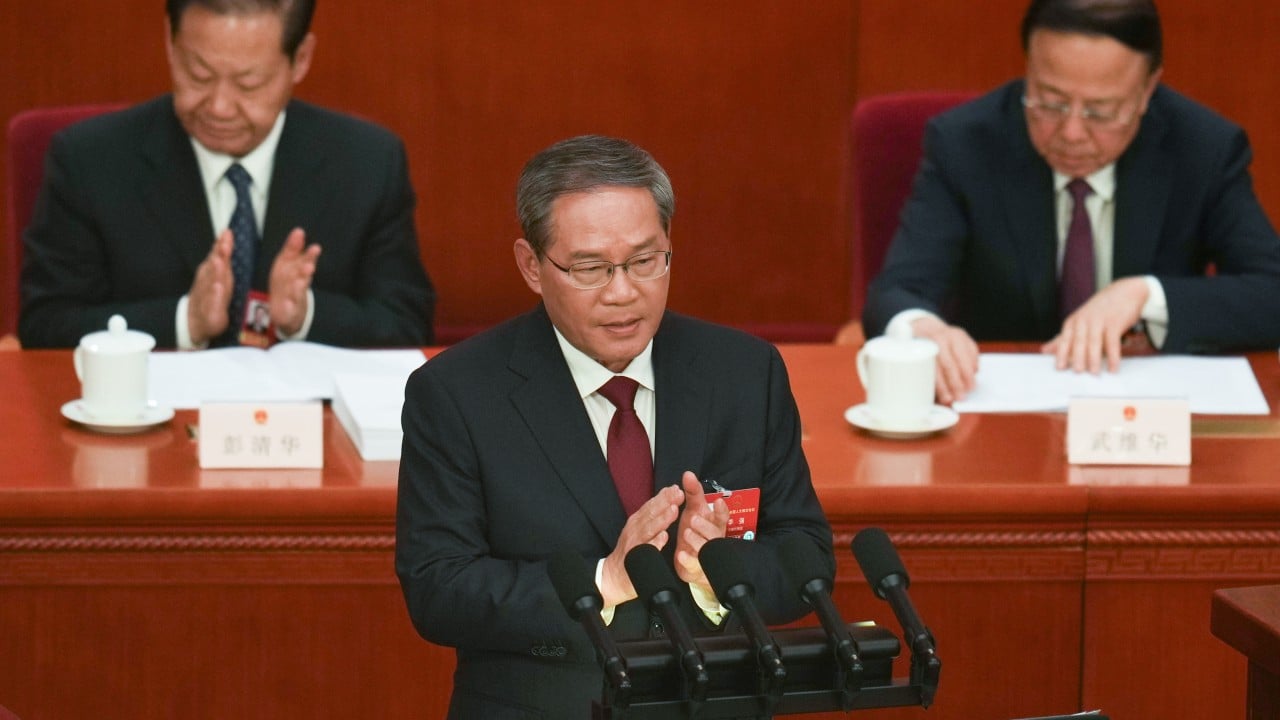
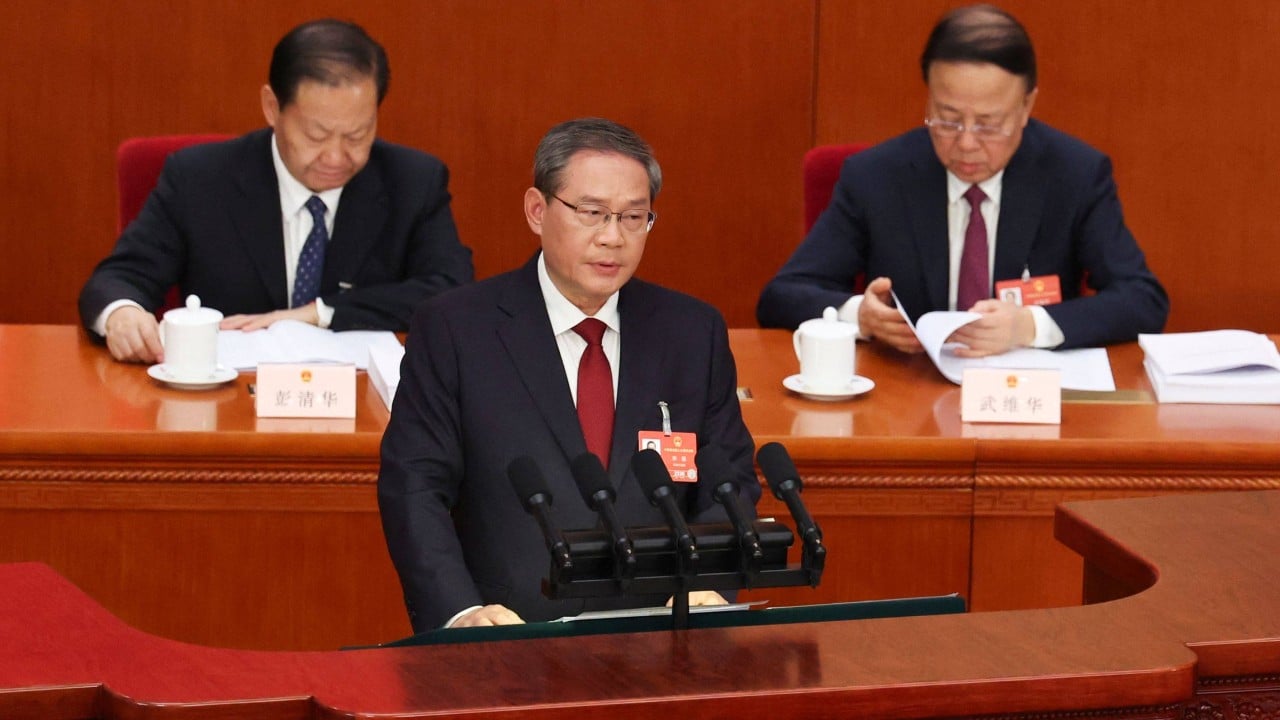
The Western press is currently tripping over itself to analyze Li Qiang’s "Two Sessions" address as a desperate pivot toward stability. They see a premier under pressure, a slowing GDP target, and a defensive posture on Taiwan. They are wrong. What we witnessed in Beijing wasn't a retreat; it was a deliberate hardening of the shell.
If you’re reading the standard headlines about China’s "economic headwinds," you’re falling for the script. Beijing is perfectly happy to let you believe they are struggling with a property crisis while they quietly rewire the global supply chain for a post-dollar world.
The GDP Target Is a Red Herring
Every year, analysts obsess over the 5% growth target like it’s a vital sign. It isn’t. In 2026, the GDP figure is a political vanity metric designed to keep the domestic middle class calm while the state strips the copper out of the old economy to fund the "New Three" industries.
I’ve watched Western firms pour billions into Chinese retail markets thinking the "recovery" is just around the corner. It’s not coming back. The capital that used to flow into luxury malls and speculative high-rises in Shenzhen is now being forcibly diverted into high-end manufacturing and logic chips. Li Qiang isn’t trying to save the consumer; he’s building a fortress.
When the Premier talks about "high-quality development," he isn't using a buzzword. He’s signaling the end of the era where China cares about your ROI. If your business doesn't align with the CCP’s push for total technological self-reliance, you are baggage.
The Trade War Is Over and the West Lost
The common consensus is that the US-China trade war is a stalemate or a slow burn. That’s a fundamental misunderstanding of the current board. By the time Li Qiang stood up in 2026, the decoupling was already a reality, not a threat.
The "New Productive Forces" mentioned in the report aren't just about making better EVs. They are about creating a closed-loop ecosystem where Western IP is irrelevant. While Washington argues over export controls on $7\text{nm}$ chips, Beijing is subsidizing the mass production of legacy-node chips that run everything from your toaster to your F-150.
Total dominance in the "unsexy" tech is how you win a trade war. If you control the $28\text{nm}$ to $90\text{nm}$ market, you control the world’s inflation rate. Li Qiang knows this. He doesn't need to win the race for $2\text{nm}$ AI processors today if he can hold the global manufacturing floor hostage tomorrow.
The Artificial Intelligence Illusion
The "AI Plus" initiative announced at the sessions is being framed by some as China playing catch-up to OpenAI or Google. This is a dangerous misread.
China isn't interested in building a better chatbot to write poetry or help kids cheat on history papers. They are integrating AI into the industrial backbone—predictive logistics, autonomous port management, and real-time kinetic targeting.
- The Myth: China is behind because of GPU shortages.
- The Reality: They are optimizing software to run on domestic architectures like Moore Threads and Biren, accepting lower performance in exchange for zero reliance on Nvidia.
Imagine a scenario where the US achieves AGI first, but China has already automated 80% of its heavy industry using "inferior" domestic silicon. Who has the actual leverage when a supply chain crisis hits? The country with the smart software, or the country with the automated factories actually making the hardware?
Taiwan and the PLA: The Price of Silence
The rhetoric on Taiwan in the 2026 report was notably "standard," which sent the markets into a sigh of relief. This is the most "insider" mistake you can make. In Beijing, silence is noise. The removal of certain conciliatory phrases regarding "peaceful reunification" isn't a typo. It’s a calibration.
The PLA’s budget increase isn't about an imminent June 2026 invasion. It’s about "Area Access/Area Denial" (A2/AD). The goal is to make the cost of Western intervention so high that the US military's internal logic dictates a retreat.
Li Qiang’s focus on "sovereign security" over "economic openness" tells you everything you need to know. They are preparing for a "gray zone" reality where the lines between trade, technology, and kinetic warfare don't exist. If you are a CEO with a heavy footprint in the Taiwan Strait and you aren't running "Total Loss" simulations, you are derelict in your duty.
Stop Asking if China Is "Investable"
The most common question I get is: "Is China still investable?"
It’s the wrong question. It assumes you have a choice.
China is no longer an emerging market; it is a parallel ecosystem. You don't "invest" in China anymore; you hedge against it, or you surrender to its gravity. The 2026 priorities make it clear: the door is open, but there’s a guard at the entrance checking your "loyalty to the mission."
Foreign firms are being relegated to "service providers" for Chinese national champions. If you provide a component they can't make yet, you’re welcome. The second they can replicate it, your permits will vanish. This isn't "unfair competition"—it's a national survival strategy.
The Brutal Truth About the 2026 Pivot
Li Qiang isn't the "pro-business" moderate the West hoped for. He is the operational lead for a pivot to a wartime economy in everything but name.
- Fiscal Discipline is a Weapon: By keeping the stimulus small, Beijing is avoiding the hyper-inflationary trap the West fell into. They are building a "dry powder" reserve for a genuine global conflict.
- Energy Dominance: While the West debates carbon taxes, China is building coal and nuclear at a rate that ensures their industrial electricity costs remain the lowest in the world.
- The Youth Unemployment Fix: They aren't trying to create "jobs" in the Western sense. They are redirecting the surplus of engineers into state-directed R&D, essentially militarizing the workforce under the guise of "industrial upgrading."
The "Two Sessions" were a signal to the Global South that the "China Model" is now officially a closed-loop alternative to the Washington Consensus. If you’re waiting for China to "fix" its economy by adopting Western-style consumerism, you’re going to be waiting until the 2030s, by which point you’ll be buying your parts from a company owned by the SASAC.
Stop looking for the "recovery." Start looking at the fortification. The 2026 report wasn't an olive branch; it was the blueprint for a fortress.
Accept that the era of "Global China" is dead, and the era of "Fortress China" has begun. Adapt your supply chain or prepare to be part of the collateral damage. There is no middle ground.
Pull your capital out of the "old" China—the retail, the real estate, the consumer tech. If you aren't in the guts of the machine—the materials science, the lithography, the energy storage—you are irrelevant to the 2026 agenda.
Move your operations to the "plus one" markets now, because when the "gray zone" turns dark, your "China-ready" strategy will become your greatest liability.