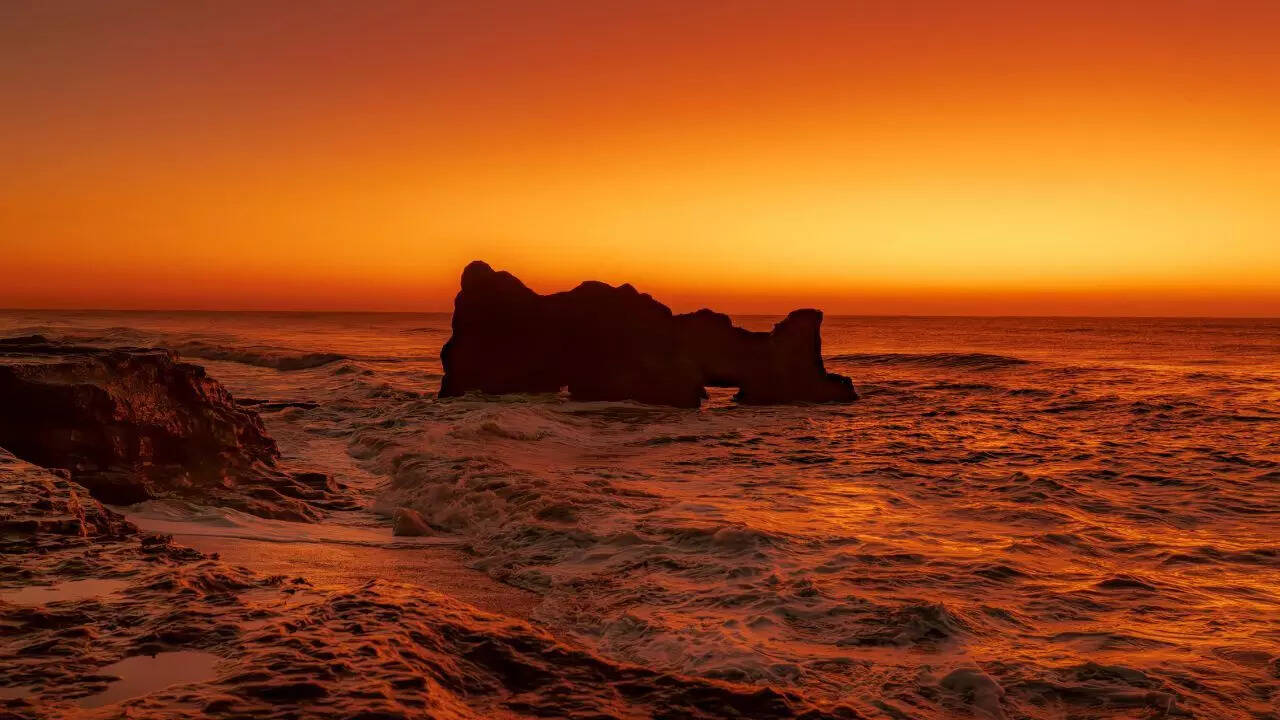
If you stood on the Martian northern plains four billion years ago, you wouldn't see a frozen red desert. You'd be looking at a coastline. The waves would be crashing against dark volcanic sand. The air would be thick enough to breathe—well, almost. For decades, planetary scientists have fought over whether Mars was "warm and wet" or "cold and icy." The skeptics pointed to the lack of clear, visible shorelines. They argued that if a massive ocean existed, we should see the scars.
The problem is we were looking at the surface.
New radar data from the MARSIS instrument on the Mars Express orbiter has finally pierced the dust. It's found what we've been missing. Underneath meters of debris and sediment lies a continuous, buried structure that looks exactly like a terrestrial shoreline. This isn't just a "maybe" anymore. We're looking at the literal edges of a lost world.
Why we couldn't see the beaches until now
Mars is a dusty place. Global dust storms happen every few years. Over billions of years, those storms have deposited a thick blanket of "regolith" over everything. Imagine trying to find a beach on Earth if someone dropped fifty feet of dirt on top of it. You wouldn't see the sand or the tide marks. You'd just see a flat, boring plain.
Researchers used low-frequency radar to see through that noise. Radar pulses bounce off different materials in different ways. Dense volcanic rock reflects differently than loose, water-laid sediment. When the team analyzed the dielectric properties—basically how well the ground conducts or resists the radar signal—they found a sharp transition.
This transition follows a specific elevation contour around the entire northern hemisphere. It's not random. It's a level line. On Earth, we call that sea level.
The fingerprints of a sedimentary sea
The data shows that the northern plains are filled with low-density material. This material is consistent with massive amounts of sediment being deposited into a standing body of water. We're talking about millions of cubic kilometers of material.
On Earth, we see similar structures in the deep-sea fans off the coast of the Mississippi or the Amazon. Those are massive deposits of silt and clay that settle out as a river enters a still ocean. On Mars, the radar data shows those same types of "lobate" or fan-shaped structures buried beneath the surface.
This isn't just "wet soil" or "permafrost." This is the fingerprint of a massive, long-lived ocean. We're talking about a sea that covered a third of the planet. It was probably miles deep in some places.
Why the skeptics are losing the fight
A common argument against a Martian ocean is that the planet was too cold. Some researchers think it was always a frozen snowball. They say any "water" was just short-lived bursts from melting glaciers. But the radar data contradicts that.
Glacial meltwater doesn't create the massive, uniform shorelines we're seeing. It creates chaotic, localized channels. It doesn't create a hemispheric-scale sea level.
To get a continuous shoreline, you need a stable, long-lived body of water. You need an atmosphere thick enough to keep that water from boiling away into space. This means ancient Mars was much more like Earth than we thought.
The mysterious "shoreline-like" features are real
One big hurdle was that the "shorelines" weren't always at the same elevation. This gave the skeptors ammunition. "If it's a sea level, why is it crooked?"
The answer is planetary deformation. Mars' crust has shifted. Massive volcanic provinces like Tharsis (where the giant volcanoes are) actually tilted the entire planet. When you account for that "true polar wander," the shorelines line up perfectly.
The radar data confirms that these features were formed when the planet's gravity and rotation were in a different orientation. This means we're looking at something incredibly old—probably between 3.5 and 4.1 billion years.
Where did all that water go
The ocean didn't just disappear overnight. It took millions of years. Much of it escaped into space as the Martian magnetic field died. Without that shield, the solar wind stripped away the atmosphere. The water literally evaporated and got blown into the void.
But a huge amount of it is still there.
The radar data doesn't just show the shorelines. It shows what's underneath them. We're seeing evidence of massive underground aquifers. Some of those "buried oceans" might still be liquid today.
The search for Martian life is about to change
We've been searching for life in "habitable zones." We've been looking at Gale Crater and Jezero Crater. Those are great spots. They're ancient lakebeds. But now we have a map of a whole ocean.
This changes the game. We're no longer looking for a puddle. We're looking for a biosphere.
The buried shorelines are the best places to look for biosignatures. On Earth, the intertidal zones—the areas where the ocean meets the land—are the most biologically productive places on the planet. They're where life probably started.
If we want to find evidence of Martian life, we need to stop looking at the bottom of craters. We need to look at the edges of the northern plains. We need to dig into those buried beaches.
The next mission targets are clear
NASA's next few years of Mars exploration will likely shift toward these coastal zones. The radar data is our treasure map. It tells us exactly where the sediment is thickest and where the transitions are sharpest.
If you want to stay on top of this, watch the upcoming Mars Sample Return mission closely. While it's focused on Jezero, the data we get from those rocks will help calibrate the radar findings. We'll be able to tell exactly what those "low-density materials" are made of.
The idea of a dry, dead Mars is dying. The more we look, the more we see a world that was once blue. The beaches are still there. They're just waiting for us to dig them up.