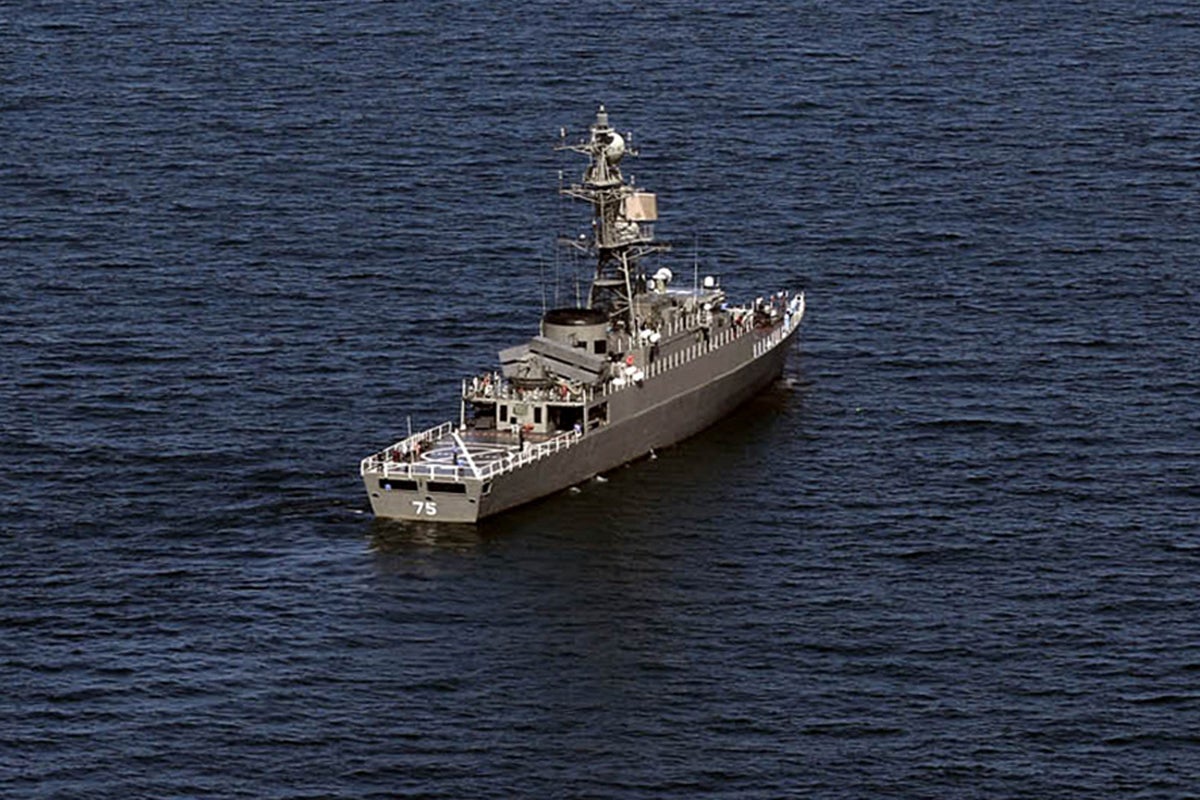
The IRIS Sahand, a mainstay of the Iranian Navy’s regional presence, has met a violent end in the deep waters off the coast of Sri Lanka. While early reports point toward a generic "technical failure," the reality emerging from the wreckage suggests something far more calculated. This was not a simple engine room fire. The precision of the hull breaches and the timing of the incident—occurring while the vessel was transiting a sensitive maritime corridor—point toward a sophisticated underwater strike. At least one sailor is confirmed dead, with dozens more hospitalized in Colombo, but the true casualty is the myth of Iranian naval resilience.
This sinking represents a massive intelligence and security failure for Tehran. The Sahand was not just a ship; it was a symbol of domestic manufacturing, a Moudge-class frigate marketed as "radar-evading." To have it neutralized so effortlessly in the Indian Ocean sends a chilling message to the Islamic Republic's military command.
The Myth of Domestic Superiority
The Sahand was launched with significant fanfare in 2018. Iranian state media hailed it as a breakthrough in indigenous engineering. However, the ship’s history has been plagued by stability issues and maintenance backlogs. Analysts who have monitored the vessel’s deployment cycles noted that its "stealth" capabilities were largely cosmetic, consisting of flat-paneled superstructures that did little to mask its heat signature or acoustic profile.
When the ship began to list heavily off the Sri Lankan coast, the initial narrative from Tehran focused on a "mishap during repairs." This story fell apart as soon as local witnesses and satellite imagery confirmed the ship was in open water, moving under its own power before a series of muffled underwater blasts crippled its propulsion. The speed with which the Sahand took on water indicates that multiple compartments were breached simultaneously—a signature of modern torpedo or limpet mine technology rather than a singular accidental explosion.
Evidence of a Submarine Strike
Military analysts are currently dissecting the acoustic data captured by regional monitoring stations. A standard boiler explosion produces a specific frequency; a high-velocity impact against a hull produces another. Sources within the Sri Lankan maritime authorities, speaking on the condition of anonymity, reported that sonar "pings" from an unidentified source were detected in the vicinity hours before the Sahand went down.
This points toward the presence of an advanced submarine. Operating a submersible in these waters requires high-level hydrographic knowledge and silent running capabilities. If a submarine was indeed responsible, it signifies a level of reach that few of Iran’s adversaries possess. It also highlights the total failure of the Sahand’s own anti-submarine warfare (ASW) suite. The frigate was supposed to be equipped with modern sonar and torpedo tubes designed specifically to prevent this type of ambush. That it was sunk without firing a single defensive shot suggests its sensors were either offline or completely outmatched by the attacker’s jamming technology.
The Strategic Value of the Indian Ocean
Why target a frigate near Sri Lanka? The geography is the message. Iran has been attempting to project power far beyond the Persian Gulf, using the Indian Ocean as a transit point for "diplomatic" missions to friendly ports. By sinking the Sahand here, the attacker has demonstrated that there is no safe harbor for Iranian assets, even thousands of miles from the Strait of Hormuz.
The Indian Ocean is the world’s busiest energy corridor. Any instability here draws immediate international scrutiny. For Iran, the loss of the Sahand is a logistical nightmare. They lack the deep-sea salvage capabilities to recover the vessel, meaning their sensitive encryption hardware and Russian-origin radar components now sit on the ocean floor, ripe for recovery by foreign intelligence agencies.
A Pattern of Maritime Attrition
This is not an isolated event. Over the last three years, the Iranian Navy and the IRGC’s maritime wing have suffered a string of "accidents." From the sinking of the Kharg in 2021 to the mysterious fires aboard smaller patrol craft, a shadow war is being fought beneath the waves. The common denominator is a lack of transparency from Tehran and a consistent failure to protect their most expensive assets.
The Moudge-class program was supposed to be the backbone of a blue-water navy. Instead, it is becoming a graveyard of high-priced hardware. The Iranian military-industrial complex relies heavily on "black market" components and reverse-engineered technology from the 1970s. When these systems are stressed by long-distance deployments or sophisticated electronic warfare, they fail. The Sahand was likely operating with a patchwork of sensors that couldn't communicate effectively with its weapons systems.
The Human Cost of Negligence
Beyond the geopolitical maneuvering, the crew of the Sahand paid the price for these systemic failures. Survivors brought to shore in Sri Lanka described a chaotic scene where emergency bulkheads failed to close and internal communication systems went dark immediately after the first impact. This speaks to poor damage control training—a recurring theme in the Iranian Navy.
In modern naval warfare, a ship’s survival depends on the "golden hour" after a hit. If the crew cannot isolate the flooding, the ship is lost. The fact that the Sahand sank so rapidly suggests that the crew was neither equipped nor trained to handle a major hull breach. One sailor lost his life not just to an enemy strike, but to a command structure that values propaganda over basic safety and redundant systems.
The Geopolitical Fallout
Tehran now faces a dilemma. To admit they were attacked by a submarine is to admit their coastal defenses and blue-water escorts are useless. To maintain the "accident" narrative is to admit their domestic shipbuilders are incompetent. Neither option is palatable for a regime that relies on an image of strength to maintain domestic control.
Regional powers are watching closely. India, which maintains a massive presence in these waters, has remained officially silent but has undoubtedly increased its surveillance flights. For the United States and its allies, the sinking of the Sahand serves as a reminder of the inherent vulnerability of Iran’s conventional naval forces. While Tehran can disrupt shipping with cheap drones and fast boats in the narrow confines of the Gulf, they are hopelessly outclassed in the deep ocean.
The technical specifications of the Sahand included an $Oto$ $Melara$ 76mm naval gun and various surface-to-air missiles. None of these mattered. In the cold calculus of maritime warfare, a ship that cannot see what is beneath it is merely a target.
The wreckage of the Sahand is now a permanent fixture of the seabed. It serves as a reminder that "indigenous" technology is no substitute for high-end integrated defense systems. Until Tehran can secure its vessels against the silent threats lurking in the depths, their ambitions of being a global maritime power will remain submerged.
Verify the status of your deep-sea assets and double-verify the acoustic signatures of any "unidentified" vessels in your sector.