On the morning of June 30, 1908, a section of the Siberian forest roughly the size of Tokyo ceased to exist. Eyewitnesses hundreds of kilometers away described the sky splitting in two, followed by a heat so intense they felt their clothes might ignite. In the decades since, popular science has leaned heavily on a single, convenient comparison to explain the Tunguska event. We are told it was 1,000 times more powerful than the Hiroshima bomb. This comparison is not just lazy; it is fundamentally misleading.
While the energy release was indeed staggering—estimated between 10 and 15 megatons—the physics of a kinetic airburst differ entirely from a nuclear detonation. To understand what happened in the Podkamennaya Tunguska River basin, we have to look past the mushroom cloud metaphors. This was a masterclass in atmospheric resistance, a high-speed collision where the air itself became a wall. A stony asteroid, roughly 50 to 60 meters wide, entered the atmosphere at 15 kilometers per second. It didn't hit the ground. It didn't have to. The pressure buildup at the front of the rock exceeded its internal strength, causing it to disintegrate in a violent transition known as a bolide fragmentation.
The Mechanical Brutality of an Airburst
When an object travels at hypersonic speeds through the atmosphere, it compresses the air in front of it into a plasma. This is the bow shock. In the case of Tunguska, the asteroid was likely a stony chondrite. Unlike iron-nickel meteors, which can survive the trek to the surface and leave craters like the one in Arizona, stone is brittle.
As the asteroid descended to an altitude of about 5 to 10 kilometers, the drag forces became unbearable. The object flattened—a process scientists call pancaking—increasing its surface area and, consequently, its drag. In a fraction of a second, the kinetic energy of a mountain moving at thirty thousand miles per hour converted into thermal and mechanical energy.
The result was a blast wave that flattened 80 million trees.
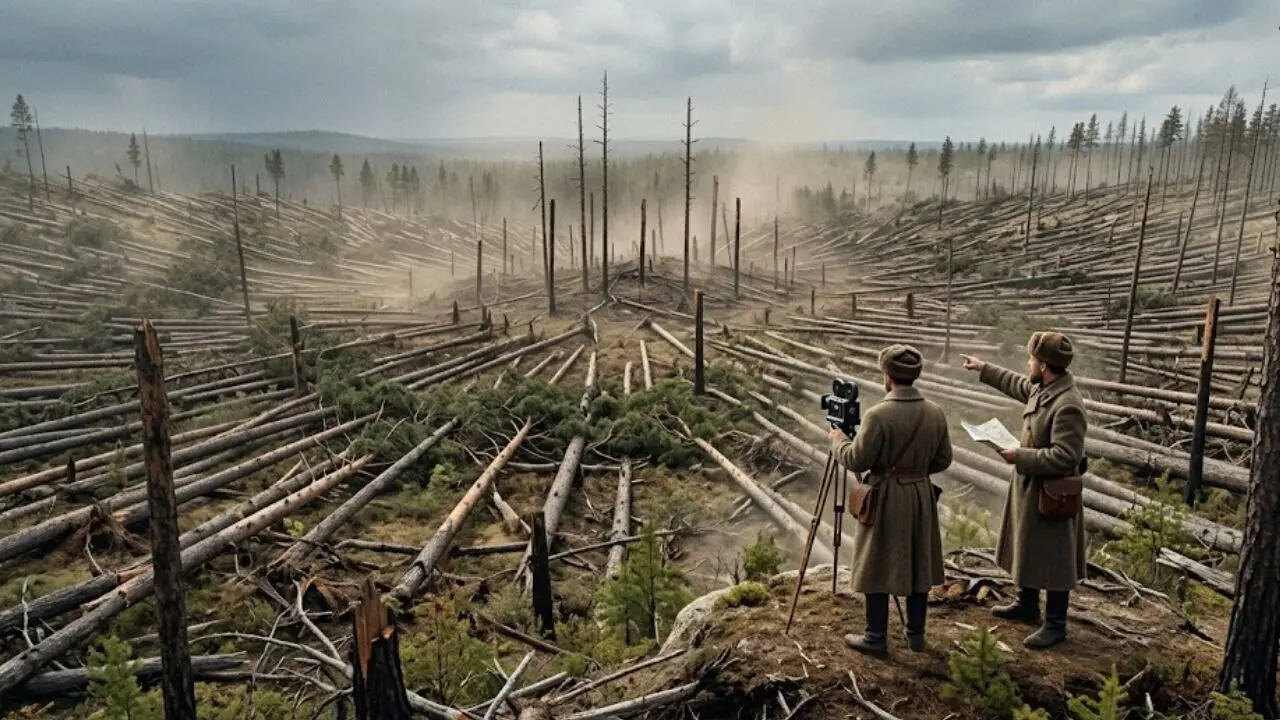
Because the explosion happened in the air, the shockwave hit the ground with a vertical component that snapped trunks like toothpicks while leaving the trees directly beneath the blast standing upright—stripped of their branches and bark, looking like telephone poles. This "forest of poles" baffled the first Soviet researchers who reached the site twenty years later. They expected a crater. They found a graveyard of standing timber instead.
The Kulik Expeditions and the Missing Metal
The delay in investigating Tunguska is one of the great tragedies of modern science. Leonid Kulik, the mineralogist who led the first official expedition in 1927, was operating under a flawed premise. He assumed a massive iron meteorite had struck the Earth and was buried beneath the swampy taiga.
Kulik spent years draining bogs and searching for a "Main Meteorite" that never existed. This lack of a physical smoking gun birthed a century of fringe theories. We’ve seen everything from miniature black holes passing through the Earth to the crash-landing of a nuclear-powered alien spacecraft. Even the great Nikola Tesla was dragged into the fray, with rumors suggesting a failed test of his "Death Ray" or Wardenclyffe Tower caused the disaster.
The truth is found in the dirt, not the stars. Modern microscopic analysis of peat samples and tree resin from 1908 has revealed silicate and magnetite spherules. These are the tiny, solidified droplets of the asteroid that vaporized during the blast. They aren't alien technology; they are the debris of a common type of space rock.
Why the Hiroshima Comparison Fails
The Hiroshima bomb, Little Boy, was a 15-kiloton weapon. Using it as a yardstick for Tunguska treats the Siberian event as a simple explosion. But a nuclear weapon produces a significant portion of its damage through ionizing radiation and a thermal pulse that lingers.
Tunguska was almost purely a mechanical event.
The pressure wave was the primary killer. If the same object entered the atmosphere over a modern metropolitan area, the casualty count wouldn't be driven by radiation sickness or fallout. It would be driven by the total collapse of reinforced concrete structures and the instantaneous shattering of glass for a hundred miles in every direction. We are talking about a Level 9 on the Mercalli intensity scale over an area of thousands of square kilometers.
The Altitude Variable
If the Tunguska bolide had been slightly denser or had entered at a steeper angle, it would have struck the ground. A ground-level impact of a 15-megaton object would have thrown enough dust into the stratosphere to trigger a volcanic winter, potentially cooling the global climate for years. By exploding in the upper atmosphere, the asteroid spared the planet a prolonged ecological disaster, though it created "white nights" across Europe for days, where the sky remained bright enough to read a newspaper at midnight due to the high-altitude dust reflecting sunlight.
The Geometry of Survival
We have to consider the sheer luck of the timing. The Earth rotates at roughly 1,000 miles per hour at the equator. If the Tunguska object had arrived just four hours and forty-seven minutes later, the rotation of the planet would have placed Saint Petersburg directly under the blast.
The Russian Empire was already on the brink of collapse in 1908. The total erasure of its capital city would have altered the course of the 20th century in ways we can barely calculate. There would have been no Russian Revolution as we know it, no Soviet Union, and a completely different geopolitical map of Europe.
The Modern Threat Matrix
The most uncomfortable fact about Tunguska is that we are still largely blind to objects of that size. We have gotten very good at tracking "planet-killers"—asteroids over a kilometer in diameter. We know where almost all of them are, and none are hitting us anytime soon.
However, "city-killers" like the Tunguska object or the smaller Chelyabinsk meteor of 2013 are a different story. The Chelyabinsk rock was only about 20 meters wide, yet it injured 1,500 people and damaged 7,000 buildings when it exploded with the force of about 500 kilotons.
Current survey systems like PAN-STARRS and the Vera C. Rubin Observatory are catching more of these, but many approach from the direction of the sun, hidden in the glare where our ground-based telescopes are useless. We are essentially playing a game of cosmic Russian Roulette with a very large cylinder.
The Fallacy of the Once-in-a-Century Event
Statistical models often label Tunguska as a "once every 300 to 500 years" event. This is a dangerous way to interpret probability. Statistics don't govern the arrival time of an asteroid; they only describe the average frequency over millions of years. Two Tunguska-class objects could hit in the same week, followed by a thousand-year drought.
The 1908 event wasn't a freak occurrence. It was a standard planetary process. Earth is effectively a giant target moving through a shooting gallery of debris left over from the formation of the solar system.
We often look back at 1908 as a historical curiosity, a campfire story for the frozen north. We should be looking at it as a structural test of our atmosphere. The air held up its end of the bargain in 1908, breaking the intruder apart before it could punch a hole in the crust. But the atmosphere is a shield, not an invincible wall.
The real lesson of Tunguska is that the planet is remarkably resilient, while our civilizations are incredibly fragile. We live on a world where the sky can turn into a hammer at any moment, and the only thing protecting a city from being flattened is the specific density of a rock we haven't seen yet.
Investment in space-based infrared telescopes is the only rational response to the data provided by the Siberian taiga. Knowing the energy of the blast is useless if we don't have the capability to change the trajectory of the next one. We are currently the only species in Earth's history with the potential to see the blow coming and move out of the way. If we fail to do so, we aren't victims of a 1,000-Hiroshima explosion; we are victims of our own refusal to look up.