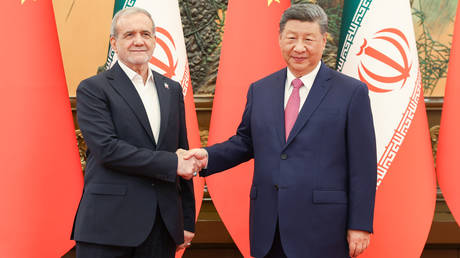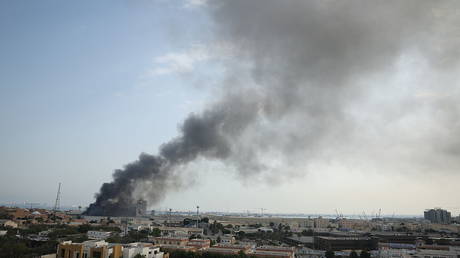
The United States has pivoted from a policy of containment to one of systematic dismantling regarding Iran’s long-range strike capabilities. Following a series of escalations in the Middle East, Secretary of State Marco Rubio confirmed that the primary objective of recent military and diplomatic pressure is the neutralization of Tehran’s ballistic missile infrastructure. This shift represents a departure from previous administrations that prioritized nuclear enrichment limits above all else. Washington now views the missiles themselves—the delivery systems capable of reaching Tel Aviv, Riyadh, or even parts of Europe—as the most immediate threat to global stability.
The strategy involves a multi-layered approach of kinetic strikes, supply chain interdiction, and severe economic isolation targeting the Aerospace Force of the Islamic Revolutionary Guard Corps (IRGC). By focusing on the hardware rather than just the warheads, the U.S. aims to strip Iran of its regional "deterrence" and force a fundamental recalculation in Tehran.
The Hardware of Hegemony
For decades, the Iranian military doctrine has rested on three pillars: proxy warfare, maritime disruption in the Strait of Hormuz, and a massive arsenal of ballistic missiles. Of these, the missiles are the most prestigious and the most dangerous. They are the "long arm" of the IRGC.
The Iranian inventory is not a monolith. It ranges from short-range tactical rockets like the Fateh-110 to the medium-range Shahab-3 and the newer, more sophisticated Kheibar Shekan. These systems use solid-propellant technology, which allows for rapid launch with minimal preparation time. Unlike older liquid-fueled rockets that require hours of fueling in the open—making them easy targets for satellite detection—solid-fuel missiles can be hidden in underground "missile cities" and fired on a moment’s notice.
Washington’s current focus on "destroying capabilities" refers to more than just blowing up launch pads. It targets the specialized manufacturing facilities where carbon fiber casings are spun and high-energy chemical propellants are mixed. Without these specific components, the production line grinds to a halt. You cannot simply substitute civilian-grade materials when building a rocket that must survive the intense thermal and structural stresses of re-entering the atmosphere at several times the speed of sound.
The Failure of Traditional Diplomacy
The logic behind the current hardline stance stems from the perceived failure of the 2015 Joint Comprehensive Plan of Action (JCPOA). Critics of that era argue that by focusing almost exclusively on uranium enrichment and centrifuges, the international community allowed Tehran to refine its missile program with impunity. While the nuclear file was frozen, the IRGC spent billions of dollars on rocket R&D, moving from primitive Scud derivatives to highly accurate precision-guided munitions.
This technological leap changed the math for regional defense. It meant that instead of just "area saturation"—firing dozens of rockets in the hopes that one might hit a city—Iran could now target specific buildings, hangars, or electrical grids. The 2020 attack on Ain al-Asad airbase in Iraq proved this point. The missiles didn't just land on the base; they hit specific structures with terrifying accuracy.
By the time the current administration took office, the threat had outpaced the old diplomatic tools. Now, the mission is not to negotiate a pause but to degrade the physical capacity to launch.
Precision over Proliferation
The shift to precision guidance is the real story behind the current tension. It is easy to build a rocket that flies a few hundred miles and crashes into the desert. It is exponentially harder to build one that can adjust its course mid-flight to hit a moving ship or a bunker.
Recent intelligence reports highlight the role of foreign-made microelectronics found in downed drones and missile wreckage. Despite decades of sanctions, the IRGC has built a clandestine network of shell companies and front organizations that procure "dual-use" technologies. These are parts used in civilian aviation or heavy industry that can be repurposed for guidance systems.
Dismantling this capability requires more than just airstrikes. It necessitates a financial war that targets the procurement officers in Tehran and their enablers in foreign capital markets. Every time a shipment of high-end gyroscopes or specialized pressure sensors is seized, the IRGC loses months of progress.
The Geography of Destruction
The physical geography of Iran makes this mission particularly difficult. The country is mountainous and vast, with a military that has spent decades digging into the earth. The "Missile Cities"—sprawling underground complexes located deep within the Zagros Mountains—are designed to withstand even the most powerful conventional bunker-busters.
To neutralize these sites, the U.S. and its allies rely on "left of launch" operations. This is military jargon for cyberattacks, sabotage, and kinetic strikes that take place before a missile ever leaves its silo. If you can disable the communication nodes that transmit the launch codes or the electrical grids that power the facility, the missile is just an expensive piece of metal sitting in a hole.
The Problem with Tunnels
Deep-buried targets present a unique challenge for conventional air power. Even the GBU-57 Massive Ordnance Penetrator (MOP), the heaviest bunker-buster in the U.S. inventory, has limits. If the tunnels are deep enough and carved through solid granite, a direct hit might only collapse the entrance, leaving the interior intact.
Strategic planners are instead looking at the logistical bottlenecks. A missile city still needs air filtration, power, and massive amounts of fuel. By targeting these life-support systems, the U.S. can render an underground facility unusable without needing to collapse the entire mountain. It is a more clinical, less flashy way to achieve the goal, but it is far more effective in the long run.
The Economic Equation of Conflict
War is, at its core, a contest of resources. The Iranian missile program is expensive. Maintaining thousands of rockets, hundreds of launch vehicles, and a vast network of underground storage sites costs billions of dollars every year.
The U.S. strategy of "maximum pressure" is designed to starve this program of its oxygen—hard currency. By cutting off Iranian oil exports and freezing the assets of the IRGC, Washington forces Tehran to make hard choices. Do they spend their remaining cash on repairing the power grid and providing food subsidies, or do they pour it into the next generation of solid-fuel rockets?
History shows that even the most ideologically driven regimes have a breaking point when the treasury runs dry. However, there is a risk. A cornered regime with a massive missile stockpile might see the loss of its capabilities as a "use it or lose it" scenario. This is the delicate balance the State Department must strike: applying enough pressure to degrade the program without triggering a full-scale regional war.
Proxy Networks and the Proliferation of Parts
One cannot discuss Iran's missile capability without mentioning its proxies. The Houthi rebels in Yemen and Hezbollah in Lebanon act as forward-deployed arms of the IRGC. They use Iranian-designed missiles and drones to harass global shipping and threaten northern Israel.
Washington's mission includes cutting the supply lines between Tehran and these groups. This is a naval game of cat and mouse played out in the Red Sea and the Gulf of Oman. Every intercepted dhow carrying missile parts or drone engines is a win for the U.S. mission. These interdictions are often more valuable than a strike on a factory because they deny the enemy the ability to project power far from their own borders.
The Role of Regional Alliances
The U.S. is not acting in a vacuum. The Abraham Accords have fundamentally changed the security architecture of the Middle East. Countries that were once sworn enemies are now quietly sharing radar data and intelligence to track Iranian aerial threats.
The "Middle East Air Defense" (MEAD) initiative is the most visible sign of this cooperation. By linking the radar systems of various regional partners, the U.S. can create a continuous picture of the airspace. This allows for more effective interception of ballistic missiles, which often fly at speeds exceeding Mach 5.
Integrated Air and Missile Defense (IAMD)
Modern missile defense is a game of high-speed geometry. A ballistic missile follows a predictable arc—the parabola—but it moves so fast that the window for interception is measured in seconds.
$$v = \sqrt{GM \left( \frac{2}{r} - \frac{1}{a} \right)}$$
The physics of orbital mechanics means that once a missile reaches its peak altitude (apogee), it begins a terminal descent that makes it nearly impossible to stop without high-end systems like the Terminal High Altitude Area Defense (THAAD) or the Patriot PAC-3. By integrating the sensors of regional allies, the U.S. can detect a launch earlier, providing more time for these interceptors to do their job. This collective defense is just as important as the offensive mission to destroy the missiles at their source.
The Intelligence War Behind the Scenes
Long before a single Tomahawk missile is fired, the real battle is fought in the digital realm. Cyber operations are a central part of the U.S. effort to dismantle Iranian capabilities. In 2010, the Stuxnet worm famously damaged Iranian nuclear centrifuges by causing them to spin out of control. Today, similar techniques are applied to missile testing.
Reports of "mysterious" explosions at Iranian testing sites are frequent. While Tehran often blames accidents or industrial mishaps, the reality is often a well-placed cyber exploit that triggers a malfunction during a static fire test or a launch sequence. This creates a culture of paranoia within the IRGC. When your own hardware cannot be trusted, your entire strategic deterrent begins to crumble.
Defectors and Dissidents
The IRGC is an elite organization, but it is not immune to internal friction. The U.S. and its allies have spent decades cultivating sources within the Iranian defense establishment. These individuals provide the high-fidelity intelligence needed to map out the supply chains and find the "single points of failure" in the missile program.
A single disgruntled engineer who can provide the blueprints for a guidance chip or the chemical composition of a new fuel can do more damage to the program than a dozen airstrikes. This human intelligence (HUMINT) is the quiet backbone of the mission Rubio described.
The Risks of Miscalculation
The drive to destroy Iranian missile capabilities is not without significant danger. Critics argue that by systematically stripping away Iran's primary means of deterrence, the U.S. may inadvertently push the regime toward the nuclear threshold. If Tehran feels that its conventional "long arm" is being severed, it may conclude that only a nuclear weapon can provide the security it seeks.
This is the "security dilemma" that haunts every policy maker in Washington. Each successful strike or interdiction brings us closer to a world where Iran has fewer missiles, but it also increases the desperation of a regime that views its survival as being tied to its military might.
Furthermore, there is the risk of a "gray zone" response. Instead of a direct missile volley, Tehran might retaliate through cyberattacks on U.S. infrastructure, assassinations, or maritime sabotage. This asymmetric warfare is designed to make the cost of the U.S. mission too high for the American public to bear.
The Technology of Interception
To truly dismantle a missile capability, you must also master the art of the intercept. The U.S. Navy’s Aegis Combat System is the gold standard here. Equipped with the SM-3 interceptor, Aegis-class destroyers can hit a ballistic missile while it is still in space. This is the "mid-course" phase of flight.
Hitting a target moving at thousands of miles per hour with another object moving just as fast has been described as "hitting a bullet with a bullet." It requires near-perfect tracking and a "kill vehicle" that uses its own kinetic energy—not explosives—to shatter the incoming threat.
The deployment of these ships to the Eastern Mediterranean and the Persian Gulf is a clear signal to Tehran: even if you manage to launch, your missiles will never reach their targets. This neutralization of the missile’s utility is just as effective as destroying the missile on the ground.
The Solid-Fuel Revolution
Iran's move toward solid-fuel missiles is the single biggest technological hurdle for U.S. defense planners. Liquid-fuel missiles, like the older Scuds, are cumbersome. They require a large train of support vehicles and take hours to prepare.
Solid-fuel rockets, however, are essentially "ready to go" from the moment they are manufactured. They can be stored for years and then fired in minutes. This reduces the "warning time" for U.S. and allied forces. The Iranian Fattah hypersonic missile is the latest evolution of this trend. While its "hypersonic" label is a matter of debate among Western analysts, its ability to maneuver at high speeds makes it a significant threat to existing air defense systems.
To combat this, the U.S. is investing heavily in space-based sensors. These satellites can detect the heat signature of a missile launch instantly, providing the "launch on remote" data needed to cue interceptors halfway around the world.
The Long Road Ahead
Dismantling a decades-old, multi-billion-dollar military program is not the work of a single afternoon or even a single year. It is a grinding, exhausting process of attrition. It requires a level of persistence that is often difficult for the short-term cycles of American politics to maintain.
The mission Rubio outlined is a commitment to a new status quo in the Middle East. It is an admission that the old ways of dealing with Tehran have failed and that a more direct, physical degradation of their power is required. Success will not be measured by a single treaty or a grand signing ceremony. It will be measured by the slow, quiet silencing of the factories in Parchin and the emptying of the silos in the Zagros.
The IRGC knows what is at stake. For them, these missiles are more than just weapons; they are the ultimate guarantee of the regime’s survival. This makes the coming years some of the most dangerous in the history of the modern Middle East. The U.S. has set its course. Now it must see it through, regardless of the cost.
Monitor the deployment of Aegis-equipped destroyers to the region to gauge the next phase of the escalation.