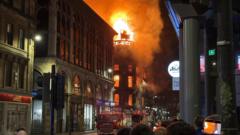
The black smoke rising above the Victorian glass roof of Glasgow Central Station is more than a localized emergency. It is a symptom of a systemic failure in how the United Kingdom maintains its most critical historical infrastructure. When the alarm sounded and the evacuations began, the immediate focus was on the visible flames and the terrifying sight of a partial building collapse. However, the real story lies in the decades of deferred maintenance and the complex web of ownership that leaves Scotland’s busiest transport hub vulnerable to catastrophe.
Glasgow Central is not just a train station. It is an architectural anchor for the city. Yet, the fire that recently tore through an adjacent commercial block, forcing a total shutdown of the West Coast Main Line, highlights a glaring vulnerability. The station sits at the heart of a dense urban fabric where private commercial interests and public transit safety are inextricably linked. When a surrounding structure fails, the entire rail network of Northern Britain grinds to a halt. This is not an isolated accident; it is the inevitable result of a "patch-and-mend" culture that prioritizes short-term budget targets over long-term structural resilience.
The Anatomy of an Infrastructure Collapse
The fire originated in a multi-use building near the station’s perimeter. This specific area has long been a point of contention for local safety inspectors. High-density urban environments like the one surrounding Hope Street and Union Street are packed with aging timber frames and outdated electrical systems. When the fire took hold, the intensity was fueled by the very materials that give the district its historic character.
Witnesses reported hearing a series of sharp cracks before the masonry gave way. That sound was the failure of load-bearing supports that had likely been compromised by moisture and neglect long before the first spark appeared. Emergency crews faced a dual nightmare: an active inferno and a structural "domino effect" that threatened the station’s legendary ironwork.
The collapse didn't just dump rubble onto the street. It severed power lines and communication cables essential for the signaling systems of the station. This is why the evacuation was so chaotic. Without signaled control, trains were stuck in the "throat" of the station—the narrow approach over the River Clyde—leaving hundreds of passengers stranded on tracks while smoke billowed toward them.
The Maintenance Debt and the Private Public Divide
To understand why this happened, we have to look at the ledger. Network Rail manages the station itself, but the surrounding buildings—often physically connected to the station’s arches—are a patchwork of private tenancies and shell companies. This creates a "gray zone" of responsibility.
Maintenance debt is a term used by engineers to describe the cost of work that has been delayed. Across the UK rail network, this debt is in the billions. In Glasgow, the salt-heavy air and relentless rain accelerate the degradation of sandstone and iron. When a private landlord fails to update a sprinkler system or repair a roof leak in a building abutting the station, they aren't just risking their own property. They are risking the economic artery of the city.
The "why" behind this fire is rooted in a lack of unified oversight. Local authorities have the power to issue improvement notices, but these are often tied up in legal appeals for years. Meanwhile, the structures continue to rot. The fire at Glasgow Central serves as a grim reminder that firewalls are only as strong as the weakest building in the block.
The Economic Ripple Effect
The cost of this fire extends far beyond the price of the bricks and mortar destroyed. Glasgow Central handles over 30 million passengers a year. A single day of closure triggers a massive financial shockwave.
- Retail Losses: Small businesses inside the station and on the surrounding streets lose hundreds of thousands in daily revenue.
- Logistics Failures: Freight movements, particularly those carrying essential goods from the south, are diverted or canceled, adding costs to the supply chain.
- Labor Displacement: Thousands of workers are unable to reach the city center, resulting in a measurable dip in productivity across the West of Scotland.
This isn't just a "bad day" for commuters. It is a failure of the city’s economic engine.
Fire Safety in the Age of Victorian Engineering
Modernizing a station built in 1879 is an immense technical challenge. You cannot simply retro-fit a 19th-century terminal with 21st-century safety protocols without fundamentally altering its structure. However, the technology exists to prevent a fire from becoming a collapse.
Thermal imaging drones and IOT-enabled heat sensors could be deployed across the station’s perimeter to catch "hot spots" in electrical conduits before they ignite. The problem isn't a lack of tools; it is a lack of investment. The rail industry is currently trapped in a cycle of reactive spending. We spend millions on cleanup and emergency repairs because we refuse to spend thousands on preventative monitoring.
Consider the hypothetical example of a sensor network installed in the voids between the station ceiling and the street-level shops. Such a system would have alerted the fire brigade to a temperature spike long before the smoke was visible to the public. Instead, we rely on the eyes of passersby and the smell of burning wood.
The Failure of the "Buffer Zone"
Every major transport hub should have a protected buffer zone. In Glasgow, the station is hemmed in by high-rise developments and aging tenements. There is no breathing room. When the building collapsed, the debris fell directly into the path of emergency vehicles, slowing the response time by several critical minutes.
The urban planning of the 19th century did not account for the fire loads of the 21st. We now have buildings filled with plastics, synthetic fabrics, and lithium-ion batteries—all of which burn hotter and faster than anything the original station designers could have imagined. To protect Glasgow Central, the city must look beyond the station gates. It must treat the surrounding blocks as a high-security zone where safety standards are non-negotiable.
Accountability and the Path Forward
Who is to blame when a historic landmark is nearly leveled? The finger-pointing usually starts with the immediate cause—a faulty wire or a discarded cigarette. But the real blame lies with the policy makers who have allowed urban decay to fester in the shadow of our most important buildings.
The Scottish Government and the Department for Transport must move beyond the rhetoric of "modernization" and start discussing "preservation through enforcement." This means:
- Mandatory Structural Audits: Any building within 50 meters of a Tier 1 transport hub must undergo an annual, independent safety audit.
- Unified Incident Command: Creating a permanent task force that bridges the gap between Network Rail, the fire service, and private property owners.
- The Infrastructure Tax: Implementing a small levy on commercial properties benefiting from station footfall, with the funds ring-fenced specifically for perimeter fire defense.
These steps are not popular. They are expensive and require a level of bureaucratic cooperation that is rarely seen in local government. But the alternative is watching our history burn.
A City at a Crossroads
Glasgow is a city defined by its resilience, but even the strongest stone has a breaking point. The fire at Central Station was a warning shot. It exposed the fragility of our heritage and the inadequacy of our current safety regimes. The smoke has cleared, but the structural weaknesses remain.
The next fire might not be contained so "successfully." If a collapse occurs during peak rush hour, or if the fire spreads to the main concourse, the loss of life and heritage would be irreparable. We are currently operating on borrowed time, relying on the bravery of fire crews to make up for the failures of planners and landlords.
We have to stop treating these events as "acts of God" or freak accidents. They are the logical conclusion of ignoring the physical reality of our cities. The sandstone is crumbling, the timber is dry, and the world is moving faster than our safety protocols can keep up with.
The immediate priority is the stabilization of the site and the restoration of rail services. But once the trains are running again, the hard conversations must begin. If we do not change how we manage the intersection of private property and public safety, we are simply waiting for the next siren.
Every hour that passes without a fundamental shift in infrastructure policy is an hour closer to the next evacuation. The city cannot afford to wait for the smoke to return before it decides to act.