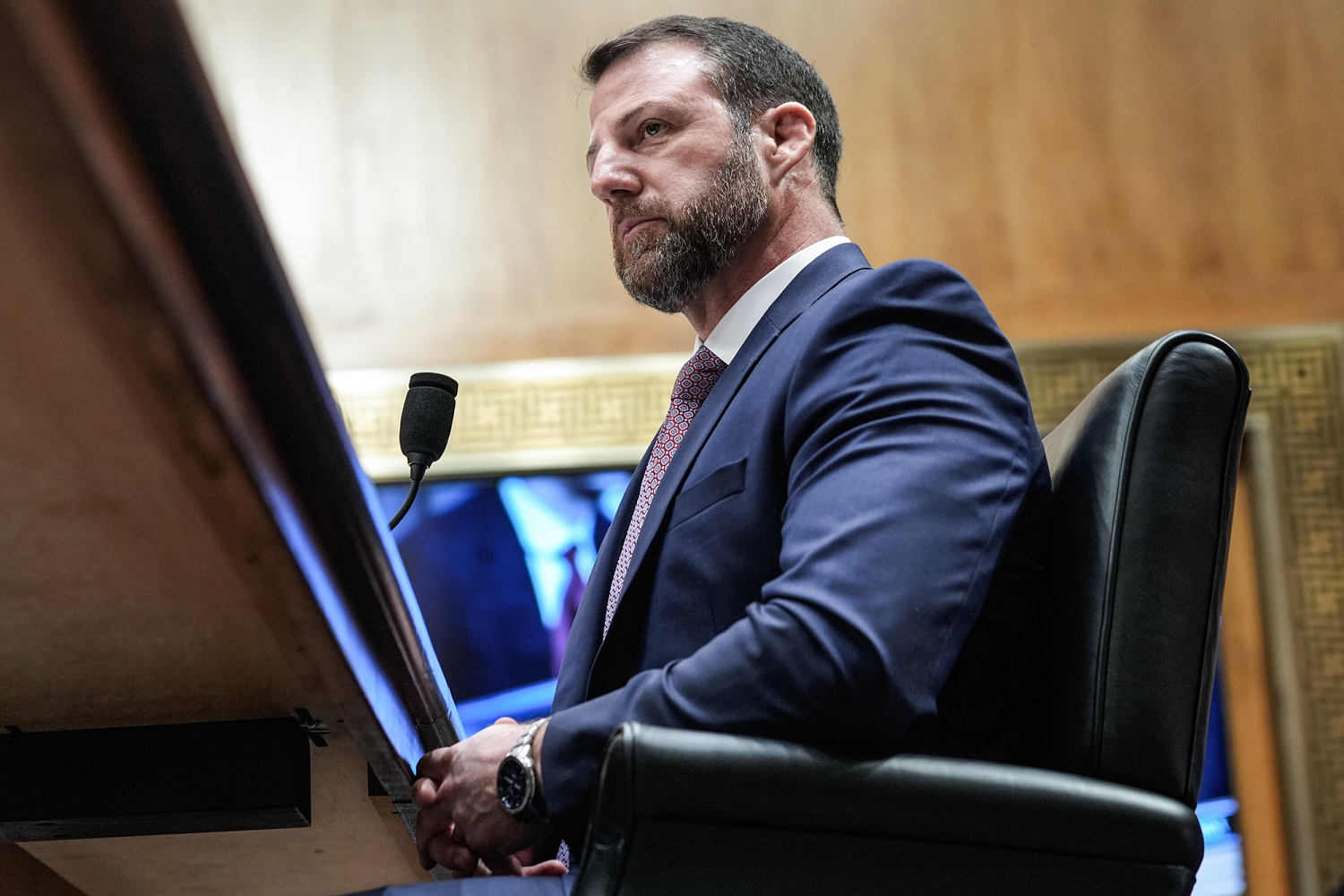
The floor of the United States Senate is often a place of hushed tones and expensive wool suits, a theater of decorum where the stakes are measured in billions of dollars and decades of policy. But when Markwayne Mullin’s name was called for confirmation as the Secretary of Homeland Security, the atmosphere shifted. It wasn't just another bureaucratic shuffle. It was the moment the Department of Homeland Security—an agency born from the ashes of 9/11—passed into the hands of a man who once made a living in a wrestling singlet, pinning opponents to a mat with raw, physical leverage.
Kristi Noem is gone. The former South Dakota Governor, who initially stepped into the role with the fanfare of a trusted prairie loyalist, has vacated the massive office at St. Elizabeths. In her wake stands a plumber from Oklahoma. A Cherokee Nation citizen. A cage fighter. A man who once stood on a desk in the House of Representatives during a riot, ready to use his fists to defend a barricaded door.
This is the new face of American domestic defense. It is blunt. It is physical. It is unapologetic.
The Weight of the Badge
To understand why this confirmation matters, you have to look past the C-SPAN cameras and into the eyes of a Border Patrol agent standing on a dusty scrub-plain in the Rio Grande Valley at three in the morning. For that agent, the Secretary of Homeland Security isn't a political figure. The Secretary is the weather. The Secretary is the rules of engagement. The Secretary determines whether that agent has the resources to process a family seeking asylum or the legal backing to intercept a fentanyl shipment that could kill five thousand people in a single weekend.
The Department of Homeland Security is a gargantuan machine. It manages everything from the TSA lines that annoy you at the airport to the cybersecurity infrastructure that prevents a foreign power from shutting down the power grid in Ohio. It is 260,000 employees. It is a $60 billion budget.
Mullin isn't entering this world as a career administrator. He is entering it as a fixer. His confirmation signals a pivot away from the polished political maneuvering of the Noem era and toward a philosophy of direct, aggressive enforcement. When the Senate voted to confirm him, they weren't just hiring a manager. They were signaling a shift in how the nation defines the word "security."
From the Octagon to the Oval
Markwayne Mullin’s life story reads like a script written for a gritty reboot of an American dream. He grew up in rural Oklahoma, a place where your word and your work ethic are the only currency that never devalues. He took over his father’s plumbing business at twenty, turning a struggling operation into a regional powerhouse. Then, he stepped into the cage.
Professional mixed martial arts is a sport of brutal honesty. You cannot lie to a man trying to choke you unconscious. You either have the stamina, the technique, and the will to win, or you don’t. There is no middle ground. There is no "consultant's report" to hide behind.
This background is precisely why he was tapped for this role. The administration wanted someone who views the border not as a policy puzzle to be debated, but as a perimeter to be secured.
Imagine a small-town sheriff. He doesn't care about the sociological trends of why a crime was committed while he’s in the middle of a pursuit. He cares about the arrest. He cares about the safety of the neighborhood. Mullin brings that "Sheriff of America" energy to a department that has often felt bogged down by its own massive weight.
The Invisible Stakes of the Transition
When a cabinet member is replaced, the media focuses on the "who." Who is in? Who is out? Who won the power struggle? But the "what" is far more terrifying.
Every time there is a transition at the top of DHS, the nation’s enemies watch for a flicker in the lights. Foreign intelligence services, drug cartels, and human trafficking rings look for the gaps that inevitably open during a handoff. They look for the moment when the new boss is still finding the keys to the bathroom, hoping the rank-and-file are distracted by the change in leadership.
Noem’s departure wasn't a quiet affair. It came after months of scrutiny and the inevitable friction that occurs when a high-profile politician tries to run a high-pressure agency. The Department of Homeland Security is not a place for "rising stars" to polish their resumes; it is a meat grinder that consumes reputations and spits out grey hair and ulcers.
Mullin is stepping into the center of that grinder. His confirmation wasn't unanimous. Critics point to his lack of traditional national security experience. They wonder if a man used to solving problems with a wrench or a chokehold can navigate the delicate diplomacy required to work with the Mexican government or the complex legalities of maritime law.
But his supporters argue that traditional experience is exactly what got us into the current mess. They see his "outsider" status as his greatest weapon. They want a plumber to look at the leaks in the system and stop them, not write a white paper about why the pipes are bursting.
The Human Cost of Policy
Beyond the marble hallways of Washington, the confirmation of a new DHS Secretary ripples out into the lives of millions.
Consider a "hypothetical" truck driver named Elias. Elias spends fourteen hours a day hauling freight across state lines. He doesn't follow the news. He doesn't know Markwayne Mullin’s name. But if Mullin decides to overhaul the way the Cybersecurity and Infrastructure Security Agency (CISA) protects GPS satellites, Elias’s navigation system stays online. If Mullin streamlines the way the Coast Guard patrols the ports, the fuel in Elias’s tank stays affordable.
Security is invisible when it works. You only notice it when it fails.
Mullin’s arrival at DHS comes at a time when the department is under more pressure than at any point since its inception in 2002. The border is the headline, but the subtext is even more complex. We are living in an era of "hybrid warfare," where the threats aren't just soldiers in boots, but code in a computer and chemicals in a pill.
Can a wrestler outmaneuver a state-sponsored hacker?
Can a plumber fix a broken immigration court system that is backed up for years?
The Senate’s confirmation is a bet. It’s a gamble that what the country needs right now isn't more finesse, but more force. It’s a belief that the "human element"—the grit, the determination, the sheer refusal to lose—is more important than the bureaucratic resume.
The Quiet Room
There is a room in the DHS headquarters known as the National Operations Center. It is filled with screens. They show the weather, the movement of ships, the flow of traffic at every port of entry, and the real-time status of the nation’s most critical assets.
Markwayne Mullin now sits at the head of that room.
He is no longer the man in the cage. He is the man in the watchtower.
The transition from Kristi Noem to Markwayne Mullin is more than a change of names on a door. It is a change of posture. America has decided to stop leaning back and start leaning in. Whether that shift leads to a more secure nation or a more fractured one is a question that won't be answered by a Senate vote, but by the events of the coming months.
The wrestler is on the mat. The clock has started. The world is watching to see if he can handle the weight of the country on his shoulders without breaking.
In the end, security isn't about fences or firewalls. It’s about the people who stand behind them. It’s about the person who stays awake so the rest of us can sleep. For better or worse, the person keeping that watch just changed.
The silence that followed the final "yea" in the Senate chamber wasn't the end of the story. It was the sharp intake of breath before the fight begins.
Outside, the sun was setting over the Potomac, casting long, thin shadows across the city. Somewhere in the vast complex of the Department of Homeland Security, a technician replaced a nameplate. The metal clicked into place.
The plumber is in. The wrestler is ready. The watch continues.
The stakes haven't changed, but the hands on the wheel have.
Those hands are calloused. They are strong. They are now ours.